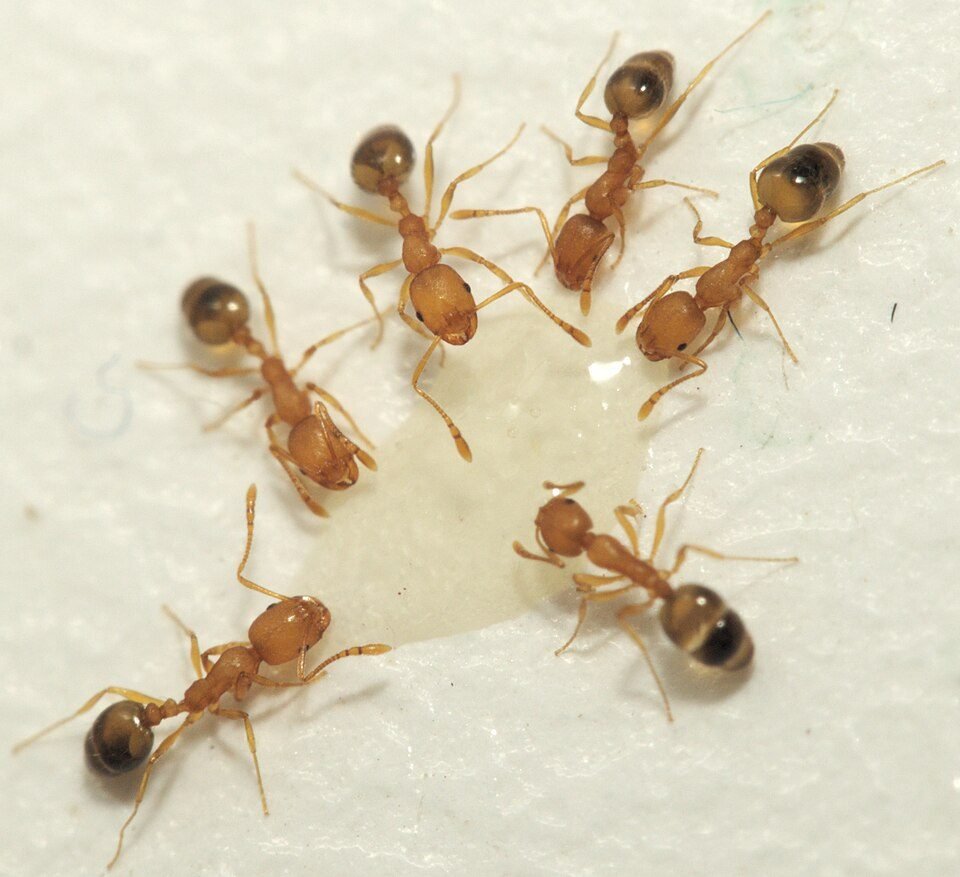
Ant traps (bait stations), gels and granular bait all reach the queen when the poison is slow-acting and the ants actually take it. Workers carry the bait back to the nest and feed it to the queens. The right choice is the format your ants accept, and some granules sold as bait are really contact insecticides that kill the workers first.

How bait reaches the queen
Ants forage for food and carry it back to the nest. Health Canada explains that a bait system must work slowly enough for the poison to be fed to all members of the nest. The University of California IPM program says workers pass the bait mouth to mouth to other workers, larvae and queens, and that the pesticide must be slow-acting so foragers are not killed before they get back.
That is why the format matters less than two other things: whether the poison is slow-acting, and whether the ants are willing to eat it.
Bait strength: why a stronger bait can work worse
The University of California IPM program explains the trade-off. Prepackaged bait stations usually contain 5.4% borate. They can kill foragers in the home but are less effective at managing major infestations, because foragers are killed before they can bring the bait back to the colony. Liquid borate baits with a much lower concentration, 0.5 to 1.0% in a sugar-water solution, have more impact on the colony, although they may take several days to a week to show results and need larger, refillable stations.
The program's research with a refillable dispenser found it effective when properly installed and maintained outside the home, usually with at least one dispenser on each side of the house, in shady places where ants trail, checked regularly and refilled as needed.
Ant traps: bait stations
Prepackaged bait stations are easy to use and quite safe if kept away from children and pets, according to the University of California IPM program. Refillable stations are more useful for difficult ant problems, because they can be checked and refilled. Liquid borate baits are used in refillable containers. Health Canada advises placing stations directly in the path of foraging ants, out of reach of children and pets, and using plenty of them.
Gel bait
Gel formulations come in small tubes and are applied in small cracks and crevices where ants are entering, according to the University of California IPM program. A gel suits places a station will not fit, such as along a baseboard or beside a pipe where a trail runs.
Granular bait: check the label
The University of California IPM program warns that granules containing cyfluthrin or permethrin are contact insecticides, not true baits. They kill foragers quickly and do not control the colony. A granular product is only a bait if it is slow-acting and meant to be carried home. Health Canada's rule for any bait applies: the poison must work slowly enough to be fed to the whole nest.
Bait formats compared
| How it is used | What to watch for | |
|---|---|---|
| Prepackaged bait station | Placed along ant trails | Keep away from children and pets; check that ants are feeding |
| Refillable liquid station | Liquid borate bait in a refillable container | Suited to difficult problems; needs checking and refilling |
| Gel | Small amounts in cracks and crevices where ants enter | Can dry up or turn rancid and needs refreshing |
| Granules | Applied where ants forage, as the label directs | Avoid products with cyfluthrin or permethrin: they kill foragers and do not control the colony |
Sources: the University of California IPM program and Health Canada (see the sources below).
What is in the bait, in plain terms
The University of California IPM program lists four common active ingredients in consumer ant baits: hydramethylnon, fipronil, boric acid or borate, and abamectin. What matters is that the product is slow-acting. Stations with propoxur or indoxacarb are not very effective because the active ingredient is too fast-acting, and granules with cyfluthrin or permethrin are contact insecticides, not baits. Health Canada says bait systems using boric acid are generally of low toxicity to other animals, and advises looking for a Pest Control Products number on the label to confirm Health Canada has approved the product.
Pick the bait the ants will take
| Preferred foods | |
|---|---|
| Odorous house ant | Sweets, sometimes proteins |
| Pavement ant | Sweets, proteins and grease |
| Pharaoh ant | Fats, proteins and sweets |
| Carpenter ant | Sweets |
| Thief ant | Greasy and fatty foods, sometimes sweets |
Preferences change through the year and between species, so the University of California IPM program suggests setting out different formulations to give ants a choice, and repositioning the stations or trying a different product if ants are not taking the bait. Health Canada also notes that two different baits at the same time give better results.
Where to put bait, and how many stations
Place bait where ants will find it, near nests, on ant trails beneath plants or along edges where they travel, and keep it out of reach of pets and small children. Outdoors, the University of California IPM program says to space stations every 10 to 20 feet around the foundation and at nest openings. Health Canada says to use multiple stations along the trails and to leave them for at least two weeks.
Use baits mainly outdoors. The program says indoor use is for a serious infestation when you cannot find the entry point, because otherwise you could attract ants indoors, while outdoor baits draw ants out of the building. Bait stations also protect the bait from sunlight and from disturbance by children, and some can be hidden in mulch so they are not immediately visible to children or pets.
Timing: when baiting works best
The University of California IPM program recommends baits only when there is an ant problem, and says treatments made in late winter and early spring, when ant populations are just beginning to grow, are the most effective. Some species also change what they want to eat through the year. Argentine ants, for example, take sweet baits year-round and protein baits mainly in spring.
When ants ignore the bait
- Wrong food. Offer a small amount of each type, sweet, protein and grease, and see which they take. Set different formulations in one station so the ants can choose.
- Competing food. Remove food particles and residues of sweet liquids from cracks, or ants will feed on those instead.
- Old bait. Bait can dry up or turn rancid and become unattractive, so check it and replace it when empty.
- Spray residue. Insecticide sprays and bait do not mix, because killing the foragers stops delivery to the nest.
- Not enough time. It can take 5 to 10 days to see fewer ants and several weeks for control, so keep cleaning trails while it works.

How long it takes and the mistakes to avoid
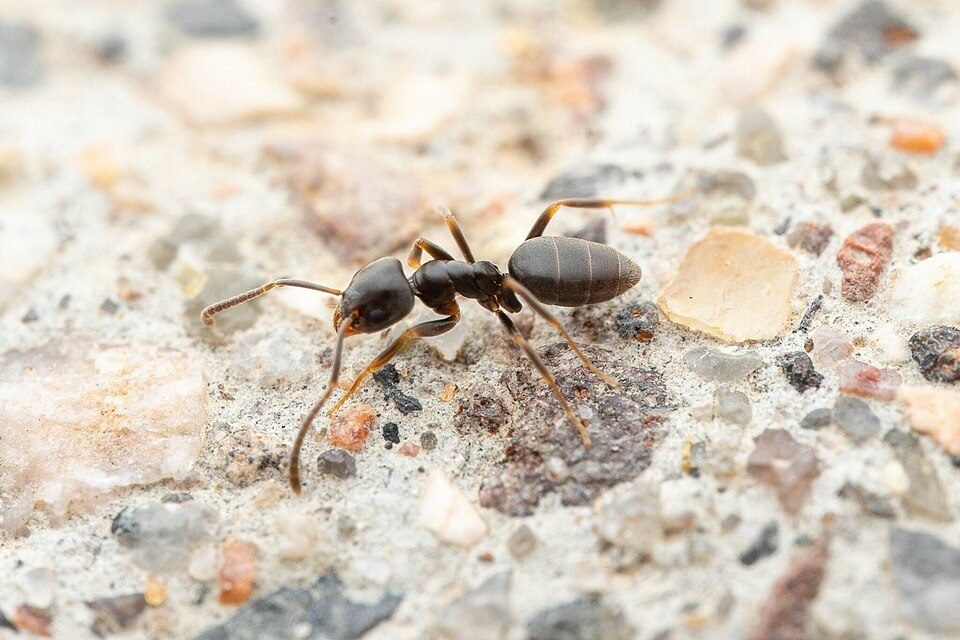
It can take 5 to 10 days to see fewer ants, and control may take several weeks. Health Canada says to keep baits available for at least two weeks, and to repeat if needed. The most common mistake is spraying. Both Health Canada and the University of California IPM program say not to use insecticide sprays while using baits, because killing the foragers stops the bait reaching the nest.
Baits can also dry up or turn rancid and become unattractive, so stations need regular checking. If ants are still active after several weeks of bait, an inspection to find the nest and the entry points is the next step.
How AstraHive Pest Control gets rid of ants
The goal with ants is the queen, not the workers on your counter. We combine bait that workers carry back to the queen with a weatherproof barrier around the outside of the house, and treat the inside when ants are active there.
How an AstraHive ants treatment works
Inspect and follow the trails
We follow the ant trails to find where they come in and where the nest is likely to be, so the bait and the barrier go in the right places.
Granular bait in the yard
We spread professional granular bait across the front and back yard around the nesting areas and colonies, and along the perimeter of the building. Workers carry it back to the queen, the queen dies and the colony collapses.
Liquid bait in bait stations
We set Scorpio liquid bait in bait stations around the exterior perimeter, near the nest and wherever ants are active. Ants feed and carry it back to the nest, and the stations keep working after we leave.
Weatherproof exterior perimeter spray
We spray a barrier around the foundation, windows, doors and entry points, applied according to the product label. It stays active for about 90 days, so ants coming from outside cross the treated zone before they get in.
Interior treatment if needed
If ants are already active inside, we treat the interior as well as the exterior, never the inside alone: a residual spray along the interior perimeter, baseboards and known travel routes, and gel bait along the trails, out of reach of children and pets.
Document everything
Where we found ants, what we found and every product used goes in the service report, along with what to change around the property, such as moisture and wood-to-soil contact.
Back it with a 90-day warranty
If ants come back within 90 days, we re-treat at no charge.
Our products are Health Canada approved and safe for kids and pets, and we apply every product according to its label. AstraHive is licensed by the Ontario Ministry of the Environment, Conservation and Parks. Ontario requires a ministry-approved certification course before it issues an exterminator licence, and that training is delivered through the University of Guelph, Ridgetown Campus.
Bait and the outer barrier are applied in different places on purpose: the bait stays on the routes ants forage along so workers can carry it home, and the barrier sits at the building's edge. That is also why we ask you not to spray the ants you see or wipe their trails before we arrive: killing the workers stops the bait reaching the queen.
Typical cost: Starting at $350 CAD, with final cost depending on property size and severity of infestation - there is no fixed upper limit. Call 905-925-8427 for an exact free quote.
Why Choose AstraHive
- Licensed & Insured: Certified by the Ontario Ministry of Environment, Conservation and Parks.
- Fast response: Same-day service available, with a callback within 5 minutes.
- 90-Day Warranty: If pests come back within that window, we re-treat at no additional charge.
- Proven track record: 5.0 stars on Google across 200+ reviews.
- Family & pet safe: Health Canada approved products on every job.
Frequently Asked Questions
Do ant traps kill the queen?
Bait stations can, if the bait is slow-acting and the ants carry it back. The University of California IPM program says the entire colony, including queens, can be killed when workers take the product to the nest.
Is granular bait or a bait station better?
Neither format is better by itself. What matters is that the poison is slow-acting and that the ants take it. Avoid granules containing cyfluthrin or permethrin, which are contact insecticides that kill foragers instead of reaching the colony.
Why are ants ignoring my bait?
Food preferences differ by species and change through the year. The University of California IPM program suggests repositioning the stations or trying a different bait, and putting out different formulations so ants have a choice.
How long should I leave ant bait out?
Health Canada says to keep baits available for at least two weeks and repeat if needed. It can take 5 to 10 days to see fewer ants.
Can I spray the ants while the bait is out?
No. Health Canada and the University of California IPM program both say not to use insecticide sprays while using baits, because spraying kills the foragers that carry bait to the nest.
Sources
- Health Canada: Ants — Chemicals, sprays and dusts can be used as barrier and nest treatments; a bait system must work slowly enough for the poison to be fed to all members of the nest, which is a highly effective way of getting rid of nests; do not use chemical sprays to kill ants while using a bait system or the bait will not work; keep baits available for at least two weeks and repeat if needed; place bait stations directly in the path of foraging ants but out of reach of children and pets; use plenty of bait stations, and two different baits at the same time give better results; repair and seal cracks in the foundation and exterior walls and caulk along baseboards.
- Ontario.ca: Pesticide licences and permits — Ontario's Ministry of the Environment, Conservation and Parks issues exterminator licences after a ministry-approved certification course, delivered through the University of Guelph, Ridgetown Campus.
- UC IPM: Ant baits for home and garden (University of California Statewide IPM Program) — The pesticide in a bait must be slow-acting so foraging ants can reach the nest and feed the colony before they die; liquid borate baits go in refillable stations, gels are applied in small cracks and crevices, and granules with cyfluthrin or permethrin are contact insecticides that kill foragers rather than true baits; ant food preferences change through the year and differ by species, so setting out different formulations gives ants a choice; if ants are not taking a bait, reposition the stations or try a different product; it can take 5 to 10 days to see fewer ants and control may take several weeks; baits can dry up or turn rancid and need checking; prepackaged stations are easy to use and safe if kept away from children and pets, and refillable stations suit difficult problems; do not use sprays while baiting.
- UC IPM: Ants (University of California Statewide IPM Program) — Spraying ants indoors with pesticides will not prevent more ants from entering; spraying around the foundation kills only foraging ants without killing the colony and queens, and ants quickly build back up and invade again; barrier sprays can make the situation worse by trapping ants indoors; baits are taken back to the nest where the entire colony including queens can be killed, and workers pass the material mouth to mouth to other workers, larvae and queens; it can take 5 to 10 days to see fewer ants; do not use insecticide sprays while using baits.
Areas We Serve
AstraHive Pest Control proudly serves 75+ communities across the following regions:
- Toronto: Toronto, North York, Scarborough, Etobicoke, East York, York, Leslieville, Lakeview
- Durham Region: Oshawa, Whitby, Ajax, Pickering, Clarington, Bowmanville, Courtice, Newcastle, Port Perry, Brooklin, Uxbridge, Scugog, Brock, Seaton
- York Region: Vaughan, Markham, Richmond Hill, Aurora, Newmarket, Thornhill, Woodbridge, Kleinburg, Maple, Stouffville, Unionville, Keswick, Holland Landing, East Gwillimbury, Georgina, King City, King Township, Nobleton, Berczy Village, Cathedraltown, Commerce Valley, Cornell, Wismer, Whitchurch-Stouffville, Sutton, Schomberg
- Peel Region: Mississauga, Brampton, Caledon, Malton, Port Credit, Streetsville, Meadowvale, Cooksville, Bolton, Palgrave
- Extended Service Area: Peterborough, Lindsay, Port Hope, Barrie, Bradford, Innisfil, Collingwood, Wasaga Beach, Orillia, Burlington, Oakville, Milton, Hamilton, Grimsby, St. Catharines, Welland, Niagara Falls
Don't see your city listed? Call us — we likely cover it.
Got a pest problem right now?
Call AstraHive for a free consultation. Licensed & insured, serving the GTA, Durham, York, Peel and Simcoe County.
Call 905-925-84275.0 Stars — 200+ Google Reviews | Licensed & Insured | Health Canada Approved