Bird mites are tiny mites that live on birds and in their nests. When the birds leave or a nest is abandoned, the mites can wander into homes and bite people, causing itchy spots. They cannot live or breed on people, and the problem fades once the source is gone. To get rid of bird mites, find and remove the nest, within the law, then vacuum and clean.
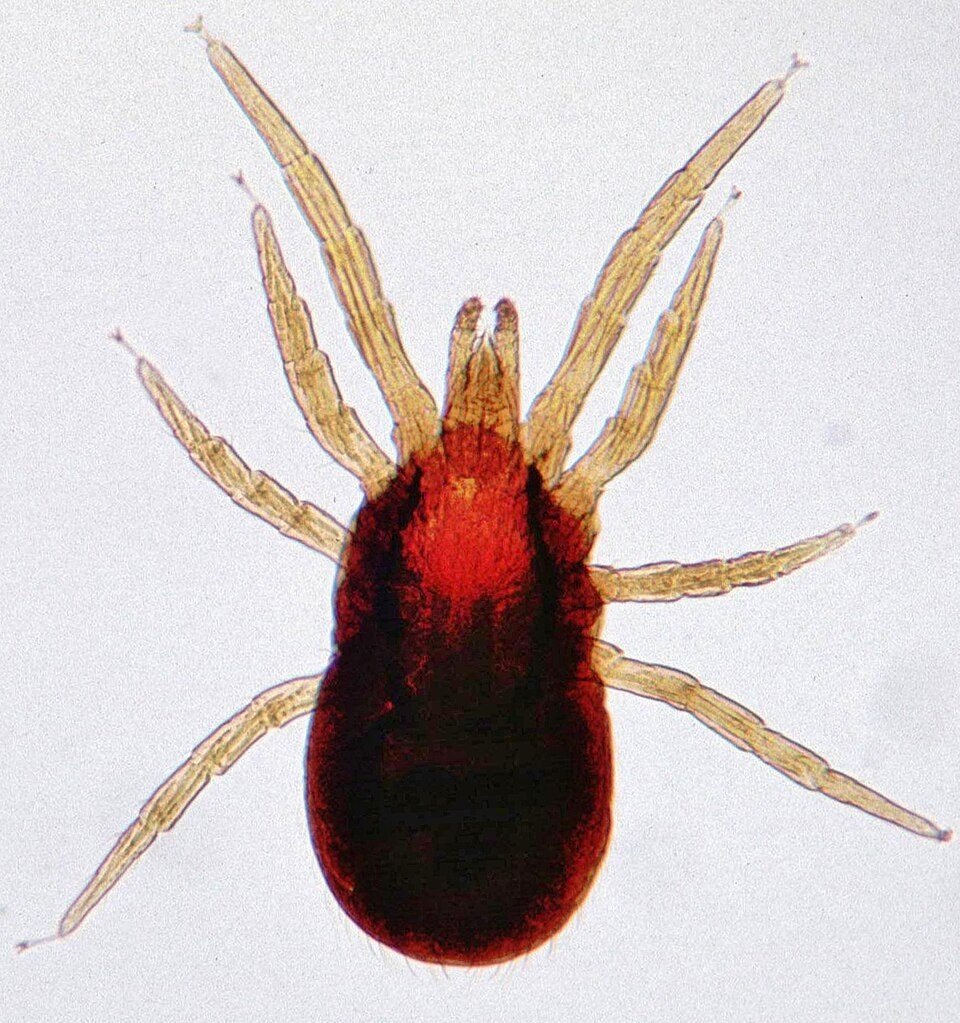

What bird mites look like
Bird mites are tiny and hard to see without magnification, which is part of why the bites are so puzzling. Two species matter most: the chicken mite (Dermanyssus gallinae) and the northern fowl mite (Ornithonyssus sylviarum). Veterinary researchers in Canada describe mites of the Ornithonyssus and Dermanyssus groups, from domestic and free-ranging birds, as the most important animal mites that end up on people here. After a blood meal a mite looks darker, as in the photo below.
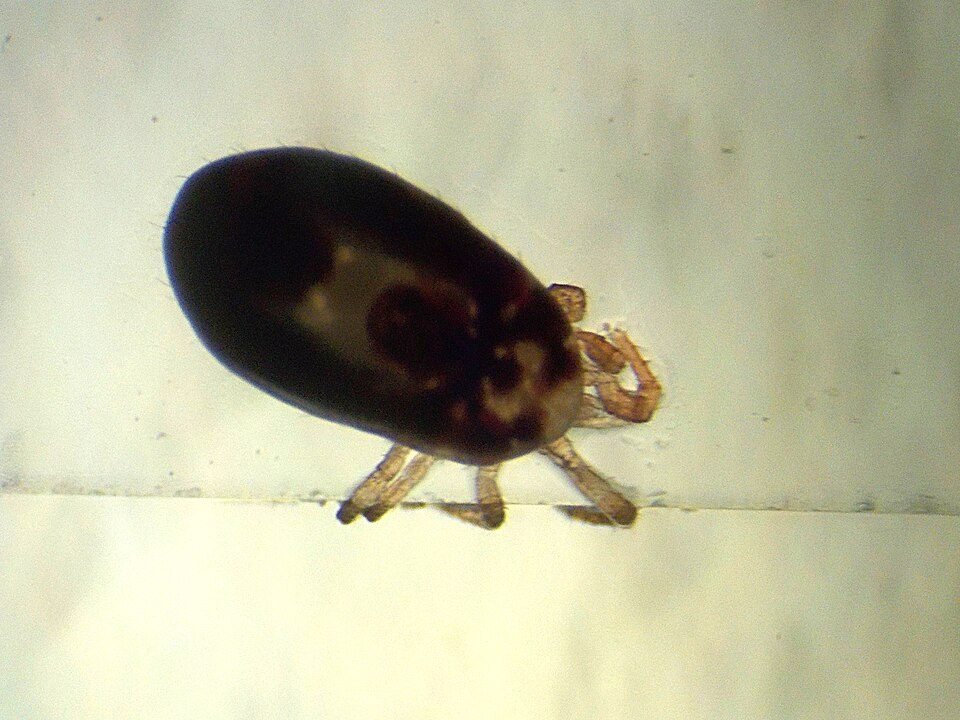

Bird mites vs clover mites and rodent mites
Three kinds of tiny mite turn up in Ontario homes, and each needs a different fix. Bird mites and rodent mites can bite. Clover mites cannot, and they come from the lawn.
| Bird mite | Clover mite | Rodent mite (tropical rat mite) | |
|---|---|---|---|
| Where they come from | Nests and roosts of birds in eaves, vents, chimneys and attics | Lawns, grass and garden plants close to the foundation | Mice and rats and their nests |
| Do they bite people? | Yes, when their bird host has gone and they look for another | No. They do not attack people | Yes, especially when the rodent host is gone or has been removed |
| Can they live on people? | They cannot reproduce on people, and the problem fades once the source is gone | They cannot reproduce indoors and die within days | They cannot reproduce on people; bites can itch for two to three days |
| First step | Find and remove the nest source, lawfully, then vacuum | Vacuum them without crushing them, and clear a dry strip around the foundation | Deal with the rodents, nests and carcasses, then clean and vacuum |
Bird mite biology and life cycle
The two species live differently. The northern fowl mite spends nearly all of its life on the bird, and if it falls off it can survive for up to a month. The chicken mite is different: it often leaves the bird to shelter in cracks and crevices by day and comes out to feed at night, and it can last for months without a host. That difference explains why the chicken mite can hang around a building long after the birds have gone.
Bird mite life and how they end up in your home
Mites build up on the birds
Bird mites live on birds and in their nests. Numbers rise fast: a northern fowl mite generation can take as little as five to 12 days, and there are several generations a year.
Nestlings are heavily infested
In spring, nestling birds in a nest can be carrying thousands of mites.
The birds leave
When the young grow up and leave, or the nest is abandoned or removed, the mites are left without a host.
Mites go looking
They wander out of the nest, through gaps in walls, vents and window frames, and into living spaces, where they bite people they find.
They die out
Mites cannot reproduce on human blood, and without a bird host they die. Some survive for a month or more, and some species for months, so the problem can last a while.
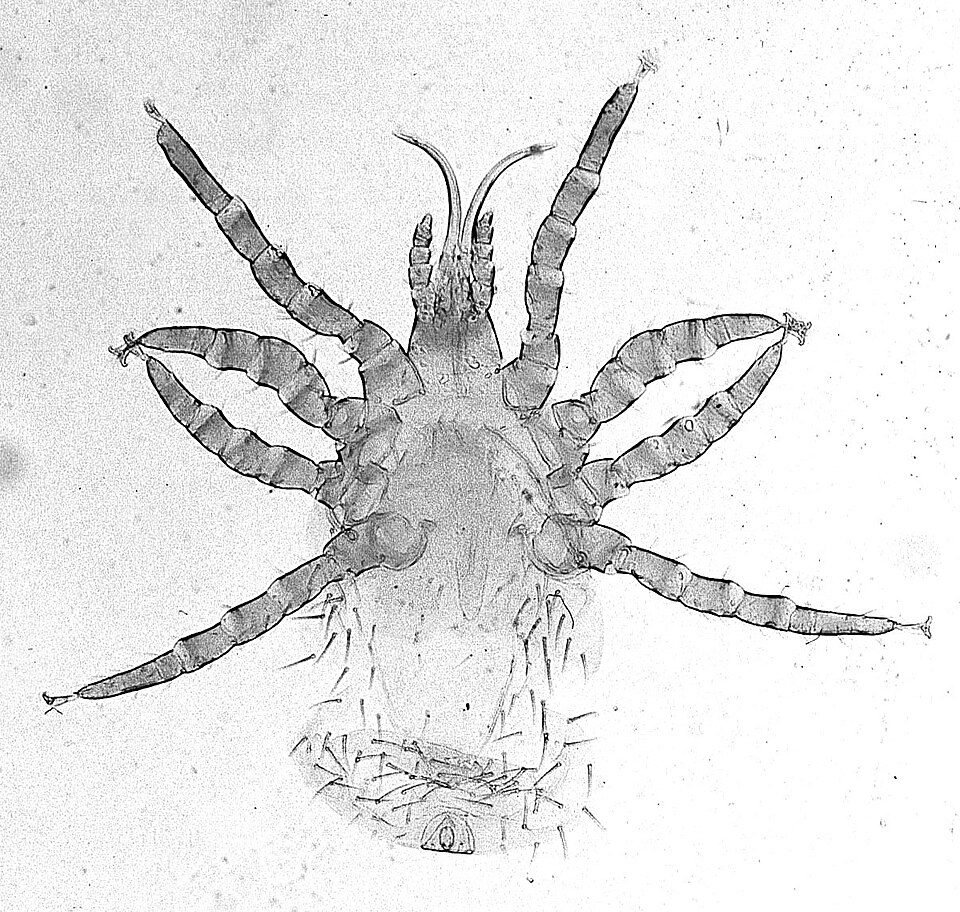

Where bird mites live
Bird mites live in nests and on birds such as pigeons, starlings and house sparrows, which choose the same places around a house: chimneys, eaves, soffits, vents and the tops of window-mounted air conditioners. Around a house the problem tends to be sporadic, but where pigeons are always present it can go on all year.
Why bird mites bite you
Bird mites want a bird. When the nestlings mature and leave, or when a nest is abandoned or dies out, the mites move on to find another host and may find their way into the building. They will bite a person they meet, but a person is not a host they can breed on. Most homeowners feel the bites only after the birds have gone, which is why the bites seem to come from nowhere.
Bird mites in the house: how far they spread
Bird mites in the house usually stay near the source, because they are looking for the nest they came from or for a new bird host. A vacuum picks up any mites that make it indoors. Preventing them comes down to stopping birds from nesting on or in the building and clearing abandoned nests promptly. Rooms next to a chimney, a vent, an eave or an air conditioner where birds nested are the ones most likely to have mites.
Signs of a bird mite infestation
- Small, itchy red spots or a crawling feeling, especially in rooms near the wall, chimney or vent where birds nested.
- A bird nest in an eave, soffit, vent, chimney or air-conditioner housing, or an old nest that has been abandoned.
- Tiny moving specks around windows, on walls and on the floor near the nest.
- Symptoms that started after nestlings fledged or after a nest was cleared out.
- Bites that do not fit bed bug, flea or mosquito patterns, in a house with a known bird problem.
Bird mite bites: what to expect
Bird mite bites are small, itchy red spots that people usually notice after the birds have gone. Because the mites cannot breed on you, the bites tend to stop once the source is dealt with and the remaining mites die off, although a few weeks is common. The bites can look like other insect bites, so do not diagnose them yourself. Have a doctor look at any skin problem that lasts, and have the home checked for a nest source.
Do bird mites live on humans? Are bird mites harmful?
Bird mites do not live on people. They bite, and the bites itch, but they cannot reproduce on human blood, so the infestation does not grow on you. Bird mites have not been shown to transmit diseases to people. The mites of birds and other animals can sometimes cause significant skin problems in people, though, so persistent, unexplained skin reactions are worth taking to a doctor. Public Health Ontario examines suspected mites from human specimens, but only when they are submitted by healthcare providers, not by the public.
If itching continues after you have removed the source, do not assume it is mites. See your doctor, and have the home inspected to find out whether mites are actually present.
Bird nests, mites and the law in Canada
The usual advice is to remove abandoned nests quickly, but in Canada you have to check the rules first. Under the federal Migratory Birds Regulations, it is prohibited to damage, destroy, disturb or remove a migratory bird nest that has a live bird or a viable egg in it. Some species, 18 of them, are protected all year and have to be given a waiting period before their nests can be treated as abandoned, and provincial rules can add more. A permit may be available if you cannot wait. If there is any doubt, wait until nesting is clearly over, or get advice before you touch a nest.
Common myths about bird mites
- "They are living in my skin or hair." They are not. Bird mites cannot reproduce on humans and cannot live on us.
- "I can spray the house and be done." Spraying does not solve it while the nest source is still there. Removing the source is what ends it.
- "They are carrying disease." Bird mites have not been shown to transmit diseases to people.
- "It will never go away." Once the source is gone and the mites have no hosts, they die out, sometimes over weeks.
How to get rid of bird mites yourself
- Find the source. Check eaves, soffits, vents, chimneys, attics and air conditioners for nests.
- Remove abandoned nests promptly and lawfully, once you are sure they are empty and not protected.
- Seal the way in. Repair gaps around vents and window frames, and install a screened cap on the chimney when the birds are not present, in early spring or fall.
- Vacuum thoroughly near the nest area and where mites are seen, and empty the vacuum outside.
- Wash bedding and clothing in hot water if you have been bitten.
- Keep birds from nesting again by blocking access points, so the problem does not come back next spring.
- Do not fill weep holes or vents with sealant, foam or mortar. The wall is hollow, and these openings let moisture and warm air out. Blocking them solid traps moisture in the wall and can lead to mould. Breathable mesh over them keeps pests out while the wall can still breathe.
How AstraHive Pest Control gets rid of bird mites
Bird mites are a source problem, and the source is the nest. Our work is to find where the mites are coming from and to deal with them once the source is dealt with lawfully.
How an AstraHive bird mites treatment works
Inspect and find the source
We inspect eaves, soffits, vents, chimneys, attics and window frames for nests and signs of mites, and check the rooms where bites are happening.
Deal with the nest source
We explain your lawful options for removing or excluding nests, so the mites lose their source and the birds cannot return.
Treat inside only when needed
If a large number of mites are already in the living space, we add an interior treatment, applied according to the label.
Back it with a 90-day warranty
If bird mites come back within 90 days, we re-treat at no charge.
Our products are Health Canada approved and safe for kids and pets, and we apply every product according to its label. AstraHive is licensed by the Ontario Ministry of the Environment, Conservation and Parks. Ontario requires a ministry-approved certification course before it issues an exterminator licence, and that training is delivered through the University of Guelph, Ridgetown Campus.
Bird mite control in Ontario: when to call an exterminator
A few bites and one old nest can be dealt with on your own. It is worth calling a licensed pest control company when bites continue after you have removed the source, when you cannot reach the nest, when you are unsure whether a nest is protected, or when mites are turning up in several rooms.
Why Choose AstraHive
- Licensed & Insured: Certified by the Ontario Ministry of Environment, Conservation and Parks.
- Fast response: Same-day service available, with a callback within 5 minutes.
- 90-Day Warranty: If pests come back within that window, we re-treat at no additional charge.
- Proven track record: 5.0 stars on Google across 200+ reviews.
- Family & pet safe: Health Canada approved products on every job.
Frequently Asked Questions
How do I get rid of bird mites?
Find and remove the nest source, once you are sure it is empty and lawful to remove, then vacuum near the nest and where mites are seen and wash bedding and clothing in hot water. Seal the gaps and screen the chimney so the birds cannot nest there again.
Do bird mites live on humans?
No. Bird mites can bite people but cannot reproduce on human blood, so they do not live on us and the problem fades once the source is gone.
Do bird mites bite?
Yes, when their bird host has gone and they go looking for another. The bites are itchy small red spots, and people often feel them only after the birds have left.
Are bird mites harmful?
They are a nuisance. They have not been shown to transmit disease to people, but the bites can be very itchy. If skin problems persist, see a doctor.
Can I remove a bird nest to stop mites?
Only if it is lawful. In Canada, it is prohibited to damage, destroy, disturb or remove a migratory bird nest that contains a live bird or a viable egg, and some species' nests are protected all year. Wait until nesting is over, or get advice.
Do I need a bird mite exterminator?
Yes if bites continue after you have removed the source, if you cannot reach the nest, or if you are unsure whether a nest can be removed. A licensed company can find the source and advise you.
Sources
- Western College of Veterinary Medicine, University of Saskatchewan: Mites (miscellaneous) of animal origin on people — Mites of animals and birds will also infest people, sometimes causing significant clinical problems but not establishing on accidental human hosts; the most important such mites in Canada are likely Ornithonyssus and Dermanyssus species from domestic and free-ranging birds.
- Government of Canada: Fact sheet, Nest Protection under the Migratory Birds Regulations, 2022 — Nests are protected when they contain a live bird or viable egg; it is prohibited to damage, destroy, disturb or remove them; 18 species have year-round protection with waiting periods; a permit may be available.
- Public Health Ontario: Arthropod identification (mites) — Public Health Ontario examines suspected arthropods, including mites, from human specimens submitted by healthcare providers, not by members of the public.
- Ontario.ca: Pesticide licences and permits — Ontario's Ministry of the Environment, Conservation and Parks issues exterminator licences after a ministry-approved certification course, delivered through the University of Guelph, Ridgetown Campus.
- University of Kentucky Entomology: Parasitic Mites of Humans (ENTFACT 637) — Bird and rodent mites usually stay on their host or nest; may enter homes when the host has left; can bite but cannot reproduce on humans; tropical rat mite about 0.03 inch, grey before and yellow to dark red after feeding, near heat sources, serious when rodent control is under way, bites cause irritation and dermatitis for two to three days.
- NC State Extension: Mites That Bug People — Northern fowl mite generation in 5 to 12 days, survives up to a month off the host; chicken mite spends much time hiding in cracks and crevices, survives months off host; nests in chimneys and under eaves; mites invade when nestlings leave; vacuum; prevent nesting and remove abandoned nests; screened chimney cap.
Areas We Serve
AstraHive Pest Control proudly serves 75+ communities across the following regions:
- Toronto: Toronto, North York, Scarborough, Etobicoke, East York, York, Leslieville, Lakeview
- Durham Region: Oshawa, Whitby, Ajax, Pickering, Clarington, Bowmanville, Courtice, Newcastle, Port Perry, Brooklin, Uxbridge, Scugog, Brock, Seaton
- York Region: Vaughan, Markham, Richmond Hill, Aurora, Newmarket, Thornhill, Woodbridge, Kleinburg, Maple, Stouffville, Unionville, Keswick, Holland Landing, East Gwillimbury, Georgina, King City, King Township, Nobleton, Berczy Village, Cathedraltown, Commerce Valley, Cornell, Wismer, Whitchurch-Stouffville, Sutton, Schomberg
- Peel Region: Mississauga, Brampton, Caledon, Malton, Port Credit, Streetsville, Meadowvale, Cooksville, Bolton, Palgrave
- Extended Service Area: Peterborough, Lindsay, Port Hope, Barrie, Bradford, Innisfil, Collingwood, Wasaga Beach, Orillia, Burlington, Oakville, Milton, Hamilton, Grimsby, St. Catharines, Welland, Niagara Falls
Don't see your city listed? Call us — we likely cover it.
Got a pest problem right now?
Call AstraHive for a free consultation. Licensed & insured, serving the GTA, Durham, York, Peel and Simcoe County.
Call 905-925-84275.0 Stars — 200+ Google Reviews | Licensed & Insured | Health Canada Approved