Black carpet beetles are shiny black to dark brown beetles, about 3 to 5 mm long, whose slender, tuft-tailed larvae eat wool, fur, feathers and stored foods such as grains and flour. The adults do not bite or feed on fabric. To get rid of black carpet beetles, find and remove every infested item, vacuum thoroughly and store food and fibres sealed.
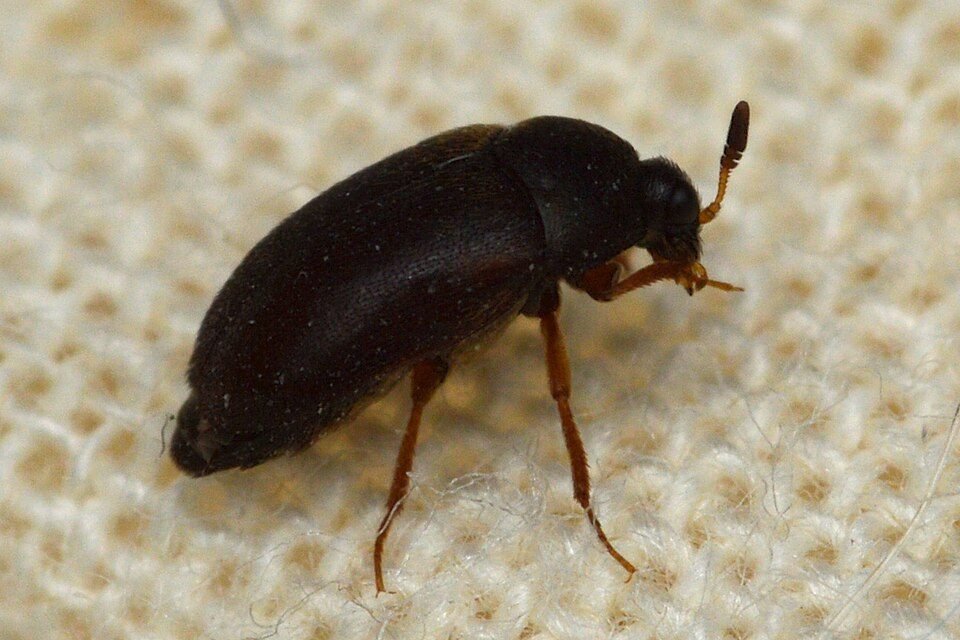

What black carpet beetles look like
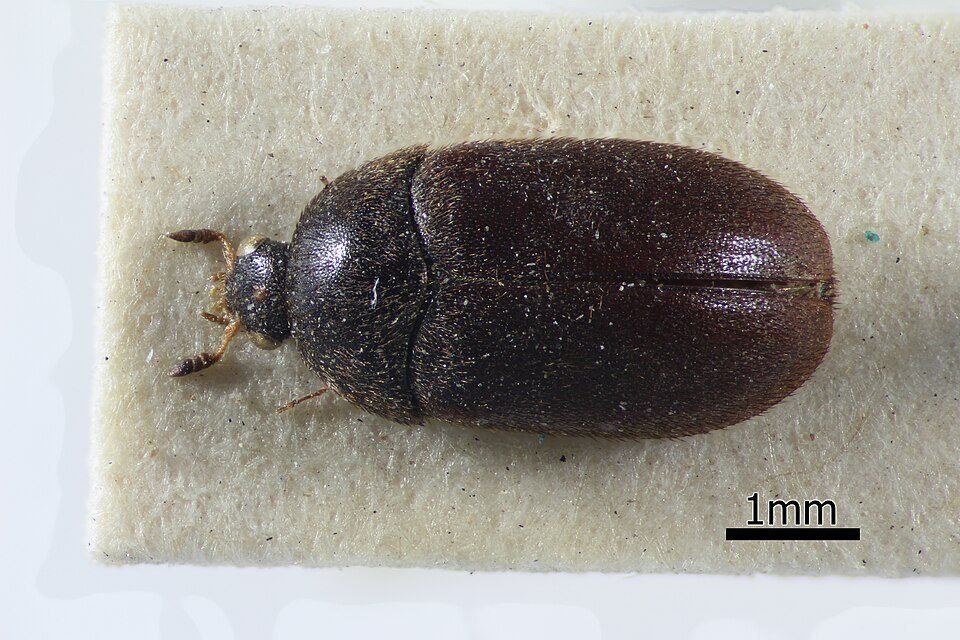
The black carpet beetle (Attagenus unicolor) is the odd one out among the carpet beetles. Adults are elongated ovals, roughly 3 to 5 mm long, shiny black to dark brown, with brownish legs, and no colourful scale pattern. Both adults and larvae look very different from the mottled varied and furniture carpet beetles.
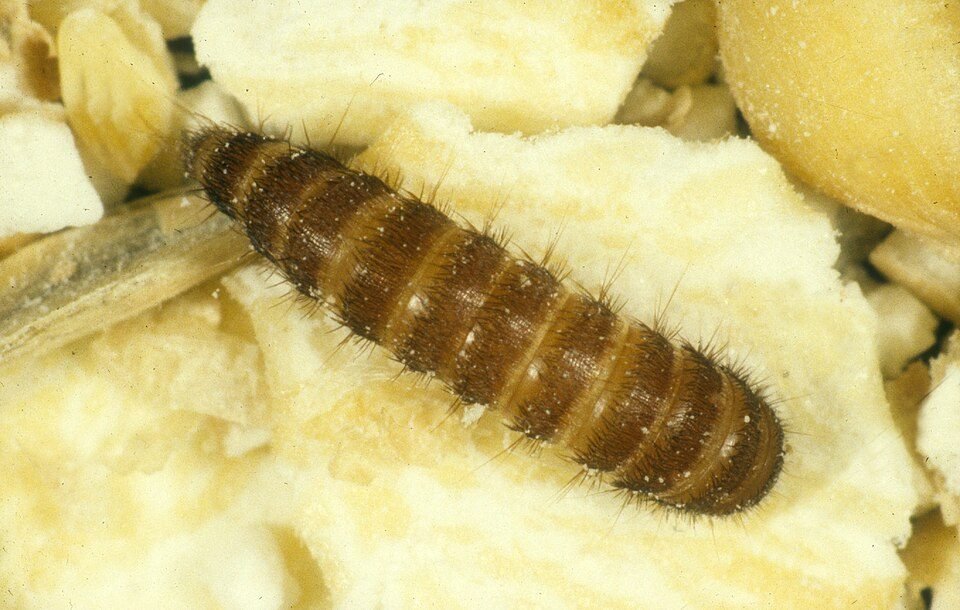
The larvae are what you are more likely to find. They are elongated and carrot-shaped, golden to chocolate brown, glossy and hard, with short stiff hairs and a tuft of very long, curled hairs at the tail. Canadian guidance describes carpet beetle larvae as oval or carrot-shaped and hairy, roughly 5 to 13 mm long.

Black carpet beetle vs varied and furniture carpet beetles
A black carpet beetle vs varied carpet beetle mix-up is easy to make at a glance, but colour and shape settle it. Black carpet beetles are plain and glossy, while the other two are speckled with coloured scales. The larvae differ even more, and the table shows the main differences.
| Black carpet beetle | Varied carpet beetle | Furniture carpet beetle | |
|---|---|---|---|
| Adult | Shiny black to dark brown, about 3 to 5 mm long, with brownish legs | Tiny, about 2.5 mm, with a speckled black, white, brown and yellow scale pattern | A little bigger and rounder than the varied, patched with black, white and yellow-orange scales, with a white underside |
| Larva | Glossy and hard, from light brown to nearly black, shaped like a slim carrot with a long-haired tail tuft | Striped in light and dark brown, with hair tufts it can raise into a round plume; the rear is wider than the front | Starts white and darkens to reddish or chestnut brown; the front is wider than the rear |
| Larval stage | About 166 to 330 days | About 220 to 630 days, the longest of the three | About 70 to 94 days, the shortest of the three |
| Known for | Feeds on fabrics and also on stored products such as grains, flour and cereal | Females lay eggs in spider webs and bird, bee and wasp nests outdoors | Eats the same fabrics, furs and feathers as the varied carpet beetle, but grows up faster |
Black carpet beetle biology and life cycle
All three species follow the same pattern of egg, larva, pupa and adult, but the black carpet beetle lays the most eggs and has a long larval stage, so one female can produce a steady stream of hungry larvae. The larvae are the only stage that does damage.
Black carpet beetle life cycle
Eggs
A female lays about 90 eggs, more than either of the other common carpet beetles, on or near a food source such as wool, fur, feathers or stored food. They hatch in roughly a week to two weeks.
Larvae
The larvae feed for anywhere from about five and a half to eleven months, depending on temperature and food. They are shiny, carrot-shaped and tuft-tailed, and they hide in dark, undisturbed places.
Pupa
When ready, the larva pupates, sometimes inside its own last cast skin. The pupal stage lasts about eight to 14 days.
Adult
Adults live four to eight weeks. They do not eat fabric. They seek pollen and nectar, so they are usually found outdoors and at sunny windows.
Where black carpet beetles live and what they eat
The larvae eat dead animals and animal products: wool, silk, leather, fur, natural-bristle brushes, pet hair and feathers. They also eat dried insects and dead rodents. What sets the black carpet beetle apart is a taste for stored foods. In drier regions it is a bigger pest of grains, flours and cereals than of fabrics, so the source can be a forgotten bag in the pantry as well as a wool rug. They do not eat synthetic fibres.
Carpet beetles are among the most common collection pests in Canada, and in British Columbia's Interior the black and common carpet beetles are abundant.
How black carpet beetles get into your house
The adults fly. They feed on pollen and nectar and often come indoors on cut flowers or through open windows, drawn to the light. The eggs are then laid in a hidden place, and you may not notice anything until the larvae have been feeding for months. Nests of birds, wasps and spiders in the eaves and attic are another source, since larvae feed on the dead insects and feathers inside.

Signs of a black carpet beetle infestation
- Tapering, hairy larvae on carpets, in closets, under furniture or in pantry goods.
- Shed skins, which stay behind as the larvae grow, and salt-sized fecal pellets near where they feed.
- Thinned or bald patches on wool, fur and feathers, and holes in stored clothing.
- Small black beetles on window sills, especially in spring.
- Larvae or shed skins in cereal, flour, pet food or other dry goods.
Are black carpet beetles harmful? Do they bite?
Black carpet beetles are a property pest and a mild nuisance to some people. They do not bite. If you have itchy welts and no other explanation, the cause can be an allergic reaction to the shed hairs of carpet beetle larvae. People who have been exposed for years are the ones who become sensitized, and the reaction is often reported as bites. It can look like other insect bites, so if you are unsure, get the room inspected.
If you find larvae in your pantry, throw away the affected food and clean the shelves. Do not try to save it. The larvae, their skins and their droppings are not something to eat.
Common myths about black carpet beetles
- "Cedar keeps them away." Cedar chests are not reliable, and the oil fades over time.
- "They only eat carpets." They eat wool, fur, feathers and dried animal matter, and they can infest stored food.
- "One beetle means nothing." The adult is often a sign that a hidden source is feeding larvae somewhere in the house.
How to get rid of black carpet beetles yourself
- Vacuum often and slowly. Go over rugs, sofas and chairs, heating and cooling ducts, gaps in floorboards and any rarely disturbed spot, particularly beneath heavy furniture and appliances.
- Wash or dry-clean infested items, or freeze those you cannot wash. Wash in hot water where the fabric allows it.
- Clear the hidden sources. Remove old spider webs, lint, hair and dead insects, and take down bird and wasp nests from eaves and the attic in autumn.
- Check the pantry. Throw out infested grains, flour and cereal, and store dry food in sealed containers.
- Use rodent traps rather than bait, and check them often, so no dead rodents are left as a breeding site.
- Screen windows and inspect cut flowers before you bring them inside.
- Do not fill weep holes or vents with sealant, foam or mortar. The wall is hollow, and these openings let moisture and warm air out. Blocking them solid traps moisture in the wall and can lead to mould. Breathable mesh over them keeps pests out while the wall can still breathe.
How AstraHive Pest Control gets rid of black carpet beetles
Carpet beetles are a source problem. The larvae feed on animal fibres, so the work is finding every item and hiding place that is feeding them. Because black carpet beetles also eat stored foods, we check the pantry as well as the closets.
How an AstraHive black carpet beetles treatment works
Inspect and find the source
We inspect closets, wool rugs, upholstery, baseboards, air returns, attics and eaves for larvae, shed skins and grazed fabric, and check for nests and dead-insect sources.
Clear the source
We show you what to wash, dry-clean, freeze or discard, what to vacuum, and how to store fibres sealed, so the larvae have nothing left to eat.
Treat inside only when needed
If a large infestation has spread through the rooms, we add an interior treatment, applied according to the label and kept away from clothing and bedding.
Back it with a 90-day warranty
If black carpet beetles come back within 90 days, we re-treat at no charge.
Our products are Health Canada approved and safe for kids and pets, and we apply every product according to its label. AstraHive is licensed by the Ontario Ministry of the Environment, Conservation and Parks. Ontario requires a ministry-approved certification course before it issues an exterminator licence, and that training is delivered through the University of Guelph, Ridgetown Campus.
Black carpet beetle control in Ontario: when to call an exterminator
A few beetles at a window are not a reason to call. It is worth calling a licensed pest control company when you keep finding larvae, when damage is spreading, when you cannot find the source, or when the infestation is in a pantry, an attic or a wall void that you cannot easily reach.
Why Choose AstraHive
- Licensed & Insured: Certified by the Ontario Ministry of Environment, Conservation and Parks.
- Fast response: Same-day service available, with a callback within 5 minutes.
- 90-Day Warranty: If pests come back within that window, we re-treat at no additional charge.
- Proven track record: 5.0 stars on Google across 200+ reviews.
- Family & pet safe: Health Canada approved products on every job.
Frequently Asked Questions
How do I get rid of black carpet beetles?
Find the source: vacuum thoroughly, wash or dry-clean infested items, freeze what you cannot wash, and throw out infested pantry goods. Clear old nests, webs and dead insects, and store fibres and food sealed. A licensed pest control company can treat if the infestation is large.
What do black carpet beetle larvae look like?
They are carrot-shaped, tapering to a tuft of long hairs at the tail, and range from golden to chocolate brown. They are shiny and smooth with short, stiff hairs and can reach about a centimetre long.
Do black carpet beetles bite?
No. The itchy rash sometimes blamed on carpet beetles is an allergic reaction to the hairs shed by their larvae, mainly in people who have been exposed for years.
Are black carpet beetles harmful?
They damage wool, fur, feathers and stored foods. They are not a direct danger to health, but the larval hairs can trigger an allergic reaction in some people.
What is the difference between black carpet beetles and varied carpet beetles?
Black carpet beetles are shiny and plain black to dark brown, and their larvae are carrot-shaped with a tail tuft. Varied carpet beetles are speckled with white, brown and yellow scales, and their striped larvae flare out tufts of hair.
Do I need a black carpet beetle exterminator?
Not for a few adults at a window. A licensed exterminator is worth calling when larvae keep appearing, when you cannot find the source, or when the infestation is in the attic, walls or pantry.
Sources
- Government of British Columbia: Home and Garden Pest Management Guide, Insects Around the Home (carpet beetles) — Carpet beetles are oval, about 3 mm; larvae carrot-shaped, 5 to 13 mm, hairy; black and common carpet beetles abundant in the BC Interior, varied more abundant on the coast; larvae feed on dead insects, hair, animal skins, feathers, fur and wool; vacuum, dry-clean, freeze; remove bird and wasp nests in autumn; use rodent traps rather than bait.
- Canadian Conservation Institute: Major insect pests and their associated, diagnostic signs — Carpet beetles and hide beetles: brown-banded furry larvae and cast skins on furs, feathers and objects; among the most common collection pests.
- Ontario.ca: Pesticide licences and permits — Ontario's Ministry of the Environment, Conservation and Parks issues exterminator licences after a ministry-approved certification course, delivered through the University of Guelph, Ridgetown Campus.
- UC Statewide IPM Program: Carpet Beetles — Species descriptions and life-cycle table for the varied, furniture and black carpet beetle; adults are pollen feeders that fly in from flowers; larvae do not feed on synthetics; shed skins and salt-sized fecal pellets.
- Penn State Extension: Carpet Beetle Dermatitis — Reactions come from an allergic response to larval hairs and hemolymph, felt as itching and rash and often reported as bites; only people with long exposure become sensitized.
Areas We Serve
AstraHive Pest Control proudly serves 75+ communities across the following regions:
- Toronto: Toronto, North York, Scarborough, Etobicoke, East York, York, Leslieville, Lakeview
- Durham Region: Oshawa, Whitby, Ajax, Pickering, Clarington, Bowmanville, Courtice, Newcastle, Port Perry, Brooklin, Uxbridge, Scugog, Brock, Seaton
- York Region: Vaughan, Markham, Richmond Hill, Aurora, Newmarket, Thornhill, Woodbridge, Kleinburg, Maple, Stouffville, Unionville, Keswick, Holland Landing, East Gwillimbury, Georgina, King City, King Township, Nobleton, Berczy Village, Cathedraltown, Commerce Valley, Cornell, Wismer, Whitchurch-Stouffville, Sutton, Schomberg
- Peel Region: Mississauga, Brampton, Caledon, Malton, Port Credit, Streetsville, Meadowvale, Cooksville, Bolton, Palgrave
- Extended Service Area: Peterborough, Lindsay, Port Hope, Barrie, Bradford, Innisfil, Collingwood, Wasaga Beach, Orillia, Burlington, Oakville, Milton, Hamilton, Grimsby, St. Catharines, Welland, Niagara Falls
Don't see your city listed? Call us — we likely cover it.
Got a pest problem right now?
Call AstraHive for a free consultation. Licensed & insured, serving the GTA, Durham, York, Peel and Simcoe County.
Call 905-925-84275.0 Stars — 200+ Google Reviews | Licensed & Insured | Health Canada Approved