Boxelder bugs are black, half-inch insects with red-orange edging that swarm sunny walls in fall and slip into homes to overwinter. They do not bite or damage your house, but they stain fabric and smell when crushed. To get rid of boxelder bugs, seal the gaps they use, vacuum the ones inside and treat the outside walls where they gather.

What boxelder bugs look like
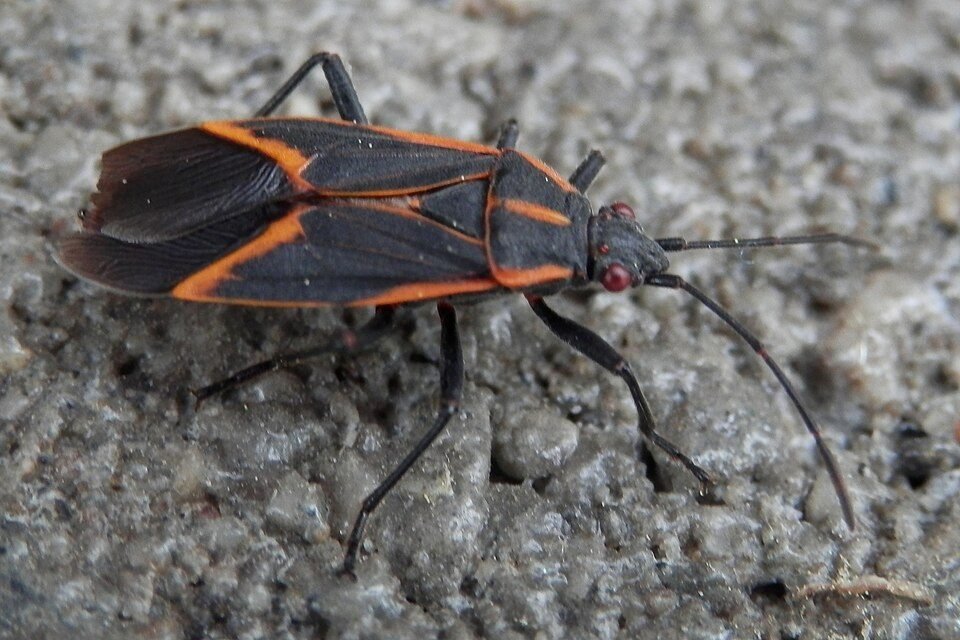
An adult boxelder bug (Boisea trivittata, also written "box elder bug") is about half an inch (11 to 14 mm) long, flat across the back and shaped like a stretched oval. The body is black or slate-gray with red-orange edging along the wings, and the eyes are dark red. The feature that separates it from the other bugs in this article is a set of three red lines on the pronotum, the plate just behind the head. One line runs down the middle and one runs along each side.
- 1Three red lines on the pronotum, the plate just behind the head: one down the middle and one along each side. This is the most reliable identification mark.
- 2Dark red eyes.
- 3Red-orange edging on the front wings over a black or slate-gray body.
- 4About half an inch (13 mm) long, flat across the back and shaped like a stretched oval.
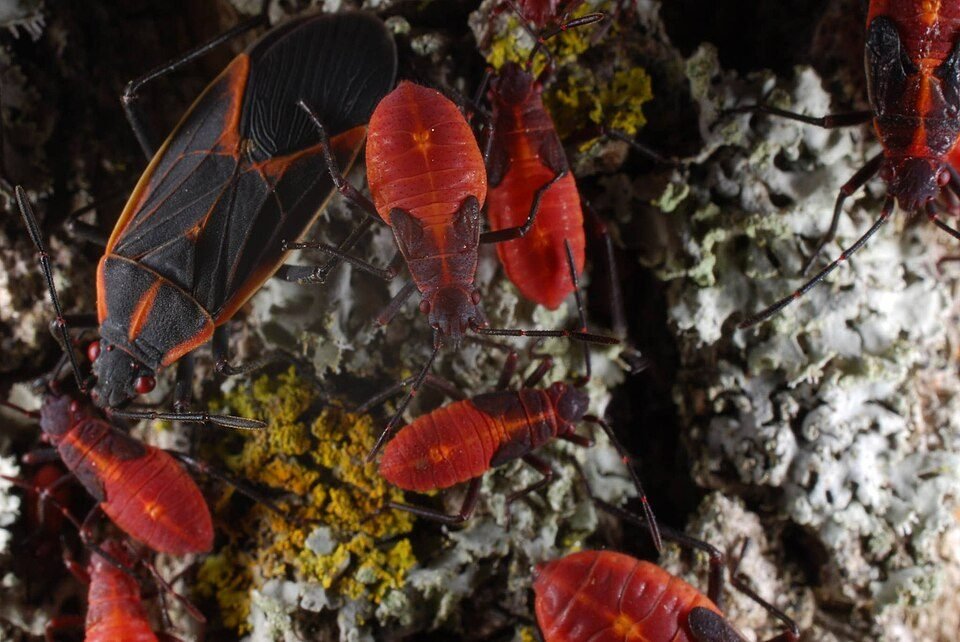
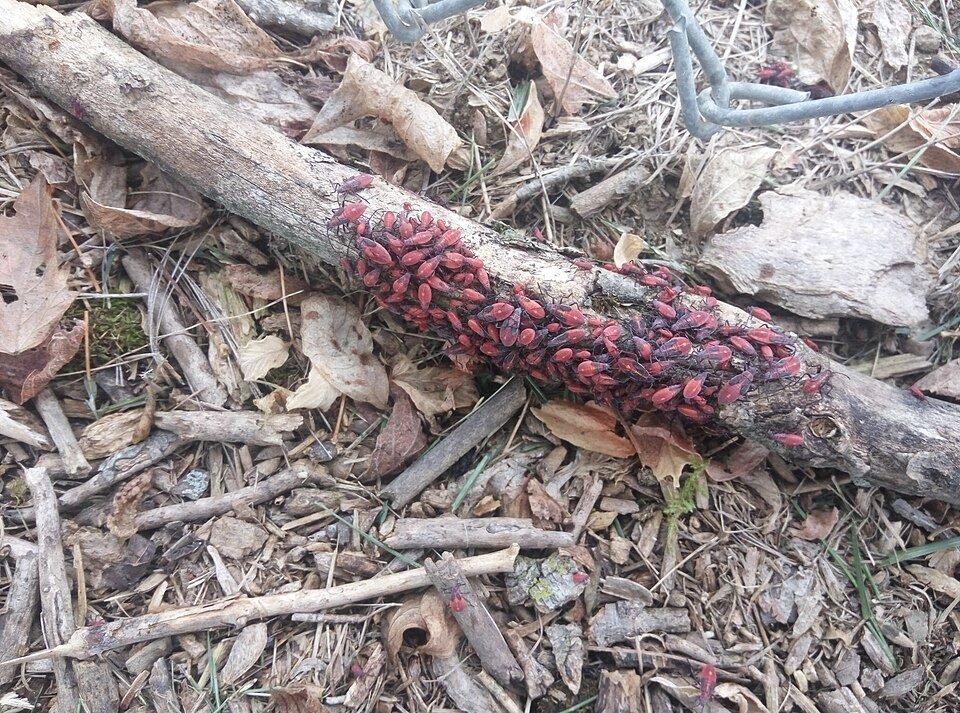
The young stages, called nymphs, look like a different insect. They have no wings. A newly hatched nymph is bright red, and black markings appear first near the head as it grows. Larger nymphs show wing pads and black legs and antennae while the abdomen stays red. Nymphs and adults share the same trees and walls in late summer, so you will often see both stages together.

Boxelder bug vs milkweed bug, squash bug and other lookalikes
Several red-marked bugs get mistaken for boxelder bugs. The three thin red lines on the pronotum settle it. A small milkweed bug has a bold red band across the pronotum and a red X on its back instead. A large milkweed bug is mostly orange-red with a black bar across the wings. A squash bug is gray-black and shield-shaped with striped abdomen edges. Where you find the bug helps as well: milkweed bugs live on milkweed, squash bugs on squash and pumpkin plants, and boxelder bugs on and around boxelder trees and, in fall, on sunny walls.
| Boxelder bug | Small milkweed bug | Large milkweed bug | Squash bug | |
|---|---|---|---|---|
| Adult size | About 1/2 in (13 mm) | About 1/2 in | Up to 3/4 in | About 5/8 in |
| Pattern | Black or slate-gray with red-orange wing edging and three thin red lines on the pronotum | Black with a large red X on the back and a bold red band across the pronotum | Orange-red with two black triangles separated by a black bar across the wings | Gray to black and shield-shaped, with the abdomen edges striped orange and brown |
| Where you find it | On and around boxelder, maple and ash trees, and on sunny walls in fall | On milkweed and other wildflowers in open, grassy areas | On common milkweed | On squash and pumpkin plants; overwinters in garden debris, not buildings |
Boxelder bug biology and life cycle
Boxelder bugs are true bugs with piercing, sucking mouthparts. They feed by puncturing seeds, leaves, twigs and fruit and drinking the fluid inside. Most of the feeding is on the seeds of female boxelder trees (also called Manitoba maple), but they also use other maples, ash and some fruit trees.
Boxelder bug life cycle, spring to winter
Spring: adults wake up and lay eggs
Adults that survived the winter become active and fly to host trees. Each female lays 200 to 300 small oval eggs on leaves, bark and other surfaces.
10 to 19 days later: eggs hatch
Bright red nymphs hatch and feed on seeds, leaves, twigs and fruit.
Late spring and summer: nymphs grow up
Nymphs molt five times, gaining black markings and wing pads, then become adults and mate. In most years this produces a second generation the same summer.
August and September: the last generation matures
Most of the summer's final generation is adult by now. As temperatures fall, they leave the trees and gather on warm, sunny walls.
Fall and winter: adults shelter
Adults overwinter in cracks and crevices in tree hollows, debris and buildings. On mild winter days they can become active again.
Depending on the climate, boxelder bugs produce anywhere from one to three generations a year, and the last generation of the summer is the one that spends the winter as adults. Boxelder bugs do not reproduce indoors. Every bug you find inside came from outside, and none of them is starting a colony in your walls.
Boxelder bugs have few natural enemies. They give off an odour that puts birds off, and spiders are only a minor predator. That is one reason populations can build up so quickly. Weather matters too. A dry summer creates good breeding conditions, and Ontario has seen years when boxelder bugs covered homes in large numbers.
Where boxelder bugs live before they reach your house
The eastern boxelder bug is native to eastern North America and occurs across southern Canada and much of the eastern U.S. In Ontario it is native to the southwest of the province. The boxelder tree, known here as Manitoba maple, is its main host, and it also feeds on other maples, ash and apple trees. Feeding can mottle leaves and make them drop early, but the damage to the tree is usually minor.
You do not need a boxelder tree on your own lot to have a problem. The adults fly, so bugs raised on a neighbour's tree can end up on your wall.
Why boxelder bugs are on your house in fall
As temperatures drop in late summer and fall, adults leave the trees and look for a dry, sheltered place to spend the winter. Buildings hold heat, and boxelder bugs prefer warm surfaces, so the largest groups collect on the south and west walls, on window and door frames and around soffits. From there they follow any crack or crevice they can find, including ones that lead inside. Boxelder bugs are not the only fall invader in Ontario: cluster flies, stink bugs and Asian lady beetles also look for winter shelter in homes.

Bugs that get indoors can mistake the warmth of a heated house for spring. On mild winter days, boxelder bugs hiding in wall voids can wake up and appear on windows or in rooms, then head back into hiding as the day cools. That explains why you can see a few indoors in the middle of winter. Outdoors, activity drops sharply after the first hard frost.
Signs of a boxelder bug infestation
- Clusters of black and red bugs on sunny south or west walls, door frames and windows in late summer and fall.
- Bugs crawling or flying around windows and door frames indoors, including on warm days in winter.
- Small dark spots of droppings on curtains, furniture and clothing.
- Groups of red nymphs on or near a boxelder or maple tree earlier in the summer.
Are boxelder bugs harmful? Do boxelder bugs bite?
Boxelder bugs are not harmful to people or pets. They do not bite or sting, there is no evidence that they spread disease, and they do not eat your food, chew wood or breed indoors. They rarely cause economic or structural damage.
The cost is mostly cosmetic. Their droppings can spot curtains, furniture, clothing and painted walls, and a crushed bug leaves a stain and a strong smell, similar to a stink bug. Outdoors they may feed on apple flowers and fruit, but the damage is usually minor.
Do not squash boxelder bugs indoors. The stain and the smell come from crushing them. Vacuum them up and empty the bag or canister outside.
Common myths about boxelder bugs
- "They bite." They do not. Their mouthparts are made for drinking plant fluids.
- "Bugs indoors mean a growing infestation." The bugs inside came in from outdoors and cannot breed in your home. The job is to stop more getting in.
- "Cutting down the tree fixes it." Removing a female Manitoba maple next to your house can trim the local population, and provincial guides list it as an option. But the bugs fly, so removal rarely ends the problem when other boxelder trees stand nearby.
- "One strong spray ends it." Sprays used on their own often do little against large nymphs and adults. Sealing, vacuuming and rinsing the bugs off do a lot of the work, which is why we combine them with treatment.
How to get rid of boxelder bugs yourself
Start with exclusion and finish it in late summer, before the first cold snap sends the bugs to your walls. Then deal with the few that get in.
- Seal gaps from the outside. Caulk cracks around windows, doors, utility lines and the foundation, and add weatherstripping around doors and windows.
- Repair torn screens and screen the attic vents. Screening keeps bugs out and lets air move.
- Do not fill weep holes or vents with sealant, foam or mortar. The wall is hollow, and these openings let moisture and warm air out. Blocking them solid traps moisture in the wall and can lead to mould. Breathable mesh over them keeps pests out while the wall can still breathe.
- Vacuum what gets in. Sealing an entire house completely is often impossible, so vacuuming the stragglers is part of the plan. Empty the bag or canister outdoors.
- Rinse clusters off the wall with a hose. Nymphs in particular are easily washed away, and a strong stream of water clears groups from siding and window frames.
- Use soapy water on clusters if you want a spray. About half a cup of laundry detergent in a gallon of water, sprayed directly on the bugs, kills the ones it hits. It has no lasting effect once dry.
- Clear debris piles near the foundation. Piles of leaves, wood and rocks give the bugs a sheltered place to gather. Stack firewood off the ground and away from the house.
- Consider removing a female Manitoba maple that stands right beside the house, especially if you were thinking of taking it out anyway. Expect it to help, not to solve the problem alone.
How AstraHive Pest Control gets rid of boxelder bugs
September is when we do most of our exterior perimeter treatments for boxelder bugs and the other fall invaders, because that is when the bugs move from the trees onto your walls. A boxelder bug job follows four steps.
How an AstraHive boxelder bug treatment works
Inspect the outside of the home
We check the sunny south and west walls, window and door frames, soffits and the foundation to see where the bugs are gathering and how they are getting in.
Treat the exterior perimeter
We apply a residual treatment around the foundation and the openings where bugs gather. It creates a barrier that stays active for about 90 days.
Treat inside only when needed
If a large number of boxelder bugs are already inside the house, we add an interior treatment. For a handful of stragglers, vacuuming is enough and we will tell you that.
Back it with a 90-day warranty
If boxelder bugs return within 90 days, we re-treat at no charge.
Our products are Health Canada approved and safe for kids and pets, and we apply every product according to its label. AstraHive is licensed by the Ontario Ministry of the Environment, Conservation and Parks. Ontario requires a ministry-approved certification course before it issues an exterminator licence, and that training is delivered through the University of Guelph, Ridgetown Campus.
A perimeter treatment works best alongside the sealing and vacuuming steps above. Government and university pest guides are cautious about spraying for boxelder bugs, and Alberta's guide calls chemical control rarely necessary. We agree that closing the gaps comes first: bugs that cannot get in cannot stain your curtains.
Boxelder bug control in Ontario: when to call an exterminator
Most light boxelder bug activity can be handled with sealing, a vacuum and a hose. It is worth calling a licensed pest control company when hundreds of bugs collect on a single wall each fall, when bugs keep turning up inside after you have sealed and vacuumed, or when you cannot safely reach the gaps yourself, such as upper storeys, soffits and rooflines. A property that backs onto several female boxelder trees will usually see heavier numbers than a home with none nearby.
Why Choose AstraHive
- Licensed & Insured: Certified by the Ontario Ministry of Environment, Conservation and Parks.
- Fast response: Same-day service available, with a callback within 5 minutes.
- 90-Day Warranty: If pests come back within that window, we re-treat at no additional charge.
- Proven track record: 5.0 stars on Google across 200+ reviews.
- Family & pet safe: Health Canada approved products on every job.
Frequently Asked Questions
How do I get rid of boxelder bugs in my house?
Vacuum the bugs that are inside, empty the bag or canister outdoors, and seal the cracks and gaps they used to get in. Rinse clusters off outside walls with a hose, and call a pest control company if large numbers keep returning. Do not squash them, because crushing leaves a stain and a strong smell.
Do boxelder bugs bite?
No. Boxelder bugs do not bite or sting people or pets, and there is no evidence that they spread disease. Their mouthparts are built for drinking plant fluids.
Are boxelder bugs harmful to my home?
No. They do not chew wood, eat food or breed indoors. The damage is cosmetic: their droppings and crushed bodies can stain curtains, furniture, clothing and painted walls.
Are boxelder bugs common in Ontario?
Yes. The eastern boxelder bug is native to southwestern Ontario and lives on Manitoba maple trees. Numbers change from year to year, and a dry summer can set off a boom that sends large groups onto homes in the fall.
Why are there so many boxelder bugs on my house?
In late summer and fall, adult boxelder bugs leave their host trees and gather on warm, sunny walls, usually the south and west sides of a house, while they look for a sheltered crack to spend the winter in. Numbers can be very high after a dry summer.
What is the difference between a boxelder bug and a milkweed bug?
A boxelder bug has three thin red lines on the pronotum, the plate behind the head, and red-orange edging on black wings. A small milkweed bug has a bold red band across the pronotum and a red X on its back, and milkweed bugs live on milkweed rather than boxelder trees.
Do I need a boxelder bug exterminator?
Not for a few bugs. Sealing gaps, vacuuming and hosing down clusters handle light activity. A pest control company is worth calling when hundreds of bugs gather on a wall each fall, when they keep coming back inside, or when the gaps are out of reach.
Sources
- Government of Alberta: Backyard Pest Management, Pests of Deciduous Trees and Shrubs (box elder bug) — Hosts (box elder or Manitoba maple, other maples, ash, apples), adult length of 11 to 14 mm, red eyes and red lines, overwintering as adults, fall movement to sunny areas, minor leaf damage, hosing, sealing with weatherstripping or caulking, removing female Manitoba maples, chemical control rarely necessary.
- Government of British Columbia: Home and Garden Pest Management Guide, Insects Around the Home (boxelder bug) — Boxelder bugs feed on female boxelder trees and move into buildings in fall; hose them off walls, vacuum indoors, seal exterior entrances, consider removing female Manitoba maples, and stack wood and stone away from foundations.
- The Canadian Encyclopedia: Eastern Boxelder Bug (Andy Stefan, 2024) — Native to eastern North America and found from southern Canada through the eastern United States; associated with Manitoba maple; about 13 mm; 200 to 300 eggs hatching in 10 to 19 days; five molts; one to three generations depending on location; shelters in leaf litter, bark and around structures; no threat to humans or pets; staining and odour; sealing entry points is the best prevention.
- CBC News: Swarms of boxelder bugs cover homes in North York and Etobicoke (2016), quoting University of Guelph entomologist Morgan Jackson — Native to southwestern Ontario; lays eggs on and feeds on Manitoba maple; dry summer created prime breeding conditions; congregates on south-facing walls; overwinters as adults in cracks and crevices of homes; do not bite, transmit disease or damage homes or plants; fewer seen after first frost.
- Ontario.ca: Pesticide licences and permits — Ontario's Ministry of the Environment, Conservation and Parks issues exterminator licences after a ministry-approved certification course, delivered through the University of Guelph, Ridgetown Campus.
- UC Statewide IPM Program: Boxelder Bug — Three red lines on the pronotum, lookalikes, overwintering behaviour, droppings on furnishings, no indoor breeding, exclusion and vacuuming.
- Utah State University Extension: Boxelder Bug (ENT-41-06) — Detailed description of adults and nymphs, life cycle, few natural enemies, hose and soapy water control, sealing and screening attic vents.
- Missouri Department of Conservation: Small Milkweed Bug — Small milkweed bug size and pattern, milkweed habitat, and how it differs from the boxelder bug.
- University of Wisconsin Extension: Common Milkweed Insects — Large milkweed bug size and pattern, small milkweed bug pattern, milkweed host plants.
- University of Wisconsin Extension: Squash Bug — Squash bug size, colour, shield shape, squash and pumpkin hosts, overwintering in garden debris.
Areas We Serve
AstraHive Pest Control proudly serves 75+ communities across the following regions:
- Toronto: Toronto, North York, Scarborough, Etobicoke, East York, York, Leslieville, Lakeview
- Durham Region: Oshawa, Whitby, Ajax, Pickering, Clarington, Bowmanville, Courtice, Newcastle, Port Perry, Brooklin, Uxbridge, Scugog, Brock, Seaton
- York Region: Vaughan, Markham, Richmond Hill, Aurora, Newmarket, Thornhill, Woodbridge, Kleinburg, Maple, Stouffville, Unionville, Keswick, Holland Landing, East Gwillimbury, Georgina, King City, King Township, Nobleton, Berczy Village, Cathedraltown, Commerce Valley, Cornell, Wismer, Whitchurch-Stouffville, Sutton, Schomberg
- Peel Region: Mississauga, Brampton, Caledon, Malton, Port Credit, Streetsville, Meadowvale, Cooksville, Bolton, Palgrave
- Extended Service Area: Peterborough, Lindsay, Port Hope, Barrie, Bradford, Innisfil, Collingwood, Wasaga Beach, Orillia, Burlington, Oakville, Milton, Hamilton, Grimsby, St. Catharines, Welland, Niagara Falls
Don't see your city listed? Call us — we likely cover it.
Got a pest problem right now?
Call AstraHive for a free consultation. Licensed & insured, serving the GTA, Durham, York, Peel and Simcoe County.
Call 905-925-84275.0 Stars — 200+ Google Reviews | Licensed & Insured | Health Canada Approved