Clover mites are tiny red, rusty-brown or olive-green mites, smaller than a pinhead, that swarm sunny walls and windowsills in spring and fall and leave red smears when crushed. They do not bite people or damage the home, and they cannot reproduce indoors. To get rid of clover mites, seal the gaps, vacuum them up without crushing and clear a dry strip around the foundation.
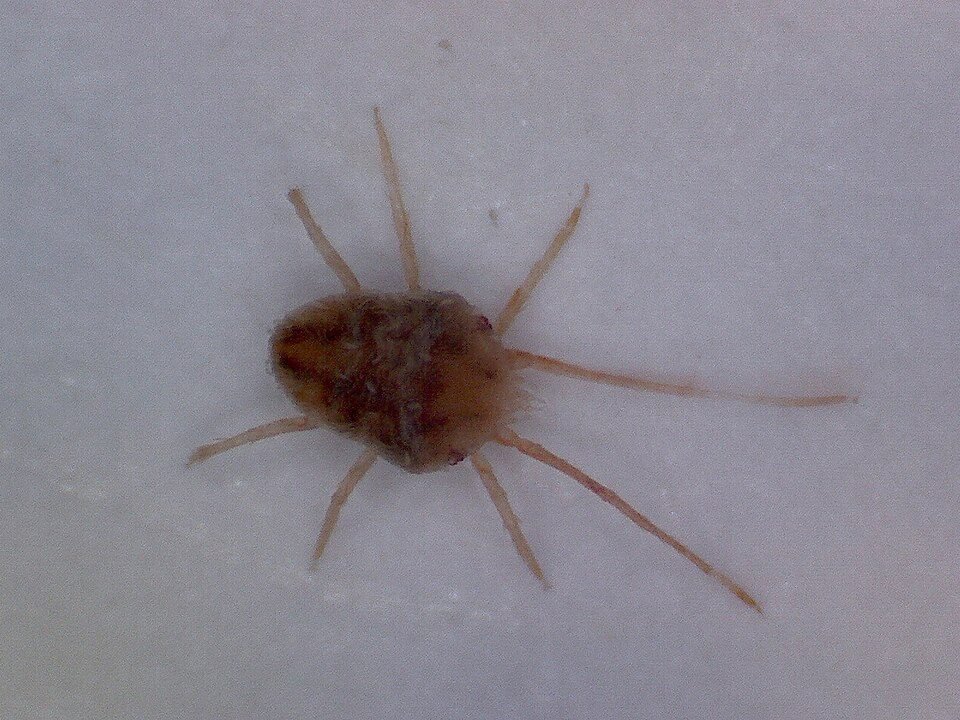

What clover mites look like
The clover mite (Bryobia praetiosa) is one of the larger plant-feeding mites, but that still means less than a millimetre: smaller than a pinhead and roughly 0.75 mm long. The colour ranges from dark red through rusty brown to olive green. It has eight legs, and the front pair is two to three times longer than the rest and reaches forward from the body, which is the easiest way to know you have a clover mite. They move quickly for something so small.
You are most likely to see them in groups on the sunny side of the house, on windowsills, curtains and outside walls in spring.
Clover mite vs bird mite vs rodent mite
Three kinds of tiny mite turn up in Ontario homes, and the fix is different for each, so it pays to know which one you have. Clover mites come from the lawn, bird mites from nests and rodent mites from mice and rats. Only the clover mite is completely harmless to people.
| Clover mite | Bird mite | Rodent mite (tropical rat mite) | |
|---|---|---|---|
| Size and colour | Smaller than a pinhead, red, rusty brown or olive green, with very long front legs | Tiny; species such as the chicken mite and the northern fowl mite turn darker red after feeding | About 0.8 mm, grey before a blood meal and yellow to dark red after |
| Where they come from | Lawns, grass and garden plants close to the foundation | Nests and roosts of birds in eaves, vents, chimneys and attics | Mice and rats and their nests |
| Do they bite people? | No. They do not attack people | Yes, when their bird host has gone and they look for another | Yes, especially when the rodent host is gone or has been removed |
| Can they live on people? | They cannot reproduce indoors and die within days | They cannot reproduce on people, and the problem fades once the source is gone | They cannot reproduce on people; bites can itch for two to three days |
| First step | Vacuum them without crushing them, and clear a dry strip around the foundation | Find and remove the nest source, lawfully, then vacuum | Deal with the rodents, nests and carcasses, then clean and vacuum |
Clover mite biology and life cycle
Clover mites are odd: every one is female. Males have not been found, and the eggs develop without fertilization. That is how a small number of mites on a lawn can become a swarm on a wall.
Clover mite year
Spring: eggs hatch
The overwintering eggs hatch in April or May, sooner if the weather is mild. The young mites go looking for food plants, and some climb walls and enter houses.
Spring and early summer: feeding
Clover mites are active between about 4 and 24 degrees Celsius, feeding on the sap of trees, shrubs, flowers and grasses. Most complete one generation, then go dormant for the heat of summer.
Fall: a second wave
Another generation is usually completed in fall. As food plants fade, mites migrate, sometimes in enormous numbers, to lay their eggs in bark and building crevices.
Winter: eggs wait
The small red eggs overwinter in sheltered cracks in bark, sidewalks and building walls. Every mite is female, and eggs develop without fertilization.

Why clover mites get into your house
They do not want your house. They are looking for plants, and they end up on your walls. The warm, south-facing walls of a building attract them, and they get in through cracks in the walls and around doors and windows. Mites overwintering under siding or inside wall voids can become active inside, and instead of going out, wander into the living space.
Lawns are the source. Clover mites are more likely in new gardens and lawns with dense, succulent, well-fertilized grass close to the foundation, and the rise of the mite as a household pest may be linked to increased use of lawn fertilizers.
Clover mites in the house: what to expect
Clover mites in the house are usually a short-lived problem. The mites that get in are mostly wanderers looking for a plant, and without one they dry out and die within a few days. Expect them around the windows and doors nearest a sunny, grassy edge, and expect a fresh wave when the eggs hatch in spring and again in the fall. The exception is when mites have been overwintering under siding or inside wall voids: those can wake up on a mild day and come out into the room instead of going outside.
Signs of clover mites
- Masses of tiny red, brown or greenish specks moving on sunny walls, sills and window frames in spring and fall.
- Red smears on walls, curtains or furniture where mites have been crushed.
- Mites on the inside of windows, on the sunny side of the house.
- Lush, well-fed grass growing right up to the foundation.
Are clover mites harmful? Do clover mites bite?
Clover mites are a nuisance and nothing more. They do not bite or attack people, they are not harmful to pets or household articles, and they cannot reproduce indoors. Mites that get inside die of dehydration within a few days. The one real problem is staining: large numbers crushed against a wall or fabric leave red smears.
Do not wipe clover mites with a cloth. Crushing them leaves a red stain. Vacuum them up gently instead.
Common myths about clover mites
- "They are biting me." They are not. Clover mites feed on plants, and itching that you blame on mites is more likely to be from bird or rodent mites, or something else.
- "They are breeding in my house." They cannot. They come in from outside and do not reproduce indoors.
- "The red stain is blood." The stain comes from the crushed mite itself. Clover mites feed on plant sap, not blood.
- "I need to spray every room." You do not. Mites indoors die within days, and vacuuming is the best treatment. The place to act is outside.
How to get rid of clover mites yourself
- Seal the way in. Caulk around windows, add weatherstripping around doors, and fill cracks in foundations and walls.
- Cut the grass short by the foundation, or better, swap it for a band about 60 cm wide of bare earth, gravel or coarse sand along the wall. Paving is a weaker barrier. Keep the band free of debris and plants that could act as a bridge.
- Wash the wall down with water to move mites off the outside, remembering that water gives no lasting protection.
- Vacuum indoors to remove mites without crushing them, then empty the vacuum outside.
- Go easy on the fertilizer close to the house, since dense, well-fed grass feeds the population.
- Do not fill weep holes or vents with sealant, foam or mortar. The wall is hollow, and these openings let moisture and warm air out. Blocking them solid traps moisture in the wall and can lead to mould. Breathable mesh over them keeps pests out while the wall can still breathe.
How AstraHive Pest Control gets rid of clover mites
Clover mites are an outside problem that follows your lawn to your walls, so we treat the outside edge of the house. That is where the mites are and where we can stop them.
How an AstraHive clover mites treatment works
Inspect first
We check the sunny south and west walls, the foundation edge, windows and doors and the grass and garden beds beside them to see where the mites gather and how they get in.
Treat where it counts
We apply a residual treatment to the exterior perimeter and the foundation edge where clover mites gather, and we show you how to clear a dry strip beside the wall.
Treat inside only when needed
Mites inside die on their own within days, so we only add an interior treatment when large numbers have got into the house. Otherwise vacuuming is enough, and we will tell you that.
Back it with a 90-day warranty
If clover mites come back within 90 days, we re-treat at no charge.
Our products are Health Canada approved and safe for kids and pets, and we apply every product according to its label. AstraHive is licensed by the Ontario Ministry of the Environment, Conservation and Parks. Ontario requires a ministry-approved certification course before it issues an exterminator licence, and that training is delivered through the University of Guelph, Ridgetown Campus.
An exterior treatment works best alongside the sealing and the dry strip described above. A wall with no gaps and no lush grass against it is far less attractive to clover mites.
Stopping a clover mite infestation before next year
A clover mite infestation follows the lawn, so the best time to stop one is before the fall migration and before the spring hatch. Seal the cracks and gaps in autumn, when the mites are looking for places to lay eggs. Set up the dry strip beside the foundation, and keep the grass there short. In spring, watch the sunny walls, since that is when hatching and the first wave arrive, and act early with a wash-down and a vacuum before the numbers build.
Clover mite control in Ontario: when to call an exterminator
A few mites on a windowsill in spring are normal. It is worth calling a licensed pest control company when mites arrive in large numbers every year, when they keep getting in despite sealing, or when you cannot reach the walls and gaps to deal with them yourself. If you are not sure whether the specks you see are clover mites or something that bites, a professional inspection can tell you.
Why Choose AstraHive
- Licensed & Insured: Certified by the Ontario Ministry of Environment, Conservation and Parks.
- Fast response: Same-day service available, with a callback within 5 minutes.
- 90-Day Warranty: If pests come back within that window, we re-treat at no additional charge.
- Proven track record: 5.0 stars on Google across 200+ reviews.
- Family & pet safe: Health Canada approved products on every job.
Frequently Asked Questions
How do I get rid of clover mites?
Seal cracks around windows, doors and the foundation, keep the lawn cut very short beside the house or swap it for a 60 cm band of bare ground, gravel or sand, and vacuum the mites indoors without crushing them. A pest control company can treat the exterior perimeter if they keep coming back.
Do clover mites bite?
No. Clover mites feed on plants and do not bite or attack people. They are harmless to pets and household items, but crushed mites leave red stains.
Why are there tiny red bugs on my windowsill?
They are likely clover mites. They are smaller than a pinhead, red, rusty brown or olive green, and swarm sunny walls and windowsills in spring and fall.
Are clover mites harmful?
No. They do not harm people, pets or household articles, and they cannot reproduce indoors. Crushing them leaves red smears, so vacuum them instead.
What is the difference between clover mites and bird mites?
Clover mites come from lawns and plants, do not bite and die within days indoors. Bird mites come from bird nests and can bite people when their host has left. The fix is different, since clover mites are handled outside and bird mites need the nest source dealt with.
Do I need a clover mite exterminator?
Not for a few mites. Call one if large numbers return every year or if they keep getting in after you have sealed and cleared the foundation edge.
Sources
- Government of Alberta: Control of Clover Mites (Agdex 622-5) — Smaller than a pinhead; dark red, rusty brown or olive green; front legs two to three times longer; active 4 to 24 C; fall migration to lay small red overwintering eggs; unfertilized eggs, no males; south-facing walls; hatch April and May; not harmful to people, pets or articles; red stains when crushed; new well-fertilized lawns; seal entry points; short grass or 0.6 m bare strip of soil, sand or gravel; water rinse; vacuum without crushing.
- Western College of Veterinary Medicine, University of Saskatchewan: Mites (miscellaneous) of animal origin on people — Mites of animals and birds will also infest people, sometimes causing significant clinical problems but not establishing on accidental human hosts; the most important such mites in Canada are likely Ornithonyssus and Dermanyssus species from domestic and free-ranging birds.
- Ontario.ca: Pesticide licences and permits — Ontario's Ministry of the Environment, Conservation and Parks issues exterminator licences after a ministry-approved certification course, delivered through the University of Guelph, Ridgetown Campus.
- Penn State Extension: Clover Mites — About 0.75 mm, reddish or greenish, long first legs; parthenogenetic; overwinter as eggs; hatch in early spring; one generation then dormant in summer, another in fall; more common with lawn fertilizers; enter around windows and doors; vacuum; die indoors of dehydration; remove grass from a band beside the foundation.
Areas We Serve
AstraHive Pest Control proudly serves 75+ communities across the following regions:
- Toronto: Toronto, North York, Scarborough, Etobicoke, East York, York, Leslieville, Lakeview
- Durham Region: Oshawa, Whitby, Ajax, Pickering, Clarington, Bowmanville, Courtice, Newcastle, Port Perry, Brooklin, Uxbridge, Scugog, Brock, Seaton
- York Region: Vaughan, Markham, Richmond Hill, Aurora, Newmarket, Thornhill, Woodbridge, Kleinburg, Maple, Stouffville, Unionville, Keswick, Holland Landing, East Gwillimbury, Georgina, King City, King Township, Nobleton, Berczy Village, Cathedraltown, Commerce Valley, Cornell, Wismer, Whitchurch-Stouffville, Sutton, Schomberg
- Peel Region: Mississauga, Brampton, Caledon, Malton, Port Credit, Streetsville, Meadowvale, Cooksville, Bolton, Palgrave
- Extended Service Area: Peterborough, Lindsay, Port Hope, Barrie, Bradford, Innisfil, Collingwood, Wasaga Beach, Orillia, Burlington, Oakville, Milton, Hamilton, Grimsby, St. Catharines, Welland, Niagara Falls
Don't see your city listed? Call us — we likely cover it.
Got a pest problem right now?
Call AstraHive for a free consultation. Licensed & insured, serving the GTA, Durham, York, Peel and Simcoe County.
Call 905-925-84275.0 Stars — 200+ Google Reviews | Licensed & Insured | Health Canada Approved