Cockroaches can carry Salmonella, E. coli and other bacteria on their bodies and in their guts, and spread them to food and surfaces by walking, excreting and regurgitating. A review of the research found that about a quarter of the microorganisms isolated from cockroaches were food-borne pathogens. Health Canada says they contaminate food and spread disease.


What bacteria cockroaches have been found carrying
A review in Environmental Health Insights listed bacterial pathogens isolated from cockroaches, including Salmonella (serovars Typhi and Typhimurium), Escherichia coli O157:H7, Shigella species, Staphylococcus aureus and Bacillus cereus. It also lists other microorganisms such as rotavirus and Cryptosporidium parvum. About a quarter of the microorganisms isolated from cockroaches were food-borne pathogens, and the review mentions multidrug resistant strains.
Where the research was done
The review gathered studies from hospitals, restaurants and homes in many countries, including India, Ethiopia, Malaysia (pediatric wards), France, Iran, Ghana, Bangladesh, Algeria and Nigeria (households). Many of the studies were in hospitals. Pathogens isolated included Shigella, Salmonella, E. coli O157:H7, Staphylococcus aureus, Bacillus cereus, Klebsiella, Pseudomonas, Citrobacter, Serratia and Proteus. Parasites such as Giardia and Cryptosporidium, viruses such as rotavirus and hepatitis A virus, and fungi such as Aspergillus and Candida were also found. The review's examples come from several countries, so it describes what cockroaches can carry in general and does not measure how often illness follows in an Ontario kitchen.
How germs travel from a cockroach to your food
| What happens | |
|---|---|
| On the body | Microorganisms may be carried externally on the cuticle, the outer surface of the insect. |
| In the gut | Microorganisms may be ingested and later excreted or regurgitated. |
| On food and surfaces | Health Canada says cockroaches contaminate food and spread disease by walking over, and excreting on, food or food preparation areas. |
Sources: the 2020 review and Health Canada (see the sources below).
How small a dose can make you sick
| Approximate number of bacteria needed to cause infection | |
|---|---|
| Shigella flexneri | 10 to 100 |
| E. coli O157:H7 | 10 to 100 |
| Salmonella | 100,000 to 1 million |
| Staphylococcus aureus and Bacillus cereus | 100,000 to 1 million |
In one experiment, the feces of cockroaches exposed to E. coli held about 440,000 coliform bacteria per gram, compared with about 1.9 million per gram in piglet feces. A cockroach does not need to leave much behind on a counter for a few of the most infectious organisms to matter.
How long the germs can last
The review cites an experiment that recorded Salmonella output from cockroaches of 80 to 20 million cells per defecation over a range of 3 to 20 days, and another that found viable E. coli in cockroach feces for up to 8 days after exposure. These are experimental findings, but they show that a contaminated cockroach can keep shedding bacteria for days.
A housing project that cut cockroaches
The review describes a study from the late 1950s and early 1960s in a Los Angeles housing project. From 1956 to 1959 the project accounted for 20% to 39% of the city's hepatitis A cases. As cockroach infestation fell by about 70%, the project's hepatitis A incidence reduced to 6.6%, then to 3.6% in 1961 and to none in 1962. The authors are careful about what that shows: the study was not backed by experimental data, so it supports the theory that cockroaches play a role in spreading food-borne pathogens but does not prove it.
What this does and does not prove
The review describes cockroaches as potential mechanical vectors: they move bacteria from one place to another rather than producing illness themselves. Carrying bacteria does not mean every cockroach sighting leads to food poisoning. It does mean that food, dishes, cutting boards and counters that cockroaches have walked over or fouled should be treated as contaminated. Health Canada also notes that people with asthma may react to cockroach droppings and body parts.
What the research has not yet shown
The review says the role of cockroaches in human infections is poorly understood and has been debated for years. It also notes that some important food-borne organisms have not been studied in cockroaches at all, including Clostridium perfringens, Clostridium botulinum, Campylobacter, norovirus and hepatitis A. The honest summary is that cockroaches can harbour and spread many pathogens, and that direct proof linking a particular outbreak to them is limited. That is a reason to treat any infestation in a kitchen seriously, not a reason to wait for proof.
Why kitchens are the problem area
Health Canada says cockroaches are attracted to food sources that contain starches, sugars and protein, and to the warm, damp conditions of kitchens, bathrooms, basements and plumbing areas. Those are the places where food is prepared and stored.
Allergens are a separate health problem
The University of California IPM program says indoor cockroach infestations are important sources of allergens and have been identified as risk factors for the development of asthma in children. Health Canada likewise notes that people with asthma may react to cockroach droppings and body parts. Those allergens are present whether or not any bacteria are, and vacuuming with a HEPA filter is one of the University of California IPM program's recommended steps for removing cast skins and egg cases.
Why speed matters
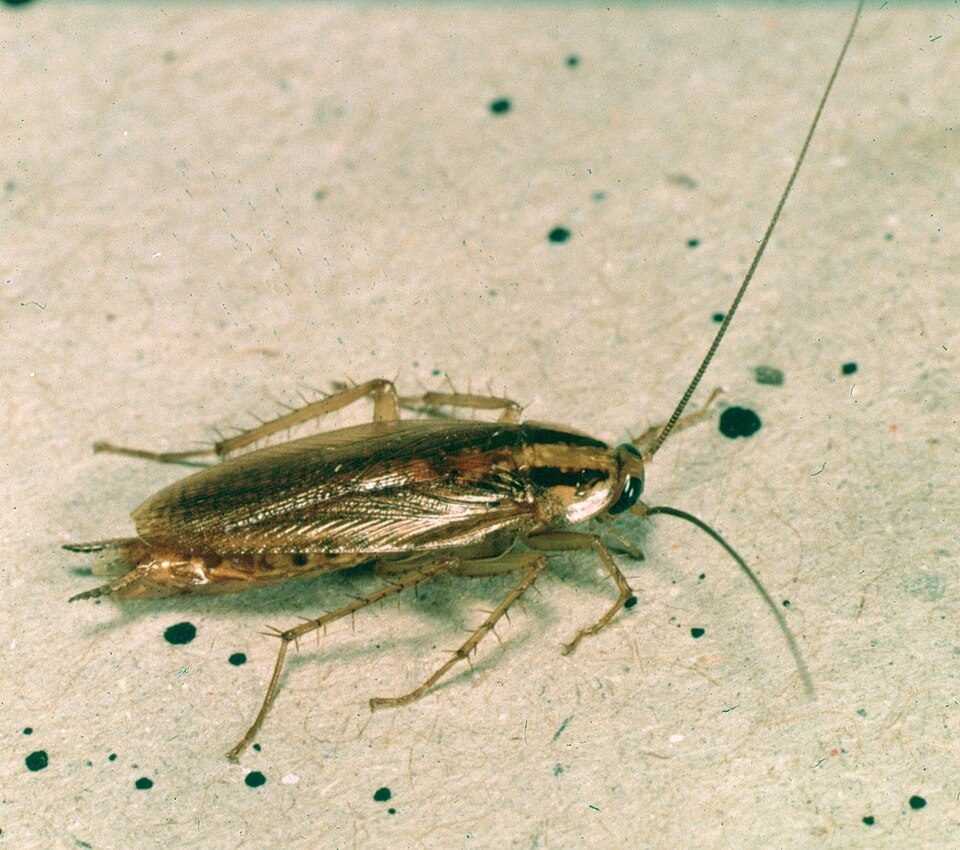
German cockroaches, the usual indoor species, can hide in cracks as narrow as 1/16 inch. According to the University of California IPM program, each egg case holds about 30 young, and a single female and her offspring can produce over 30,000 cockroaches in a year. The program also says sticky traps placed at floor and wall junctions, behind appliances and in cabinets are the best way to monitor, with many cockroaches caught within 24 hours, and that sprays and foggers give only temporary knockdown because they do not reach the cracks where cockroaches hide.

What to do
Health Canada's sanitation steps: clean up spills immediately, do not leave pet food and water out 24 hours a day, keep food in tightly sealed plastic or glass containers rather than paper or cardboard, store garbage in sealed plastic containers and dispose of it daily, and regularly clean dark or damp areas close to food, such as beneath and behind appliances. Baits kill cockroaches about 48 to 96 hours after they eat the active ingredient.
For a do-it-yourself step in cracks and crevices away from food preparation surfaces, diatomaceous earth and boric acid applied lightly are common choices. Boric acid is ingested and attacks the cockroach's nervous system and stomach from the inside, while diatomaceous earth abrades the protective outer shell and dries the cockroach out from the outside. Use products registered in Canada, follow the label and keep them away from children and pets.
The review recommends good hygiene and sanitation together with the application of proper insecticides, and says cockroaches should not be tolerated where food is handled. The sources here do not give a cleanup protocol, so ordinary hygiene applies to anything cockroaches may have touched, and a licensed professional can treat the infestation.
How AstraHive Pest Control gets rid of cockroaches
Cockroaches hide where sprays and traps cannot easily reach, so we open up the places they live and work through eight steps that reach the whole colony.
How an AstraHive cockroaches treatment works
Inspect, pulling out the appliances
We inspect kitchens, bathrooms, appliances, cabinets, wall voids and drains, and look for egg capsules, shed skins and droppings to see how far the problem has spread. We pull out the fridge, stove, dishwasher and the electrical outlet covers, because the colony lives behind the motors and insulation panels, and zones that are not opened up never get treated.
Interior residual spray where they travel
We apply a residual spray, according to the product label, along the interior edges cockroaches travel: baseboards, under sinks and appliances, and along plumbing lines. It stays active for about 90 days, and cockroaches that cross it carry it back to their hiding places and to the cockroaches they touch.
Flush them out
We inject a flushing agent (a ULV treatment where needed) into voids and behind cabinets, applied according to the product label, to force every cockroach hiding there out into the open and through the sprayed areas.
Dust the voids
We inject a pesticide dust into wall voids, electrical outlets, fridge compressor areas and plumbing voids, places the spray and the flushing agent cannot reach. The dust stays active for up to a year.
Gel bait that spreads through the colony
We place a professional gel bait inside cabinet hinges, behind appliances and near moisture and heat sources. Cockroaches eat each other's droppings and dead cockroaches, so the poison in the gel bait passes from one to the next through the whole colony, much like a disease spreading. Where needed we add an insect growth regulator, sometimes as a gel, to stop nymphs maturing into breeding adults.
Document everything
Where we found cockroaches, what we found and every product used goes in the service report, so the next visit shows exactly what changed.
Leave insect monitors
We leave insect monitors in place after treatment so we can track exactly where activity is still showing up.
Follow up in 4 to 6 weeks and back it with a 90-day warranty
We come back 4 to 6 weeks later to check the results, treat again where needed and finish the life cycle. If cockroaches return within 90 days, we re-treat at no charge.
Our products are Health Canada approved and safe for kids and pets, and we apply every product according to its label. AstraHive is licensed by the Ontario Ministry of the Environment, Conservation and Parks. Ontario requires a ministry-approved certification course before it issues an exterminator licence, and that training is delivered through the University of Guelph, Ridgetown Campus.
A real cockroach treatment takes about 1.5 to 3 hours, because the work is behind the appliances and inside the walls. A visit of 20 to 30 minutes cannot reach the colony.
Treatment works best with a change in the home itself: cleaning up food and water sources and storing food in sealed containers. Pest control products alone will not win the fight without those changes.
Typical cost: Starting at $350 CAD, with final cost depending on property size and severity of infestation - there is no fixed upper limit. Call 905-925-8427 for an exact free quote.
Why Choose AstraHive
- Licensed & Insured: Certified by the Ontario Ministry of Environment, Conservation and Parks.
- Fast response: Same-day service available, with a callback within 5 minutes.
- 90-Day Warranty: If pests come back within that window, we re-treat at no additional charge.
- Proven track record: 5.0 stars on Google across 200+ reviews.
- Family & pet safe: Health Canada approved products on every job.
Frequently Asked Questions
Can cockroaches give you food poisoning?
They can contaminate food with bacteria such as Salmonella and E. coli, which Health Canada says they do by walking over and excreting on food or food preparation areas. Carrying bacteria does not mean every exposure causes illness.
Do cockroaches carry Salmonella?
A review of the research lists Salmonella among the pathogens isolated from cockroaches, and an experiment recorded Salmonella in cockroach output for 3 to 20 days.
How do cockroaches spread E. coli?
Bacteria can be carried on the outside of the insect, or ingested and later excreted or regurgitated onto food and surfaces. One study found viable E. coli in cockroach feces for up to 8 days after exposure.
What should I do if I see a cockroach in my kitchen?
Clean up spills and food, seal food and garbage in containers, clean beneath and behind appliances, and discard any exposed food. Health Canada notes baits kill cockroaches 48 to 96 hours after they eat them, and a licensed professional can treat the infestation.
Are cockroaches a health risk besides bacteria?
Yes. Health Canada notes that people with asthma may react to cockroach droppings and body parts.
Sources
- Health Canada: Cockroaches — Cockroaches contaminate food and spread disease by walking over and excreting on food or food preparation areas; people with asthma may react to their droppings and body parts; they are attracted to starches, sugars and protein and to warm, damp kitchens, bathrooms, basements and plumbing areas; prevention steps are to clean up spills immediately, not leave pet food and water out 24 hours a day, keep food in tightly sealed plastic or glass containers, store garbage in sealed plastic containers and dispose of it daily, and regularly clean dark or damp areas near food such as beneath and behind appliances; baits kill the insects about 48 to 96 hours after they eat the active ingredient.
- Ontario.ca: Pesticide licences and permits — Ontario's Ministry of the Environment, Conservation and Parks issues exterminator licences after a ministry-approved certification course, delivered through the University of Guelph, Ridgetown Campus.
- Cockroaches and Food-borne Pathogens, Environmental Health Insights (2020) — About a quarter of the microorganisms isolated from cockroaches are food-borne pathogens, including Salmonella (serovars Typhi and Typhimurium), Escherichia coli O157:H7, Shigella species, Staphylococcus aureus and Bacillus cereus; microorganisms may be carried externally on the cuticle or ingested and later excreted or regurgitated; one experiment recorded Salmonella output of 80 to 20 million cells per defecation over 3 to 20 days and another found viable E. coli in cockroach feces for up to 8 days after exposure; multidrug resistant strains are mentioned; the review recommends good hygiene and sanitation and the application of proper insecticides.
- UC IPM: Cockroaches (University of California Statewide IPM Program) — A German cockroach female carries an egg case for about 30 days and drops it about the time the eggs hatch, each case holds about 30 young and a female may produce a new case every few weeks; one female and her offspring can produce over 30,000 individuals in a year; sprays give a quick temporary knockdown but no long-term control and may repel and disperse cockroaches; baits may take 7 days or longer; when populations are under control keep monitoring with traps to make sure re-infestation is not taking place, and sticky traps are the best way to detect and monitor.
Areas We Serve
AstraHive Pest Control proudly serves 75+ communities across the following regions:
- Toronto: Toronto, North York, Scarborough, Etobicoke, East York, York, Leslieville, Lakeview
- Durham Region: Oshawa, Whitby, Ajax, Pickering, Clarington, Bowmanville, Courtice, Newcastle, Port Perry, Brooklin, Uxbridge, Scugog, Brock, Seaton
- York Region: Vaughan, Markham, Richmond Hill, Aurora, Newmarket, Thornhill, Woodbridge, Kleinburg, Maple, Stouffville, Unionville, Keswick, Holland Landing, East Gwillimbury, Georgina, King City, King Township, Nobleton, Berczy Village, Cathedraltown, Commerce Valley, Cornell, Wismer, Whitchurch-Stouffville, Sutton, Schomberg
- Peel Region: Mississauga, Brampton, Caledon, Malton, Port Credit, Streetsville, Meadowvale, Cooksville, Bolton, Palgrave
- Extended Service Area: Peterborough, Lindsay, Port Hope, Barrie, Bradford, Innisfil, Collingwood, Wasaga Beach, Orillia, Burlington, Oakville, Milton, Hamilton, Grimsby, St. Catharines, Welland, Niagara Falls
Don't see your city listed? Call us — we likely cover it.
Got a pest problem right now?
Call AstraHive for a free consultation. Licensed & insured, serving the GTA, Durham, York, Peel and Simcoe County.
Call 905-925-84275.0 Stars — 200+ Google Reviews | Licensed & Insured | Health Canada Approved