No, peppermint oil does not repel mice in any meaningful, lasting way. Lab studies show mice briefly avoid a concentrated scent placed directly at their nose, but that avoidance fades within hours as the oil evaporates. A hungry mouse with pups to feed will walk straight through it to reach food, warmth, or shelter.


What the Peppermint Oil Studies On Mice Actually Show
It is one of the most common questions about mice, usually from someone who has already tried cotton balls under the sink. The honest answer disappoints people, so let me walk through the actual research instead of just repeating the myth.
Mice rely heavily on smell, and a strong, concentrated scent placed right where their nose is can trigger avoidance. That's a real, documented reaction, not a myth. But the details of how these studies were run matter a lot.
- One patent research report tested wild mice in an olfactometer chamber against a blend containing peppermint oil. The ternary blend of peppermint, cinnamon leaf, and lemongrass had impressive deterrent effects, and mice spent significantly less time in the scented chamber than in the unscented control chamber.
- Notice that result came from a three-oil blend, not peppermint alone, tested in a small, controlled chamber where the mouse had nowhere else to go.
- A separate peer-reviewed study on wild house mice testing essential oil baits found the repellent effects varied depending on mouse gender and how fresh the bait was, with results changing as the oils aged.
That last point is the whole story in one line. The repellent effect isn't stable. It moves depending on freshness, concentration, and the individual mouse, which is a very different thing from "peppermint oil keeps mice out."
Why the Effect Disappears In a Real Home
A lab olfactometer is a sealed box with one scented chamber and one unscented chamber. Your kitchen is not that. It has airflow, multiple rooms, temperature swings, and, most importantly, food.
Three things happen once you take peppermint oil out of a lab and into a house:
- Evaporation. The concentration that caused the reaction in a sealed chamber dissipates within hours in a home with any airflow at all.
- Habituation. Mice adjust to a scent that stays around without consequence, the same pattern we see with ultrasonic repellers, where mice resume normal activity within one to two weeks even with the device running continuously.
- Survival pressure. A mouse that's cold, hungry, and feeding a litter has a stronger drive to reach food than to avoid an unpleasant smell. It will cross a peppermint-soaked cotton ball to get to a food source behind it.
Peppermint oil will make a cabinet smell clean. It will not stop a mouse from entering your house, building a nest in your insulation, or finding your pantry.
If your entry points are still open, peppermint oil is perfuming a highway, not blocking it. The scent fades in hours; the hole in your foundation doesn't.
The Only Thing That Actually Stops Mice: Physically Blocking Entry Points
Health Canada identifies getting rid of easy entry points as the first line of defence, noting that mice can squeeze through cracks as small as a dime while rats need only a quarter-sized hole. That's not a rounding error. That's the actual size gap you're dealing with.
Here's a detail that trips up a lot of homeowners doing this themselves: we only ever seal exterior entry points, never interior ones. If you caulk a gap inside a wall or under a baseboard where mice are already active, you haven't removed the mouse, you've just forced it to chew a new route somewhere else in the same wall void. Sealing has to happen at the building's exterior shell, foundation, utility penetrations, door thresholds, weep holes, where the mouse enters the structure in the first place. Seal there, and there's nowhere left to detour to.
Health Canada is also explicit that baits or poisons should never be used as the only method, and that mouse-proofing combined with sanitation is required to actually get control. That lines up with what we see on every job: bait alone without exclusion just means you're feeding a revolving door of new mice.
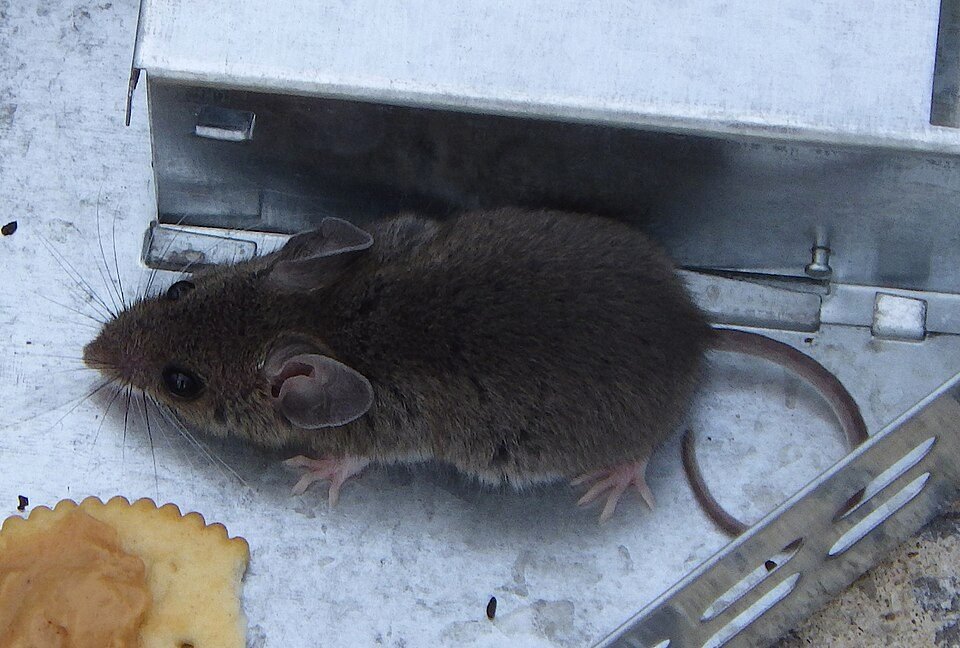

How AstraHive Pest Control gets rid of mice
Mice get in through small gaps, so the lasting fix is at the outer shell of the building. We find the entry points, close them from the outside and deal with the mice already inside.
How an AstraHive mice treatment works
Inspect and find the entry points
We inspect the outside and inside of the building for droppings, gnaw marks, runways and every gap. A single property usually has several entry points, not just the one you noticed.
Seal the exterior entry points
We seal the exterior only: foundation cracks, utility and pipe penetrations, vents, weep holes, rooflines and garage door corners. Gaps are packed with steel wool or copper mesh locked in with sealant or foam, and larger openings get hardware cloth. Foam or caulk alone is not a rodent barrier.
Trap and bait where needed
Mice already inside are removed with traps and with tamper-resistant bait stations, inside and outside where needed, using Health Canada approved products applied according to the product label.
Flag structural damage and report
If we find structural damage that needs repair beyond what we can seal, we flag it in the service report, along with every observation, every entry point found and every product used.
Follow up and back it with a 90-day warranty
We come back to re-inspect, refill the bait stations and make sure everything is holding. If mice return within 90 days, we re-treat at no charge.
Our products are Health Canada approved and safe for kids and pets, and we apply every product according to its label. AstraHive is licensed by the Ontario Ministry of the Environment, Conservation and Parks. Ontario requires a ministry-approved certification course before it issues an exterminator licence, and that training is delivered through the University of Guelph, Ridgetown Campus.
Sealing is what ends repeat visits. Traps and bait only remove the mice that are already inside, and new mice keep coming for as long as an exterior entry point stays open.
Sealing lowers the risk a great deal, but it cannot make a house completely mouse-proof. Mice can chew new ways in through the softer parts of a building, such as the rubber seal on a garage door, weatherstripping, siding, wood trim and the plastic coating on wires, and a house keeps shifting and ageing, so gaps that did not exist on the day of the work can open later. Chewing can also damage the structure itself, including wiring, insulation and framing, and that wear and tear can continue after every entry point we found has been sealed. We record the damage we find so you can arrange repairs, we check at the follow-up visit that the seals are holding, and anything new that opens up afterward is a new entry point rather than a failure of the old work. If you see fresh gnaw marks or droppings, or hear scratching, call us early.
If You Still Want to Use Peppermint Oil Anyway
We're not going to tell you to throw it out. Used correctly, it can make a room smell better and act as a very short-term, minor deterrent in one specific spot. Just don't mistake it for a mouse control plan.
- Fine as: a short-term scent in a drawer or cabinet you want to feel "fresher" while other work gets done.
- Not fine as: your only defense against an active infestation, or a substitute for sealing an entry point you already found.
- If you're seeing droppings, hearing scratching at night, or finding chewed packaging, that's past the point where any scent product will help.
Typical cost: Starting at $300 CAD, with final cost depending on property size and severity of infestation - there is no fixed upper limit. Call 905-925-8427 for an exact free quote.
Why Choose AstraHive
- Licensed & Insured: Certified by the Ontario Ministry of Environment, Conservation and Parks.
- Fast response: Same-day service available, with a callback within 5 minutes.
- 90-Day Warranty: If pests come back within that window, we re-treat at no additional charge.
- Proven track record: 5.0 stars on Google across 200+ reviews.
- Family & pet safe: Health Canada approved products on every job.
Frequently Asked Questions
Does peppermint oil keep mice away permanently?
No. Peppermint oil causes short-term avoidance at best, and that effect fades within hours as the scent evaporates in a normal home with airflow. Mice also habituate to smells that don't carry any real consequence, so even repeated application stops working within days.
Will a mouse really walk through peppermint oil to get food?
Yes. A mouse that's hungry, cold, or feeding a litter has stronger survival pressure than sensory discomfort, so it will cross a peppermint-soaked cotton ball to reach a food source on the other side. This is exactly why scent-based deterrents fail against active infestations.
What actually stops mice from entering a house?
Physically sealing exterior entry points is the proven first step, since mice can fit through a gap as small as a dime. That has to be combined with interior trapping to remove mice already inside, because sealing alone doesn't deal with an existing infestation and traps alone don't stop new mice from getting in.
Should I seal up gaps I find inside my house where I've seen mice?
No, focus on exterior entry points only. Sealing an interior gap where mice are already active just forces them to chew a new route through the same wall void instead of removing them, so exclusion work should always target the building's outer shell, not interior walls or baseboards.
Sources
- Public Health Agency of Canada: Hantavirus, spread, prevention and risks — Hantaviruses are spread by rodents, most often through droppings, urine and saliva; infection can follow breathing in particles stirred up during cleaning; the deer mouse is a carrier in Canada; wear gloves and an N95-level respirator in confined spaces, spray droppings and nesting material with a bleach and water mixture and let it soak for 10 minutes; seal holes with wire screening, steel wool, metal flashing or cement.
- Health Canada — Mice can squeeze through cracks as small as a dime, and baits or poisons should never be used as the only method to control mice; exclusion and sanitation are required.
- Ontario.ca: Pesticide licences and permits — Ontario's Ministry of the Environment, Conservation and Parks issues exterminator licences after a ministry-approved certification course, delivered through the University of Guelph, Ridgetown Campus.
- ScienceDirect (Journal of Stored Products Research) — A peer-reviewed study on wild house mice found the repellent effect of essential oil baits varied by mouse gender and bait freshness rather than remaining stable over time.
- USPTO Patent Filing (Mouse Repellent Research Report) — Laboratory olfactometer testing found a peppermint-containing essential oil blend produced significant short-term avoidance behavior in mice within a controlled chamber.
Areas We Serve
AstraHive Pest Control proudly serves 75+ communities across the following regions:
- Toronto: Toronto, North York, Scarborough, Etobicoke, East York, York, Leslieville, Lakeview
- Durham Region: Oshawa, Whitby, Ajax, Pickering, Clarington, Bowmanville, Courtice, Newcastle, Port Perry, Brooklin, Uxbridge, Scugog, Brock, Seaton
- York Region: Vaughan, Markham, Richmond Hill, Aurora, Newmarket, Thornhill, Woodbridge, Kleinburg, Maple, Stouffville, Unionville, Keswick, Holland Landing, East Gwillimbury, Georgina, King City, King Township, Nobleton, Berczy Village, Cathedraltown, Commerce Valley, Cornell, Wismer, Whitchurch-Stouffville, Sutton, Schomberg
- Peel Region: Mississauga, Brampton, Caledon, Malton, Port Credit, Streetsville, Meadowvale, Cooksville, Bolton, Palgrave
- Extended Service Area: Peterborough, Lindsay, Port Hope, Barrie, Bradford, Innisfil, Collingwood, Wasaga Beach, Orillia, Burlington, Oakville, Milton, Hamilton, Grimsby, St. Catharines, Welland, Niagara Falls
Don't see your city listed? Call us — we likely cover it.
Got a pest problem right now?
Call AstraHive for a free consultation. Licensed & insured, serving the GTA, Durham, York, Peel and Simcoe County.
Call 905-925-84275.0 Stars — 200+ Google Reviews | Licensed & Insured | Health Canada Approved