Vinegar spray will not keep ants out of a house on its own. A vinegar and water mix can wipe away the scent trail a scout ant leaves for other workers, which cuts activity on a counter or sill for a short while, but it never touches the nest, the queen, or the gap ants are using to get indoors.

Does Vinegar Spray Keep Ants Out of a Home?
Ants spotted on a counter or tracking along a windowsill are usually workers following a scent path that leads back outside to food or water. Wiping that path down with vinegar erases the cue those ants are relying on, so the line in that one spot typically falls apart. That is where the benefit stops. The vinegar never reaches the colony, has zero impact on the queen, and does not touch the crack, gap, or weep hole the ants are using to move between the nest and the building.
How Vinegar Disrupts Ant Pheromone Trails
Ant colonies operate almost entirely on scent. Once a scout locates a food or water source, it marks the return route with a chemical signal, and other workers pick that signal up through their antennae and follow the same line. Wiping the trail with a diluted vinegar solution is a known way to scramble that signal for a while, though it was never meant to serve as a permanent solution.
Vinegar's acidity and sharp odor also mean it physically lifts the oily residue off a surface when it is wiped, not just sprayed into the air. That difference matters: a quick mist that sits there does far less than actually scrubbing the area down.
| What it does | How long it lasts | Reaches the nest or queen | |
|---|---|---|---|
| Vinegar and water wipe | Erases the pheromone trail and lifts residue from the spot treated | Hours to a few days | No |
| Spraying visible ants directly | Kills only the ants hit directly on contact | Immediate but very limited | No |
| Bait stations/granular bait | Carried back by workers to feed the nest and queen | Days to weeks for colony activity to drop | Yes |
Using Vinegar Around Doors and Windows for Ant Prevention
A common question is whether wiping a vinegar and water mix along thresholds, window tracks, and baseboards can act as a barrier. It can break up a trail that is actively running through that one spot for a day or two. It cannot stop a fresh trail from forming through that same crack, or through another opening a few inches away, as long as the colony outside keeps sending scouts.
- Combine equal parts white vinegar and water, and wipe it on rather than just misting.
- Target the exact line the ants are following instead of treating the whole room.
- Expect results to hold for a matter of hours up to a couple of days, not weeks.
- Reapply once an area is cleaned again, since both the odor and the residue wear off.
Vinegar is most useful as a cleanup step once food debris has already been cleaned up, not as a barrier that stands on its own.
Does Vinegar Repel Insects for Good, or Just Temporarily?
Vinegar does not hold insects back the way a residual insecticide barrier does. There is no active ingredient left behind that continues deterring ants after it dries. As soon as the smell fades and the surface stops being freshly cleaned, ants still foraging nearby will rebuild a trail, frequently finding a slightly different way in. This is why homeowners often notice vinegar "working for a few days" before ants reappear: the colony outside was untouched the whole time, only the indoor scent marker was wiped away temporarily.
Other DIY Steps That Work Better Alongside Vinegar
Vinegar covers only a small part of an ant prevention routine. These additional measures deal with the food, moisture, and travel routes that keep ants interested in a property in the first place:
- Wipe up crumbs, grease, and spills, and keep food and pet food sealed in containers.
- Rinse recyclables and empty kitchen trash on a regular basis so leftover residue does not draw scouts in.
- Dust dry cracks and crevices lightly with diatomaceous earth, which works by scraping away the ants' outer shell and drying them out.
- Place boric acid sparingly into cracks and crevices as a different approach, since it is ingested and damages the ant's nervous system and stomach from within.
- Keep mulch, soil, and firewood away from the foundation to cut down on nesting spots close to the wall.
When Ant Activity Needs Professional Treatment
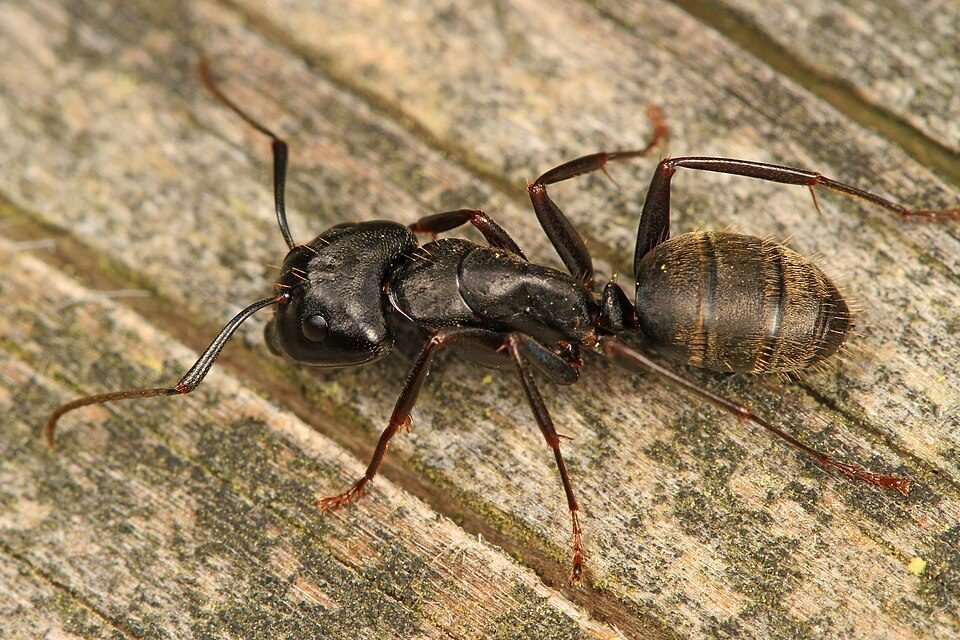
If vinegar and cleaning have not slowed activity after a week or two, or the ants turn out to be carpenter ants (larger bodies, sawdust-like frass near wood), the colony is probably established and large enough that disrupting trails on your own will not reach it. Professional ant treatment typically involves locating active trails and nest sites, applying bait that workers carry back to the colony and queen, and treating the exterior perimeter so activity does not simply pick back up.

How AstraHive Pest Control gets rid of ants
The goal with ants is the queen, not the workers on your counter. We combine bait that workers carry back to the queen with a weatherproof barrier around the outside of the house, and treat the inside when ants are active there.
How an AstraHive ants treatment works
Inspect and follow the trails
We follow the ant trails to find where they come in and where the nest is likely to be, so the bait and the barrier go in the right places.
Granular bait in the yard
We spread professional granular bait across the front and back yard around the nesting areas and colonies, and along the perimeter of the building. Workers carry it back to the queen, the queen dies and the colony collapses.
Liquid bait in bait stations
We set Scorpio liquid bait in bait stations around the exterior perimeter, near the nest and wherever ants are active. Ants feed and carry it back to the nest, and the stations keep working after we leave.
Weatherproof exterior perimeter spray
We spray a barrier around the foundation, windows, doors and entry points, applied according to the product label. It stays active for about 90 days, so ants coming from outside cross the treated zone before they get in.
Interior treatment if needed
If ants are already active inside, we treat the interior as well as the exterior, never the inside alone: a residual spray along the interior perimeter, baseboards and known travel routes, and gel bait along the trails, out of reach of children and pets.
Document everything
Where we found ants, what we found and every product used goes in the service report, along with what to change around the property, such as moisture and wood-to-soil contact.
Back it with a 90-day warranty
If ants come back within 90 days, we re-treat at no charge.
We also dust into the accessible wall voids and cracks where ants travel and nest, with a professional dust that keeps working in places a spray cannot reach. That, together with the bait and the outside barrier, is how we keep ants from coming back, rather than trying to seal every gap, because ants find another way in.
Our products are Health Canada approved and safe for kids and pets, and we apply every product according to its label. AstraHive is licensed by the Ontario Ministry of the Environment, Conservation and Parks. Ontario requires a ministry-approved certification course before it issues an exterminator licence, and that training is delivered through the University of Guelph, Ridgetown Campus.
Bait and the outer barrier are applied in different places on purpose: the bait stays on the routes ants forage along so workers can carry it home, and the barrier sits at the building's edge. That is also why we ask you not to spray the ants you see or wipe their trails before we arrive: killing the workers stops the bait reaching the queen.
Typical cost: Starting at $350 CAD, with final cost depending on property size and severity of infestation - there is no fixed upper limit. Call 905-925-8427 for an exact free quote.
Why Choose AstraHive
- Licensed & Insured: Certified by the Ontario Ministry of Environment, Conservation and Parks.
- Fast response: Same-day service available, with a callback within 5 minutes.
- 90-Day Warranty: If pests come back within that window, we re-treat at no additional charge.
- Proven track record: 5.0 stars on Google across 200+ reviews.
- Family & pet safe: Health Canada approved products on every job.
Frequently Asked Questions
Does vinegar spray keep ants out of the house?
No. Vinegar can temporarily erase the pheromone trail ants are following on a treated surface, but it does not stop new ants from coming in through the crack or gap they are using, and it has no effect on the nest or queen.
Does vinegar repel insects long-term?
Not reliably. Vinegar leaves behind no residual active ingredient, so once the smell fades and the surface is no longer freshly wiped, ants still foraging nearby can rebuild a trail, sometimes through a different entry point.
Is it safe to spray vinegar around doors and windows for ants?
Yes, a diluted vinegar and water mix is generally safe to wipe along door thresholds and window tracks. It can break up an existing trail in that spot briefly, but it will not close the gap ants are using to get inside.
Why do ants come back after I clean with vinegar?
Cleaning clears away food residue and the existing scent trail, but if the colony outside is still active, a scout ant can lay a new trail through the same or a nearby entry point within a short time.
Sources
- Health Canada - Pest Control Tips: Ants — Scout ants leave a scented trail for other workers to follow back to a food source.
- Ontario.ca: Pesticide licences and permits — Ontario's Ministry of the Environment, Conservation and Parks issues exterminator licences after a ministry-approved certification course, delivered through the University of Guelph, Ridgetown Campus.
- University of Minnesota Extension - Ants — A mild vinegar and water solution used to wipe ant trails is described as a way to temporarily disrupt ant activity, not a permanent fix.
- UC Statewide IPM Program - Ants — Cleaning up invading ants with soapy water removes the scent trail they leave behind, and outdoor baits are used to control the colony since pesticide sprays only provide temporary control.
Areas We Serve
AstraHive Pest Control proudly serves 75+ communities across the following regions:
- Toronto: Toronto, North York, Scarborough, Etobicoke, East York, York, Leslieville, Lakeview
- Durham Region: Oshawa, Whitby, Ajax, Pickering, Clarington, Bowmanville, Courtice, Newcastle, Port Perry, Brooklin, Uxbridge, Scugog, Brock, Seaton
- York Region: Vaughan, Markham, Richmond Hill, Aurora, Newmarket, Thornhill, Woodbridge, Kleinburg, Maple, Stouffville, Unionville, Keswick, Holland Landing, East Gwillimbury, Georgina, King City, King Township, Nobleton, Berczy Village, Cathedraltown, Commerce Valley, Cornell, Wismer, Whitchurch-Stouffville, Sutton, Schomberg
- Peel Region: Mississauga, Brampton, Caledon, Malton, Port Credit, Streetsville, Meadowvale, Cooksville, Bolton, Palgrave
- Extended Service Area: Peterborough, Lindsay, Port Hope, Barrie, Bradford, Innisfil, Collingwood, Wasaga Beach, Orillia, Burlington, Oakville, Milton, Hamilton, Grimsby, St. Catharines, Welland, Niagara Falls
Don't see your city listed? Call us — we likely cover it.
Got a pest problem right now?
Call AstraHive for a free consultation. Licensed & insured, serving the GTA, Durham, York, Peel and Simcoe County.
Call 905-925-84275.0 Stars — 200+ Google Reviews | Licensed & Insured | Health Canada Approved