Drain flies are small, fuzzy, dark flies, about 3 mm long, that rest on bathroom and kitchen walls near drains. They breed in the slimy film inside sink, shower and floor drains. They do not bite, but they are a sign of dirty pipes. To get rid of drain flies, scrub the film out of the drain, fix any slow drains and swat or trap the adults.


What drain flies look like
Drain flies, also called moth flies (family Psychodidae), are small, about 3 mm long, with a dark grey body and lighter wings covered in long hairs and scales. The hairs give the whole fly a fuzzy, moth-like look. At rest the wings are held over the back like a little roof, and the wing veins run in parallel, a pattern found only in this group of flies. They are weak flyers that move in short hops, and they usually sit on walls or ceilings until disturbed. If you swat one, it leaves a puff of fine dust.
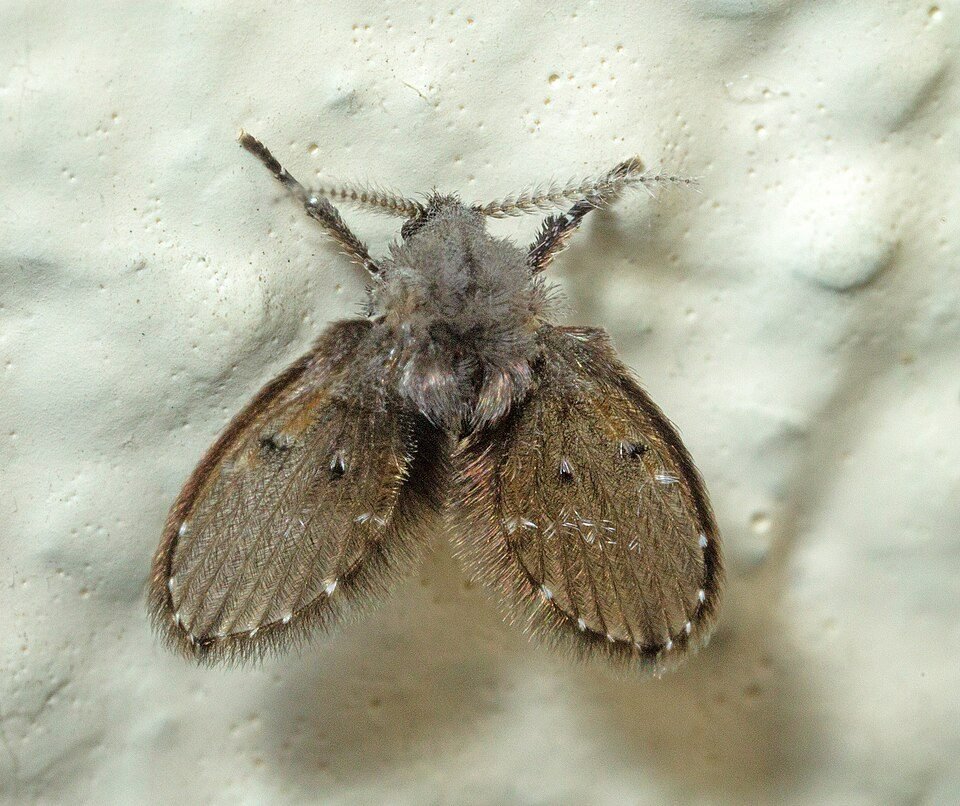

Drain fly vs fruit fly vs fungus gnat
Three tiny flies get confused constantly. Where you see the fly and how it flies are the best clues, and the wings settle the question if you can get close.
| Drain fly (moth fly) | Fruit fly | Fungus gnat | |
|---|---|---|---|
| What it looks like | About 3 mm, dark and fuzzy, with hairy wings held like a roof over the body | Brown to yellowish, about 2 to 3 mm, with red eyes and clear wings | About 3 mm, black to dark, with long legs and antennae and clear wings with a Y-shaped vein |
| Where it breeds | The slimy film inside sink, shower and floor drains, and other wet organic matter | Ripe or rotting fruit, spilled sweet liquids, compost and other moist, fermenting matter | Damp potting soil and other moist growing media |
| Where you see it | Bathrooms, kitchens and basements, near drains | Kitchens, around fruit bowls, bins and compost | Around houseplants, seed trays and worm bins, and at windows and lights |
| How it flies | A weak flyer with short hopping flights; rests on walls | A strong flier that hovers over food | Weak and drawn to light |
| First step | Scrub the film out of the drain and fix slow drains | Remove ripe fruit and food waste, empty bins daily and set a trap | Let the top of the soil dry out and clear debris from the pot |
Drain fly biology and life cycle
Drain flies need moisture, and lots of it. Their larvae can live almost anywhere water sits for a week or more, and they eat the microscopic life and decaying matter in the film on the water. Warm bathrooms and basements are ideal.
Drain fly life cycle
Eggs in the drain film
A female lays her eggs in wet, slimy organic matter, most often the film that coats the inside of a sink, shower or floor drain.
Hatching in about two days
The eggs hatch in roughly 48 hours. The larvae live in the same film, feeding on the decaying organic matter.
Larvae and pupae
Larvae grow to about 6 mm and breathe through a small siphon. They pupate right at the breeding site.
Adults emerge
The whole cycle can take as little as eight days in warm conditions and up to about three weeks when it is cool, so a single unscrubbed drain can supply flies for months.
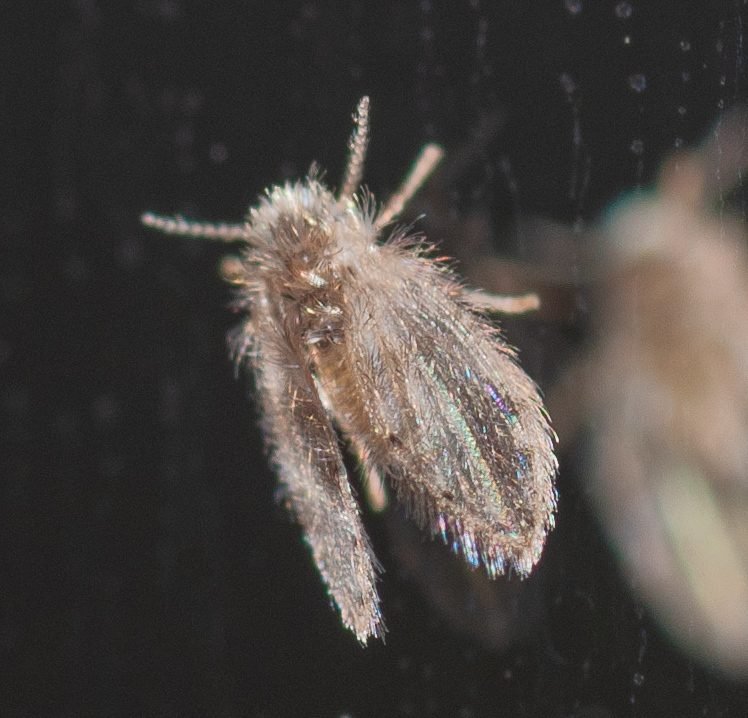

Where drain flies come from
Indoors, the breeding site is nearly always a drain or a wet spot that hardly moves. The usual suspects are the slimy film inside sink and shower drains, floor drains in basements and garages, toilets and toilet tanks that are rarely used, and the drain pan under a refrigerator. Outdoors they also develop in wet manure, sewage and compost. Small numbers usually mean one or two indoor drains, while very large numbers suggest a bigger source such as a wet drain system or a sewage or compost site nearby.
They are often a short-lived problem. After a holiday, water stands in unused drains and traps, and flies appear. They usually vanish soon after normal use resumes and water starts to move through the drains again.
Why drain flies get into your house
They breed inside it. Occasionally adults come in from outdoors, but most of the flies you see were born in your own plumbing. Slow drains, infrequently used fixtures, leaks, and film that has built up over months give them what they need. A gardening expert interviewed by CBC noted that flies also like to lay their eggs in sinks, drains and showers, which is one reason small flies at a sink are worth investigating.
Drain flies in the house: a room-by-room check
Drain flies in the house are easiest to find room by room. In the bathroom, check the shower drain, the tub overflow and the sink, and look inside a toilet that is rarely used. In the kitchen, check the sink drain, the dishwasher drain and the garbage disposal. In the basement and garage, check floor drains, laundry standpipes and the drip pan under any refrigerator or dehumidifier. Wherever flies are resting in numbers on the wall, look within a metre or so for a drain or wet spot.
Signs of a drain fly infestation
- Small, fuzzy flies on the walls or ceiling of the bathroom, kitchen or basement, mainly close to the drains.
- Flies that hop rather than fly, and leave a smear of dust when swatted.
- Slimy film inside the drain, in the overflow or on a rarely used toilet.
- Small, grey, wriggling larvae in standing water in a drip pan or a toilet tank.
- New flies each day even though you keep swatting them.
Are drain flies harmful? Do drain flies bite?
Drain flies do not bite people or animals, and they do not damage buildings or plants. But because they breed in the slime of drains and in sewage, they could carry pathogens, and they can trigger allergies. That is why they are worth dealing with, even if they seem harmless.
Swatting drain flies does not fix a drain fly problem. The flies come from the film in the pipe, so the pipe has to be cleaned.
Common myths about drain flies
- "They are baby moths." They are small flies, and the hairy wings just look moth-like.
- "They are fruit flies." They are not. Fruit flies are tan with red eyes and breed in fruit. Drain flies breed in drains.
- "They come up from the sewer." Usually they breed in the film in your own drain, not in the main sewer.
- "A fly spray will finish them." A spray kills the adults but not the larvae in the pipe, so the flies return.
How to get rid of drain flies yourself
- Find the drain. Place a jar upside down over a drain outlet, or tape a clear plastic bag over the opening of an overflow, and check it after a day or two. The drain that traps flies is the source.
- Scrub the film out. Clean the sink, drain pipe and trap with a stiff brush or a steam cleaner. A drain snake may be needed first to clear a blockage that is slowing the water.
- Run water through unused drains, and flush infrequently used toilets and floor drains so water does not stand.
- Fix leaks and empty drip pans under the refrigerator and other appliances.
- Kill the adults you can see with a swatter, sticky trap or flying-insect spray, but do not rely on that alone.
- Check again in a week or two. If flies keep appearing, there is another breeding site you have not found.
- Do not fill weep holes or vents with sealant, foam or mortar. The wall is hollow, and these openings let moisture and warm air out. Blocking them solid traps moisture in the wall and can lead to mould. Breathable mesh over them keeps pests out while the wall can still breathe.
How AstraHive Pest Control gets rid of drain flies
Drain flies are a source problem, and the source is inside your plumbing. The work is finding which drain is breeding them and cutting the source off.
How an AstraHive drain flies treatment works
Inspect and find the source
We inspect the bathrooms, kitchen, laundry, basement floor drains, toilets and any wet, still spots to find which drains are breeding flies.
Clear the source
We show you which drains, traps and wet spots need cleaning and how to clean them properly, so the larvae lose their breeding film.
Treat inside only when needed
If a large number of drain flies are already flying through the house, we add an interior treatment, applied according to the label. Otherwise, cleaning the source is what solves it.
Back it with a 90-day warranty
If drain flies come back within 90 days, we re-treat at no charge.
Our products are Health Canada approved and safe for kids and pets, and we apply every product according to its label. AstraHive is licensed by the Ontario Ministry of the Environment, Conservation and Parks. Ontario requires a ministry-approved certification course before it issues an exterminator licence, and that training is delivered through the University of Guelph, Ridgetown Campus.
Drain fly control in Ontario: when to call an exterminator
A few flies after a holiday are normal. Call a licensed pest control company when flies keep coming back after you have cleaned the drains, when you cannot tell which drain is the source, when they are in several rooms, or when you run a kitchen or food business.
Why Choose AstraHive
- Licensed & Insured: Certified by the Ontario Ministry of Environment, Conservation and Parks.
- Fast response: Same-day service available, with a callback within 5 minutes.
- 90-Day Warranty: If pests come back within that window, we re-treat at no additional charge.
- Proven track record: 5.0 stars on Google across 200+ reviews.
- Family & pet safe: Health Canada approved products on every job.
Frequently Asked Questions
How do I get rid of drain flies?
Find the drain they are breeding in by covering outlets with a jar or bag, then scrub the slimy film out of the drain, trap and pipe with a stiff brush. Fix slow drains and leaks, run water through unused drains, and swat or trap the adults.
What do drain flies look like?
They are about 3 mm long and dark grey, with fuzzy, hairy wings held like a roof over the body. They fly in short hops and rest on walls near drains.
Do drain flies bite?
No. Drain flies do not bite people or animals, but because they breed in drain slime and sewage they could carry pathogens and trigger allergies.
Are drain flies harmful?
They are mainly a nuisance, and they are a sign of a dirty drain. They do not damage buildings or plants, but they can trigger allergies and could carry germs from drains.
What is the difference between a drain fly and a fruit fly?
Drain flies are dark, fuzzy and moth-like and breed in drain film. Fruit flies are tan with red eyes, hover over food, and breed in ripe or rotting fruit.
Do I need a drain fly exterminator?
Not for a small problem after a holiday. Call one if flies keep returning after you clean the drains, if you cannot find the source, or if you run a food business.
Sources
- CBC News: Those annoying little fruit flies are heading indoors at this time of year (Edmonton, 2023) — Small flies indoors like to lay eggs in sinks, drains and showers; they do not travel far from where they lay eggs.
- Ontario.ca: Pesticide licences and permits — Ontario's Ministry of the Environment, Conservation and Parks issues exterminator licences after a ministry-approved certification course, delivered through the University of Guelph, Ridgetown Campus.
- UC Statewide IPM Program: Moth or Drain Flies — About 1/8 inch, dark, hairy wings held roof-like, parallel wing veins, weak flyers with hopping flights; eggs hatch in about 48 hours; life cycle 8 to 24 days; develop in the slimy organic film in drains; do not bite; may transmit pathogens and trigger allergies; eliminate breeding sites.
- University of Kentucky Entomology: Drain Flies or Moth Flies (ENTFACT 615) — Small, dark-winged, non-biting gnats; wings covered in scales; short hopping flights; develop in standing water; common after a vacation; breeding sites include rarely used toilets, sink and floor drains and refrigerator drip pans; clean thoroughly and remove films.
- Penn State Extension: Moth Flies in the Home — About one-tenth inch, dark gray body, hairy wings; breed in gelatinous organic deposits in drains; maggots mature in about two weeks; clean sinks, drain pipes and traps with a stiff wire brush or steam; find the infested drain with a jar or a bag over the outlet.
Areas We Serve
AstraHive Pest Control proudly serves 75+ communities across the following regions:
- Toronto: Toronto, North York, Scarborough, Etobicoke, East York, York, Leslieville, Lakeview
- Durham Region: Oshawa, Whitby, Ajax, Pickering, Clarington, Bowmanville, Courtice, Newcastle, Port Perry, Brooklin, Uxbridge, Scugog, Brock, Seaton
- York Region: Vaughan, Markham, Richmond Hill, Aurora, Newmarket, Thornhill, Woodbridge, Kleinburg, Maple, Stouffville, Unionville, Keswick, Holland Landing, East Gwillimbury, Georgina, King City, King Township, Nobleton, Berczy Village, Cathedraltown, Commerce Valley, Cornell, Wismer, Whitchurch-Stouffville, Sutton, Schomberg
- Peel Region: Mississauga, Brampton, Caledon, Malton, Port Credit, Streetsville, Meadowvale, Cooksville, Bolton, Palgrave
- Extended Service Area: Peterborough, Lindsay, Port Hope, Barrie, Bradford, Innisfil, Collingwood, Wasaga Beach, Orillia, Burlington, Oakville, Milton, Hamilton, Grimsby, St. Catharines, Welland, Niagara Falls
Don't see your city listed? Call us — we likely cover it.
Got a pest problem right now?
Call AstraHive for a free consultation. Licensed & insured, serving the GTA, Durham, York, Peel and Simcoe County.
Call 905-925-84275.0 Stars — 200+ Google Reviews | Licensed & Insured | Health Canada Approved