The time it takes a mouse to die after bait or a trap varies widely by method. A properly set snap trap ends things in seconds. Anticoagulant bait generally needs 2 to 10 days of repeated feeding before it proves fatal, while bromethalin products like Tomcat usually finish within 1 to 4 days.


How Long Does It Take for a Mouse to Die in a Snap Trap?
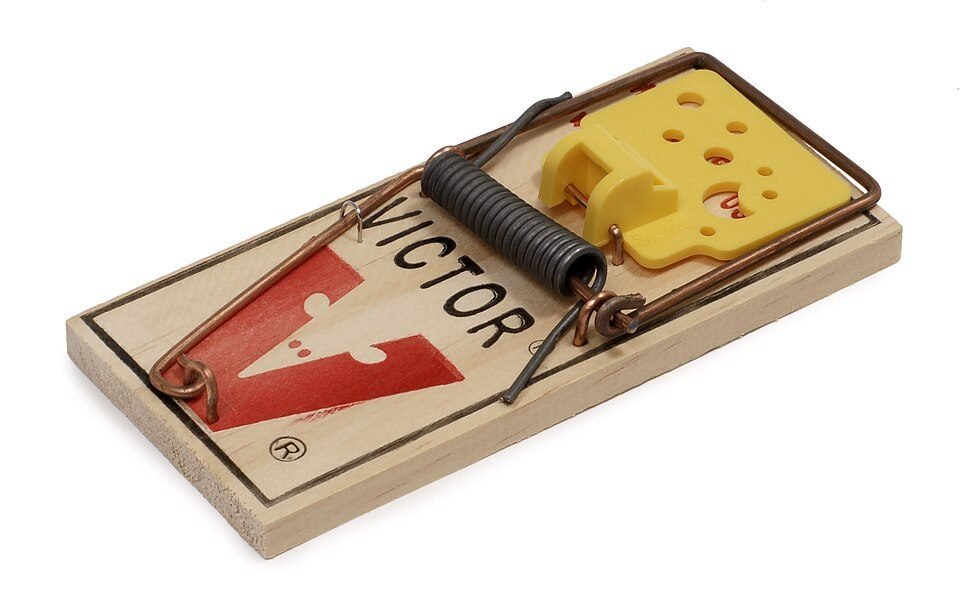
A snap trap that is baited and set correctly kills within seconds. The striking force is enough to cause instant death, which is why this method carries the lowest risk of odour problems or animal suffering: the mouse never gets the chance to crawl away and die somewhere out of sight.
Bait placement affects success more than most people assume. A small, pea-sized smear of peanut butter pushed right onto the trigger works better than a heaping scoop, since the sticky texture and scent force the mouse to work the trigger loose rather than nibble safely from the edges. Peanut butter also holds its texture longer than Nutella, making it the stronger first choice, with Nutella as a workable substitute.
How Long Does It Take for a Mouse to Die After Eating Bait?
Nearly all rodent baits sold in Canada, whether store-bought packets or the professional blocks used in bait stations, belong to a handful of chemical classes, and that class is what sets the timeline. Anticoagulants are the most widely used type. They interfere with the body's ability to reuse vitamin K, a nutrient needed to activate clotting, so death comes from internal bleeding rather than an immediate toxic reaction.
After a mouse begins eating anticoagulant bait, death typically follows within 2 to 10 days. This isn't a shortcoming of the product; it's the reason the bait can take out an entire group of mice instead of just the one that found it first.
One sign worth watching for: if mice keep eating the bait, or ignore it altogether, and activity hasn't dropped after two to three weeks of steady feeding, that usually signals warfarin resistance in the local population. At that point, switching active ingredients or control methods becomes necessary.
| Typical Time to Death | How It Works | Odour or Welfare Note | |
|---|---|---|---|
| Snap trap | Seconds | Mechanical strike | Lowest odour and welfare risk; death is immediate |
| Anticoagulant bait | 2 to 10 days after feeding begins | Blocks vitamin K recycling, causing internal bleeding | Delay allows multiple mice to feed before any die |
| Bromethalin bait (Tomcat, Fastrac) | 1 to 4 days, often a single feeding | Neurotoxin that stops nerve cells producing energy | No antidote exists; supportive veterinary care only |
| Cholecalciferol bait (some Decon formulations) | Several days | Vitamin D3 overdose raises blood calcium until organs fail | Check the label; formulations vary by product |
| Glue trap | Unpredictable, can be prolonged | Physical adhesive restraint, not a kill method | Considered inhumane; live handling risks Salmonella or leptospirosis |
How Long Does It Take for Mice to Die After Eating Tomcat Bait?
Tomcat's mouse bait relies on bromethalin, a nerve toxin rather than a blood thinner, formulated at a 0.01 percent concentration. Instead of triggering bleeding, bromethalin interrupts energy production in nerve cells, which causes those cells to swell. The swelling puts pressure on the brain and eventually leads to paralysis and death.
Bromethalin is built to work after a single feeding in most cases. Product labeling indicates that one adequate meal can deliver a fatal dose, with the first deaths showing up roughly one to two days afterward, and full mortality occurring anywhere from 12 hours to 4 days after ingestion. Unlike anticoagulant baits, which can be reversed with vitamin K1, bromethalin poisoning has no antidote; veterinary care can only offer supportive treatment.
How Long Does It Take for a Mouse to Die After Eating Decon?
Decon brand products have switched active ingredients multiple times over the years, so the real answer depends on which version is currently on the shelf. Some formulations use cholecalciferol, which is simply vitamin D3 given at a toxic level. It raises blood calcium to dangerous levels until organs fail, and Health Canada classifies it separately from anticoagulants, much like bromethalin. Other Decon products instead contain bromethalin or a standard anticoagulant.
Since the mechanism shifts by formulation, checking the active ingredient printed on the packaging is far more reliable than assuming the brand name tells the whole story. One thing stays constant across all of them: none cause death within minutes, and each requires at least one feeding before the toxic effect sets in over the following days.
What Happens After a Mouse Eats Bait: A Rough Timeline
Hours 0 to 24: Feeding Continues
The mouse eats the bait and, since the effects are delayed, carries on feeding and moving as usual with no outward sign of trouble.
Day 1 to 2: Bromethalin Cases Begin to Show
For single-feed neurotoxin baits like Tomcat, the earliest affected mice may already be weakening or dying in this window.
Day 2 to 10: Anticoagulant Cases Finish
Mice that fed on anticoagulant bait die during this stretch as internal bleeding progresses, typically retreating into a wall void or insulation beforehand.
Week 1 to 3 After Death: Drying Out
Given its small body size, a dead mouse dries out quickly, with any odour fading within roughly one to three weeks.
Why Mouse Bait Is Designed to Work Slowly, Not Fast
A slow kill is intentional engineering, not an accident. If mice got sick or died within minutes of eating bait, the rest of the colony would quickly associate that food with danger and avoid it, a response known as bait shyness. Because the toxic effect builds gradually instead, mice keep returning to feed normally, allowing a single tamper-resistant bait station in the right location to eliminate several mice sharing the same wall void over one to two weeks.
It also helps to clear up a common misconception: mice don't carry bait back to share with nestmates. Every mouse that dies from poison has to have eaten the bait itself.
What Happens to a Mouse Between Feeding and Death
Contrary to popular belief, a mouse that has consumed a lethal dose doesn't go looking for water outdoors. It usually burrows deeper into whatever space already feels secure, a wall cavity, an attic corner, behind insulation, growing progressively weaker over the following days until death occurs.
Since a house mouse weighs only around 15 to 30 grams, with an average adult around 15 grams and roughly 8 cm long, a mouse that dies inside a wall dries out fast rather than decomposing over a long stretch. One dead mouse usually produces minimal or no smell, and whatever odour does appear typically clears up within one to three weeks as the body dries. An odour that persists well beyond that window usually means more than one mouse died, or that a rat rather than a mouse is involved.
Why "How Long" Has No Good Answer for Glue Traps
Glue traps need to be addressed separately, because unlike every method above, there's no reliable timeline attached to them. The Canadian Veterinary Medical Association rejects glue traps as a humane option, since a trapped mouse can remain alive and in distress on the board for an extended period rather than dying quickly. Consumer glue boards also lose their grip once dust accumulates, requiring replacement every two to three weeks in dusty spaces, and a larger adult mouse can sometimes break free entirely.
There's also a direct health concern tied to this method: removing a live, struggling mouse from the board increases exposure risk to Salmonella or leptospirosis. Snap traps and well-maintained bait stations sidestep this issue entirely, since neither requires handling a living animal.
Why Waiting It Out Doesn't End a Mouse Problem
Regardless of how quickly or slowly bait and traps work, they only deal with the mice already present inside the structure at the time they're deployed. A mouse can squeeze through an opening as narrow as 6 to 7 mm, roughly the width of a pencil or a dime, because its skeleton is flexible everywhere except the skull. Health Canada specifically flags dime-sized gaps as entry points, which is why cracks around pipes, foundations and utility lines matter so much in Ontario's attached and semi-detached homes.
If those entry points are never located and sealed with chew-resistant material, new mice will simply move in through the same openings once the original group is gone. That's why homeowners sometimes feel like "the same" mouse problem has returned weeks or months after bait was set out. The most reliable approach combines sealing entry points with mechanical traps and properly placed bait stations, rather than depending on one method alone.
If a mouse appears to disappear after bait is placed, avoid the temptation to search behind walls for it. A single mouse typically dries out with little to no odour within one to three weeks, and disturbing the area only raises the risk of contact with droppings or urine.

How AstraHive Pest Control gets rid of mice
Mice get in through small gaps, so the lasting fix is at the outer shell of the building. We find the entry points, close them from the outside and deal with the mice already inside.
How an AstraHive mice treatment works
Inspect and find the entry points
We inspect the outside and inside of the building for droppings, gnaw marks, runways and every gap. A single property usually has several entry points, not just the one you noticed.
Seal the exterior entry points
We seal the exterior only: foundation cracks, utility and pipe penetrations, vents, weep holes, rooflines and garage door corners. Gaps are packed with steel wool or copper mesh locked in with sealant or foam, and larger openings get hardware cloth. Foam or caulk alone is not a rodent barrier.
Trap and bait where needed
Mice already inside are removed with traps and with tamper-resistant bait stations, inside and outside where needed, using Health Canada approved products applied according to the product label.
Follow up and back it with a 90-day warranty
We return 4 to 6 weeks later to check that the seals are holding and that activity has stopped, and to refill or move the bait stations. If mice return within 90 days, we re-treat at no charge.
Our products are Health Canada approved and safe for kids and pets, and we apply every product according to its label. AstraHive is licensed by the Ontario Ministry of the Environment, Conservation and Parks. Ontario requires a ministry-approved certification course before it issues an exterminator licence, and that training is delivered through the University of Guelph, Ridgetown Campus.
Sealing is what ends repeat visits. Traps and bait only remove the mice that are already inside, and new mice keep coming for as long as an exterior entry point stays open.
Sealing lowers the risk a great deal, but it cannot make a house completely mouse-proof. Mice can chew new ways in through the softer parts of a building, such as the rubber seal on a garage door, weatherstripping, siding, wood trim and the plastic coating on wires, and a house keeps shifting and ageing, so gaps that did not exist on the day of the work can open later. Chewing can also damage the structure itself, including wiring, insulation and framing, and that wear and tear can continue after every entry point we found has been sealed. We record the damage we find so you can arrange repairs, we check at the follow-up visit that the seals are holding, and anything new that opens up afterward is a new entry point rather than a failure of the old work. If you see fresh gnaw marks or droppings, or hear scratching, call us early.
Typical cost: Starting at $300 CAD, with final cost depending on property size and severity of infestation - there is no fixed upper limit. Call 905-925-8427 for an exact free quote.
Why Choose AstraHive
- Licensed & Insured: Certified by the Ontario Ministry of Environment, Conservation and Parks.
- Fast response: Same-day service available, with a callback within 5 minutes.
- 90-Day Warranty: If pests come back within that window, we re-treat at no additional charge.
- Proven track record: 5.0 stars on Google across 200+ reviews.
- Family & pet safe: Health Canada approved products on every job.
Frequently Asked Questions
How long does it take for a mouse to die?
It depends entirely on the method. A snap trap kills in seconds, anticoagulant bait takes roughly 2 to 10 days of feeding, and bromethalin bait such as Tomcat typically takes 1 to 4 days. Glue traps have no predictable timeline and can leave a mouse alive for an extended period.
How long does it take for mice to die after eating Tomcat bait?
Tomcat's mouse bait uses bromethalin, a neurotoxin that can deliver a lethal dose in a single feeding. Manufacturer label language describes first deaths appearing one to two days after feeding, with death occurring anywhere from about 12 hours to 4 days depending on the dose consumed.
How long does it take for a mouse to die after eating Decon?
It depends on the specific formulation, since Decon branded products have used different active ingredients over time, including cholecalciferol (vitamin D3), bromethalin and anticoagulants. Checking the active ingredient on the package is the only reliable way to know which multi-day timeline applies.
Why do mice keep showing activity for weeks after bait is put down?
Anticoagulant and bromethalin baits are designed to act over days rather than minutes, so different mice in the same area may feed and die on a staggered schedule. If activity has not dropped after two to three weeks of consistent feeding, it may signal bait resistance rather than a timing issue.
Will I smell a dead mouse after bait works?
Usually not much. A single dead mouse weighs only about 15 to 30 grams, so it dries out quickly and produces little or no odour, with any smell fading within one to three weeks. A smell that lasts much longer than that points to several dead mice or a rat rather than one mouse.
Sources
- Public Health Agency of Canada: Hantavirus, spread, prevention and risks — Hantaviruses are spread by rodents, most often through droppings, urine and saliva; infection can follow breathing in particles stirred up during cleaning; the deer mouse is a carrier in Canada; wear gloves and an N95-level respirator in confined spaces, spray droppings and nesting material with a bleach and water mixture and let it soak for 10 minutes; seal holes with wire screening, steel wool, metal flashing or cement.
- Health Canada: Rats and mice (Pest control tips) — Mice can squeeze through cracks as small as a dime, and poisoned baits must be used inside a tamper-proof bait box.
- MyHealth Alberta — An adult house mouse weighs about 15 grams and is around 8 cm long.
- HealthLink BC — Poisoned rodents can crawl away and die out of sight, and traps are considered the best general method.
- Ontario.ca: Pesticide licences and permits — Ontario's Ministry of the Environment, Conservation and Parks issues exterminator licences after a ministry-approved certification course, delivered through the University of Guelph, Ridgetown Campus.
- National Pesticide Information Center: Rodenticides Fact Sheet — Bromethalin stops nerve cells from producing energy, causing swelling, paralysis and death.
- Pest Control Technology: The Return of Bromethalin — Bromethalin label language states first dead rodents appear one to two days after a single feeding, with death occurring from 12 hours to 4 days after a lethal dose.
Areas We Serve
AstraHive Pest Control proudly serves 75+ communities across the following regions:
- Toronto: Toronto, North York, Scarborough, Etobicoke, East York, York, Leslieville, Lakeview
- Durham Region: Oshawa, Whitby, Ajax, Pickering, Clarington, Bowmanville, Courtice, Newcastle, Port Perry, Brooklin, Uxbridge, Scugog, Brock, Seaton
- York Region: Vaughan, Markham, Richmond Hill, Aurora, Newmarket, Thornhill, Woodbridge, Kleinburg, Maple, Stouffville, Unionville, Keswick, Holland Landing, East Gwillimbury, Georgina, King City, King Township, Nobleton, Berczy Village, Cathedraltown, Commerce Valley, Cornell, Wismer, Whitchurch-Stouffville, Sutton, Schomberg
- Peel Region: Mississauga, Brampton, Caledon, Malton, Port Credit, Streetsville, Meadowvale, Cooksville, Bolton, Palgrave
- Extended Service Area: Peterborough, Lindsay, Port Hope, Barrie, Bradford, Innisfil, Collingwood, Wasaga Beach, Orillia, Burlington, Oakville, Milton, Hamilton, Grimsby, St. Catharines, Welland, Niagara Falls
Don't see your city listed? Call us — we likely cover it.
Got a pest problem right now?
Call AstraHive for a free consultation. Licensed & insured, serving the GTA, Durham, York, Peel and Simcoe County.
Call 905-925-84275.0 Stars — 200+ Google Reviews | Licensed & Insured | Health Canada Approved