Pantry moths are small moths, about 12 mm long, with two-toned brown wings, that breed in dry food such as flour, cereal, nuts and pet food. They do not bite or spread disease, but the larvae contaminate food with webbing and droppings. To get rid of pantry moths, find and remove every infested item, then store food in hard containers.

What pantry moths look like
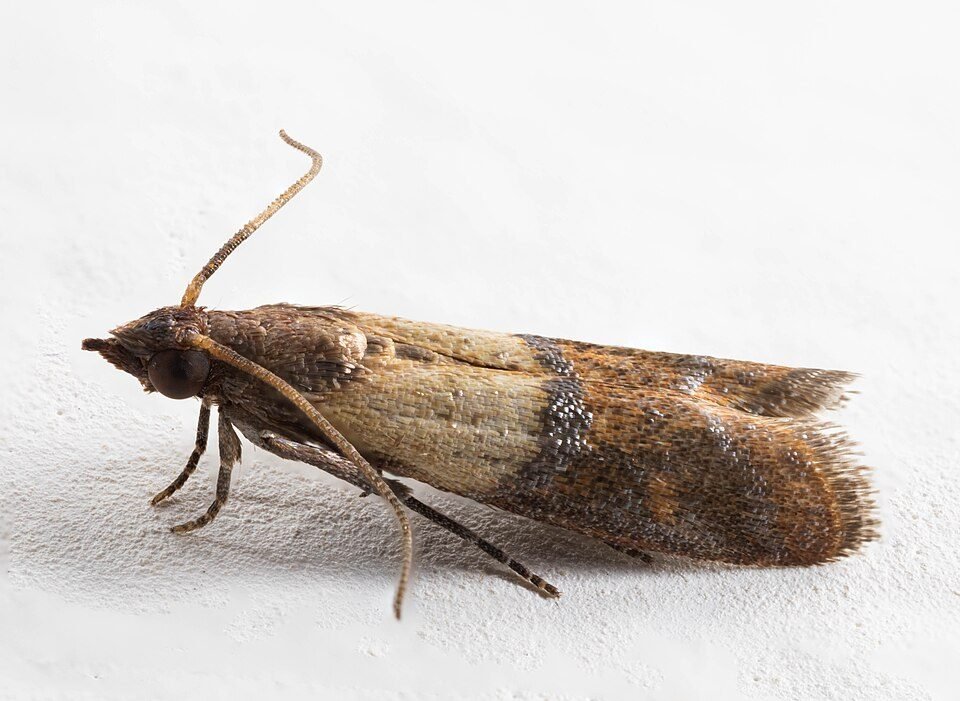
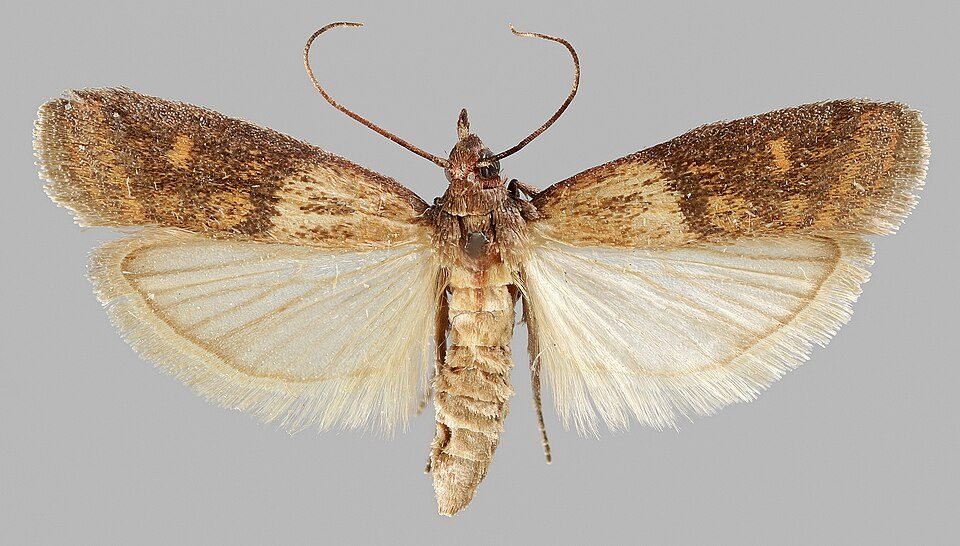
The moth most people call a pantry moth is the Indian meal moth (Plodia interpunctella), also written Indianmeal moth. An adult is about 12 mm long, and with its wings spread it measures about 1.6 to 1.9 cm across. Each wing has a pale grey or tan band near the body and a broad, dark, coppery-brown band toward the tip.
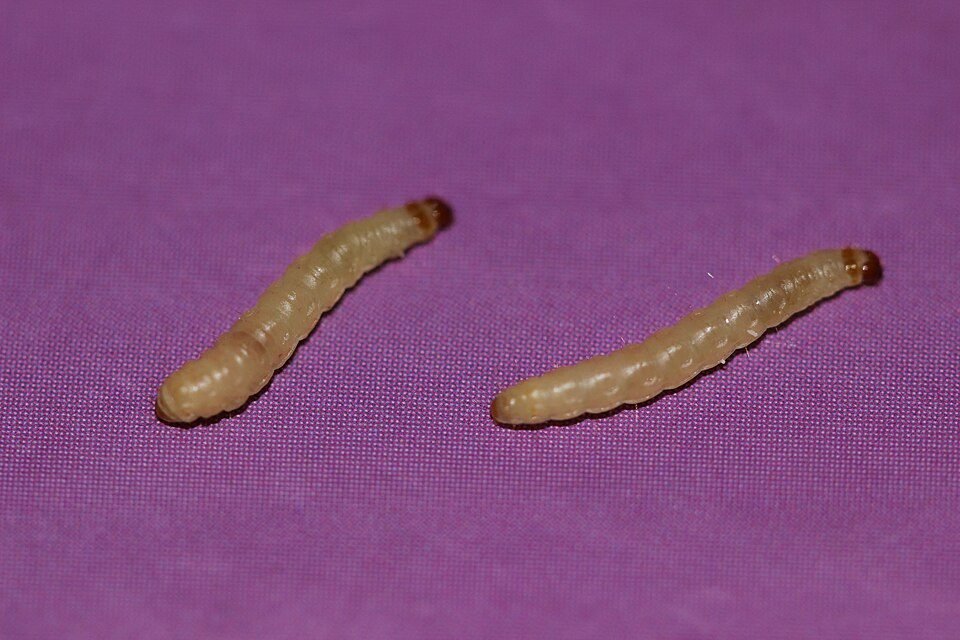
The caterpillars are more likely to be what you notice first. They are creamy white with a distinct head, grow to about 12 to 15 mm, and leave silken webbing in the food they infest.

Pantry moth vs clothes moth and grain moth
Several small moths turn up in Ontario homes, and they are easy to confuse. Size, wing pattern and where you find them sort them out. Pantry moths fly around the kitchen, clothes moths hide in closets and grain moths stay near stored grain.
| Pantry moth (Indian meal moth) | Clothes moth | Angoumois grain moth | |
|---|---|---|---|
| Size | About 12 mm long, roughly 1.6 to 1.9 cm across the wings | About 7 to 8 mm long | About 8.5 mm long |
| Look | Two-toned wings: a pale grey or tan band near the body and a dark coppery-brown band toward the tip | Golden buff, with a fringe of long hairs on the wings and a reddish tuft on the head | Small, yellowish brown, with fringed rear wing edges |
| What it infests | Dry food: grains, flour, cereal, nuts, dried fruit, pet food, pasta | Wool, fur, feathers and other animal fibres | Whole grains, where the larva develops inside the kernel |
| Where you see it | Fluttering around kitchens and pantries; larvae wander up walls | In dark, undisturbed places such as closets | Around stored grain |
Pantry moth biology and life cycle
Pantry moths go through egg, larva, pupa and adult. The larva is the only stage that feeds, and it does all of its damage inside your food. Larval development can be quick in a warm kitchen and very slow in a cold one, so an infestation can hide for months.
Pantry moth (Indian meal moth) life cycle
Eggs on the food
A female lays 100 to 400 eggs on or near the food she has chosen, often a bag of grain, pet food, nuts or dried fruit.
Larvae feed under webbing
The creamy white larvae settle into crevices in the food and spin a cover of webbing. They feed for anywhere from about two weeks to more than nine months, depending on temperature and food supply.
Larvae wander to pupate
When they are about 12 mm long, the larvae leave the food to find a place to pupate. This is when you find them crawling on walls or in the corners where walls meet the ceiling.
Adult moths emerge
New moths flutter around the kitchen and pantry, mate, and lay eggs in the next package. One forgotten bag can restart the cycle.

Where pantry moths come from
Almost every pantry moth problem starts in a shopping bag. The eggs or larvae come home in dry goods from the grocery store, in pet food and in birdseed. Once indoors, larvae can enter other packages through small gaps in the packaging, and a damaged package that arrives already infested introduces the pest to the pantry. Even a small amount of spilled food can support a population.
They eat almost any dry food: grains and grain products, pasta, crackers, cookies, nuts, seeds, dried fruit, powdered milk, chocolate and dry pet food.
Pantry moths in the house beyond the pantry
When moths keep returning after a clean-out, the source is usually an item people forget. Dry pet food and birdseed are the classic culprits, followed by nuts, dried fruit and pasta at the back of a cupboard. Pantry moths in the house can also start in a bag of flour that was opened and left, and adults will fly into other rooms even though the eggs are laid near the food. Check anything dry that has sat for months, and treat every package as a suspect until you have looked inside it.
Signs of a pantry moth infestation
- Small moths fluttering around the kitchen or wherever the food is stored.
- Silky webbing or clumped food in bags of flour, grains, cereal or pet food.
- Creamy white larvae in packages or crawling on shelves and walls.
- Larvae or silken cocoons in the corners where walls meet the ceiling.
- Small holes in packaging.
Are pantry moths harmful?
Pantry moths are a contamination problem, not a health hazard. They foul food with droppings, shed skins and webbing, and in most cases they do not change the flavour, but the food is unappealing once you find them. Pantry moths are not known to transmit any human pathogens.
Do not use insecticide sprays in the pantry, in cupboards or on food. Removing the infested food and cleaning the shelves is what solves the problem.
Common myths about pantry moths
- "They are eating my clothes." They are not. Pantry moths feed on food. Clothes moths are a different, smaller insect that eats wool and fur.
- "One or two moths do not matter." Even a small amount of food can support a population, and one female lays hundreds of eggs.
- "A pheromone trap will get rid of them." Traps help you find the problem and catch some adults, but they will not clear an infestation on their own.
- "Spraying the pantry will finish them." Pest guides advise against it, because insecticide in a kitchen is unsafe near food and it does not remove the infested items that are feeding the moths.
How to get rid of pantry moths yourself
- Identify the pest first. Confirm that they are food moths before you begin.
- Empty the shelves and check every package, including pet food, birdseed, spices, nuts and dried fruit. Throw out anything with webbing or larvae.
- Freeze what you want to keep. Keeping a suspect item in the freezer for more than two days kills every stage.
- Vacuum shelves, cracks and corners, including the wall and ceiling edges where larvae go to pupate, and empty the vacuum outdoors.
- Store food in hard plastic or glass containers, not plastic bags, and use it up every two months or so.
- Buy undamaged packages and check them before you put them away.
- Use pheromone traps to monitor. They show where the moths are and whether there is more than one source.
How AstraHive Pest Control gets rid of pantry moths
Pantry moths are a source problem, and the source is inside your food. Pest guides advise against spraying in kitchens and pantries, so the work is about finding every source and cutting it off.
How an AstraHive pantry moths treatment works
Inspect and find the source
We inspect the pantry, cupboards, pet food, birdseed and every place food is stored, and check corners and crevices where larvae go to pupate. There can be more than one infested item.
Remove the source and change how food is stored
We help you identify and discard the infested items, and set up storage in sealed containers so the moths cannot start again.
Treat inside only when needed
If a large number of larvae have left the food and are in the cracks and crevices around the room, we add an interior treatment, applied according to the label and kept away from food and food-preparation surfaces.
Back it with a 90-day warranty
If pantry moths come back within 90 days, we re-treat at no charge.
Our products are Health Canada approved and safe for kids and pets, and we apply every product according to its label. AstraHive is licensed by the Ontario Ministry of the Environment, Conservation and Parks. Ontario requires a ministry-approved certification course before it issues an exterminator licence, and that training is delivered through the University of Guelph, Ridgetown Campus.
How long it takes to clear pantry moths
Expect it to take a few weeks. Larvae can develop anywhere from about two weeks to more than nine months depending on how warm the room is and what they are eating, so moths can keep emerging after you have thrown out the infested food. A pheromone trap left in place is the easiest way to tell when the last ones are gone. If new moths are still appearing after several weeks and you have checked every package, there is another source you have not found.
Pantry moth control in Ontario: when to call an exterminator
Most pantry moth problems clear up with a thorough clean-out and better storage. It is worth calling a licensed pest control company when the moths keep coming back after a clean-out, when larvae are turning up in several rooms, when you cannot find the source, or in a food business where any sighting needs a quick response.
Why Choose AstraHive
- Licensed & Insured: Certified by the Ontario Ministry of Environment, Conservation and Parks.
- Fast response: Same-day service available, with a callback within 5 minutes.
- 90-Day Warranty: If pests come back within that window, we re-treat at no additional charge.
- Proven track record: 5.0 stars on Google across 200+ reviews.
- Family & pet safe: Health Canada approved products on every job.
Frequently Asked Questions
How do I get rid of pantry moths?
Empty the shelves, inspect every package, and throw out anything with webbing or larvae. Freeze items you want to keep for more than two days, vacuum shelves and corners, and store dry food in hard plastic or glass containers. Do not spray insecticide in the pantry or on food.
Where do pantry moths come from?
They usually come home in dry goods from the grocery store, in pet food or in birdseed. Once inside, larvae can get into other packages through small openings in the packaging.
What do pantry moths look like?
Adults are about 12 mm long with two-toned wings: a pale grey or tan band near the body and a dark coppery-brown band toward the tip. The larvae are creamy white with a distinct head and leave webbing in the food.
Are pantry moths harmful?
They are not known to transmit pathogens, and they usually do not change the flavour of food. They contaminate it with webbing, droppings and shed skins, so infested food should be thrown out.
What is the difference between pantry moths and clothes moths?
Pantry moths are larger, about 12 mm, with two-toned wings, and they breed in dry food. Clothes moths are smaller, golden buff with fringed wings, and their larvae eat wool, fur and feathers.
Do I need a pantry moth exterminator?
Not for a small problem. A full clean-out and sealed storage usually solve it. Call a pest control company if the moths keep returning, if they are in several rooms, or if you cannot find the source.
Sources
- Government of British Columbia: Home and Garden Pest Management Guide, Insects Around the Home (grain and flour moths) — Flour moths infest dry pet food, nuts, seeds, dried fruit, pasta and grains; adults about 16 mm across the wings with a dark coppery band on a white-grey background; larvae cream-coloured, 12 to 15 mm; webbing in food; store in hard plastic or glass, freeze infested material for over two days, use food up every two months, discard infested material, pheromone traps, no insecticides in the kitchen or pantry.
- Ontario.ca: Pesticide licences and permits — Ontario's Ministry of the Environment, Conservation and Parks issues exterminator licences after a ministry-approved certification course, delivered through the University of Guelph, Ridgetown Campus.
- Cornell Integrated Pest Management: Pantry Moths — Adults 12 to 13 mm; females lay 100 to 400 eggs; larvae feed 13 to 288 days depending on temperature and food; larvae leave food to pupate at wall-ceiling junctions; brought home in groceries, pet food and birdseed; not known to transmit pathogens; traps alone will not eliminate; pesticide sprays should not be used in the pantry.
- Penn State Extension: Clothes Moth — Webbing clothes moth adults about 7 to 8 mm, golden buff with a fringe of long hairs and a reddish tuft on the head.
Areas We Serve
AstraHive Pest Control proudly serves 75+ communities across the following regions:
- Toronto: Toronto, North York, Scarborough, Etobicoke, East York, York, Leslieville, Lakeview
- Durham Region: Oshawa, Whitby, Ajax, Pickering, Clarington, Bowmanville, Courtice, Newcastle, Port Perry, Brooklin, Uxbridge, Scugog, Brock, Seaton
- York Region: Vaughan, Markham, Richmond Hill, Aurora, Newmarket, Thornhill, Woodbridge, Kleinburg, Maple, Stouffville, Unionville, Keswick, Holland Landing, East Gwillimbury, Georgina, King City, King Township, Nobleton, Berczy Village, Cathedraltown, Commerce Valley, Cornell, Wismer, Whitchurch-Stouffville, Sutton, Schomberg
- Peel Region: Mississauga, Brampton, Caledon, Malton, Port Credit, Streetsville, Meadowvale, Cooksville, Bolton, Palgrave
- Extended Service Area: Peterborough, Lindsay, Port Hope, Barrie, Bradford, Innisfil, Collingwood, Wasaga Beach, Orillia, Burlington, Oakville, Milton, Hamilton, Grimsby, St. Catharines, Welland, Niagara Falls
Don't see your city listed? Call us — we likely cover it.
Got a pest problem right now?
Call AstraHive for a free consultation. Licensed & insured, serving the GTA, Durham, York, Peel and Simcoe County.
Call 905-925-84275.0 Stars — 200+ Google Reviews | Licensed & Insured | Health Canada Approved