Powderpost beetles are small brown beetles, under 6 mm long, whose grubs tunnel through dried hardwood and leave fine, flour-like powder and tiny round exit holes. They are a wood problem, not a health problem, but they can quietly wreck furniture, floors and beams. To get rid of powderpost beetles, confirm the infestation is active, then replace, seal or fumigate the wood.
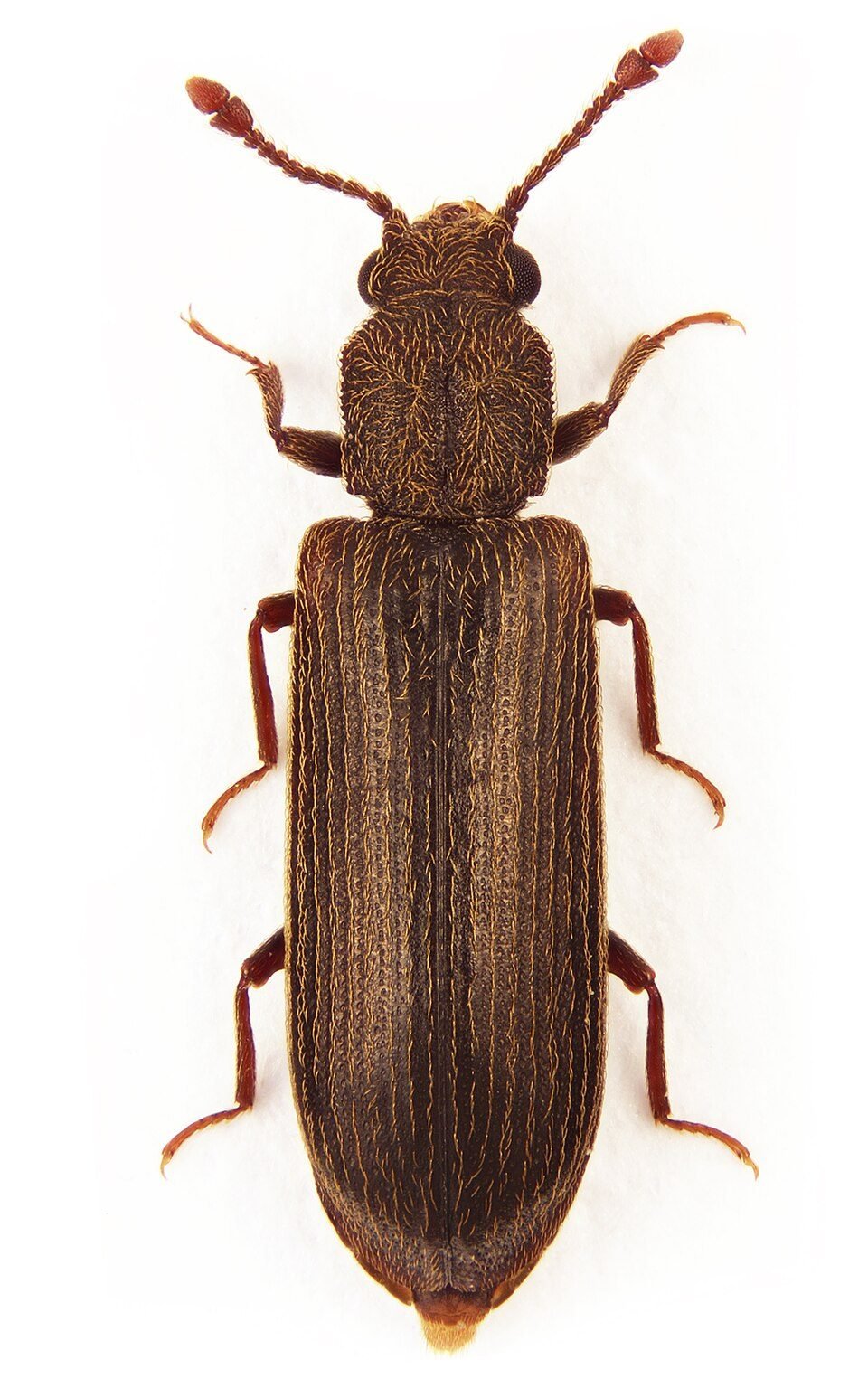

What powderpost beetles look like
Powderpost beetles belong to the family Lyctidae, and they are small, slender, brown insects, usually less than 6 mm long. They attack seasoned hardwoods only. Canadian heritage-collection guidance lists them among the major wood pests and notes that they are prevalent across Canada, so this is not only a southern or old-house problem.
You will almost never see the beetle itself. What gives it away is the wood: small round holes and a fine, powdery dust.
Powderpost beetle holes and frass: what to look for
The clear sign is a scattering of small round holes, about 1.6 to 3.2 mm across, in flooring, paneling, furniture or exposed framing. The holes are the exits the adults chew on their way out. Below them, or in the tunnels, is a fine, floury dust called frass, produced by the larvae as they bore. If the dust is fresh and loose, the infestation is likely active. Old, dark, compacted dust and weathered holes are more likely a past problem.
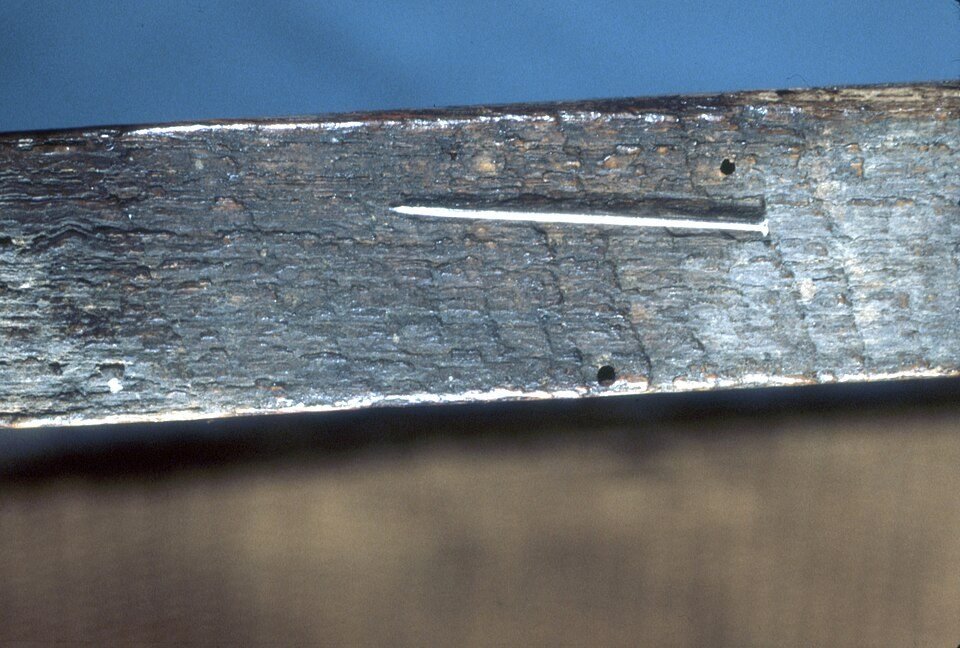

Powderpost beetle vs carpenter bee damage
Homeowners often confuse the two because both leave round holes in wood. The size of the hole sorts it out immediately.
| Powderpost beetle | Carpenter bee | |
|---|---|---|
| The insect | A small brown beetle, usually under 6 mm long | A large bee, roughly 1.3 to 2.5 cm long |
| Exit or entry hole | Tiny round holes, about 1.6 to 3.2 mm across | A large, nearly perfect round hole about 1.3 cm across |
| What it leaves | Fine, floury, powder-like dust | Coarse sawdust and stains below the hole |
| The wood it attacks | Dead, dried hardwoods, especially oak sapwood, often in furniture, floors and rafters | Bare or weathered wood, often eaves, decks, rails and fascia |
| When you see it | Adult beetles emerge from the holes in spring | Bees hover around the nest in spring |
Powderpost beetle biology and life cycle
Powderpost beetles breed in dead, dried hardwood. They typically get into lumber while it is being stored and cured, and they come out later from the finished product, which is why furniture, antiques, flooring and framing all turn up. They prefer the sapwood of oak and other hardwoods.
Powderpost beetle life cycle
Spring: eggs in the wood
Adult beetles lay eggs, usually in spring, in the pores and old exit holes of seasoned wood.
Larvae tunnel and make powder
The eggs hatch into small white grubs about 5 mm long. They bore through the wood and leave behind the fine, powder-like dust that gives the beetle its name.
Winter inside the wood
The larvae overwinter in the wood, out of sight, and keep feeding on the sapwood.
Next spring: adults emerge
The adults chew small round exit holes and come out. They mate and lay eggs in the same wood, so a piece can be infested for generation after generation.

Why powderpost beetles are in your house
The beetles usually arrive inside the wood. Timber that was infested before it was milled or finished, an antique bought at a sale, a piece of furniture from a barn or shed, or lumber stored for a long time can all bring them in. Because the larvae overwinter inside, the first sign is often the adult beetles emerging in spring, when the wood seems to have been fine for years.
Powderpost beetles in the house: where to check
These beetles are overlooked until they are found in stored lumber, rafters, joists, floors and furniture. In a house, check exposed floor joists and rafters in the basement and attic, hardwood flooring, paneling, and any furniture, frames or antiques made from oak or other hardwood. Barns, sheds and garages are often infested with wood-boring beetles, so wood or furniture that has been stored there deserves a close look before it comes indoors.
Which wood is at risk from powderpost beetles
Only dead, dried hardwood is at risk, and the sapwood of oak is a favourite. The beetles need bare crevices and pores to lay eggs in, which is why uninfested wood that has been sanded and varnished is not normally attacked. Rough-cut lumber should be kiln-dried, because that kills every stage of the beetle. Unfinished hardwood in an unheated shed or an old barn is the highest-risk wood you can bring into a house.
Powderpost beetle damage: what it does to wood
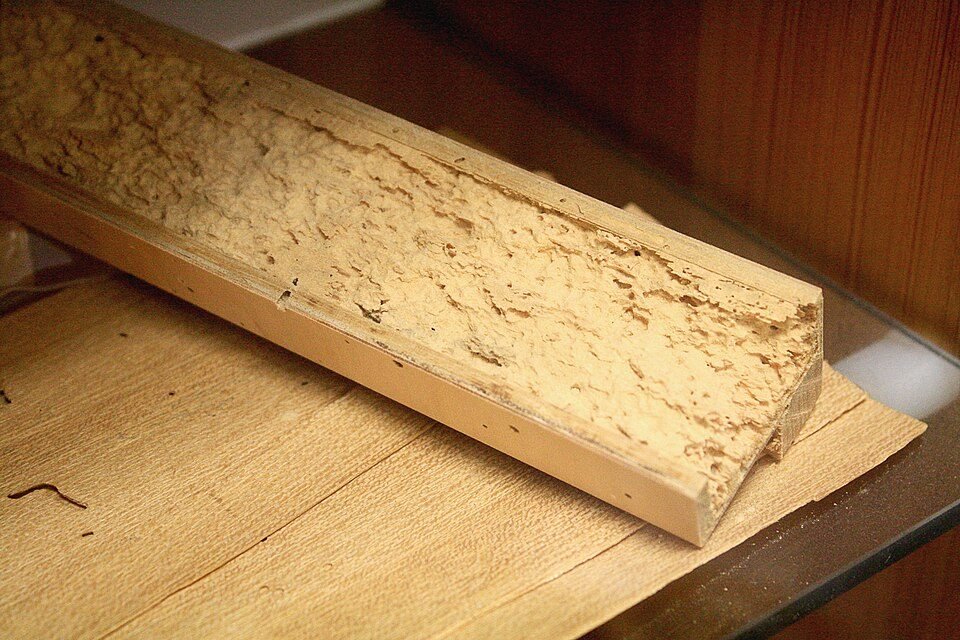
Powderpost beetle damage starts small and ends serious. A single generation tunnels through the sapwood and turns it to powder, leaving a thin shell of sound wood with holes in it. Because the beetles keep breeding in the same piece for generation after generation, the damage compounds, and a floor board, a beam or a piece of furniture can be destroyed from the inside without any warning on the surface. That is why the small holes matter, even when the wood still looks solid.
Signs of a powderpost beetle infestation
The signs of powderpost beetles are easy to miss, so check for all of them: numerous small round holes, fine powder below the holes or in tunnels, adult beetles emerging in spring, and wood that sounds hollow or crumbles when it is pressed. Fresh, loose powder is the best sign that the infestation is active.
Are powderpost beetles harmful?
Powderpost beetles are a property problem, not a health problem. The damage is slow and out of sight, and if a piece of wood is left to be reinfested generation after generation, it can be destroyed from the inside.
Do not assume small holes mean an old, harmless infestation. If you see fresh powder below the holes, especially in spring, the beetles are probably still active.
Common myths about powderpost beetles
- "They only affect old wood." They can also get into new lumber, floors and framing, because the beetles often enter wood while it is being stored and cured.
- "A surface spray will kill them all." A borate surface spray stops newly hatched larvae from entering the wood. It does not reach the larvae already inside, and it does not work on varnished, waxed or otherwise sealed wood.
- "Varnish will fix an infested piece." Varnish helps protect uninfested wood because the adults cannot find crevices to lay eggs in. It does not remove beetles already inside.
How to deal with powderpost beetles yourself
- Confirm it is active. Wipe or vacuum the powder from beneath the holes and check again in a week or two. New powder means active larvae.
- Check the furniture and lumber you bring home. Ask for proof that any antique with numerous holes has been fumigated.
- Store valuables in a dry, sealed space, not in barns and sheds, where wood-boring beetles are common.
- Seal unfinished wood. Sanded and varnished, uninfested wood is not normally attacked.
- Replace badly damaged pieces. Wood that has been eaten from the inside cannot be repaired.
- Leave the treatment of valuable items to licensed people. Fumigation can only be done by licensed fumigators, and it clears all stages but does not protect the wood from future attack.
How AstraHive Pest Control gets rid of powderpost beetles
Powderpost beetles are inside the wood, so the first job is knowing exactly what you have. We are honest about what a surface treatment can and cannot do.
How an AstraHive powderpost beetles treatment works
Inspect and find the source
We inspect the wood for exit holes, fresh powder and tunnelling, confirm whether it is powderpost beetles, another wood-boring insect or an old infestation that has died out, and check how far it goes.
Explain your options
We tell you whether the answer is replacing the wood, sealing it, or a fumigation by a licensed fumigator, so you are not paying for treatments that will not reach larvae inside the wood.
Treat inside only when needed
Where a treatment is appropriate, we apply it according to the product label. Surface treatments cannot get into sealed or varnished wood, and where that is the case we will say so.
Back it with a 90-day warranty
If powderpost beetles come back within 90 days, we re-treat at no charge.
Our products are Health Canada approved and safe for kids and pets, and we apply every product according to its label. AstraHive is licensed by the Ontario Ministry of the Environment, Conservation and Parks. Ontario requires a ministry-approved certification course before it issues an exterminator licence, and that training is delivered through the University of Guelph, Ridgetown Campus.
Powderpost beetle control in Ontario: when to call an exterminator
Call a licensed pest control company when you find small round holes with fresh powder, when a piece of furniture or a floor has numerous holes, when you have just bought an antique with signs of infestation, or when you are not sure whether the damage is powderpost beetles, carpenter bees or something else. Early identification is the difference between replacing one board and replacing a floor.
Why Choose AstraHive
- Licensed & Insured: Certified by the Ontario Ministry of Environment, Conservation and Parks.
- Fast response: Same-day service available, with a callback within 5 minutes.
- 90-Day Warranty: If pests come back within that window, we re-treat at no additional charge.
- Proven track record: 5.0 stars on Google across 200+ reviews.
- Family & pet safe: Health Canada approved products on every job.
Frequently Asked Questions
How do I get rid of powderpost beetles?
First confirm the infestation is active by checking for fresh powder below the holes. Then replace badly damaged wood, seal and varnish uninfested wood, and use fumigation by a licensed fumigator for valuable items. A surface spray does not reach larvae deep inside the wood.
What do powderpost beetle holes look like?
They are tiny round holes, about 1.6 to 3.2 mm across, often with a fine, floury powder below them. They are the exit holes the adult beetles chew when they emerge in spring.
Are powderpost beetles dangerous?
Not to people, but they are hard on wood. Infested pieces can be destroyed from the inside if the beetles keep breeding.
What is the difference between powderpost beetle holes and carpenter bee holes?
Powderpost beetle holes are tiny, about 1.6 to 3.2 mm, with fine powder. Carpenter bee holes are large, about 1.3 cm across, with coarse sawdust and stains below.
Where do powderpost beetles come from?
Usually from the wood itself. Beetles lay eggs in seasoned hardwood, and lumber, furniture and antiques can already be infested when they arrive. The adults emerge in spring.
Do I need a powderpost beetle exterminator?
Yes if you find small round holes with fresh powder, if a floor or furniture has many holes, or if you are not sure what wood pest you have. A licensed company can confirm the insect and explain your options.
Sources
- Canadian Conservation Institute: Major insect pests and their associated, diagnostic signs — Powderpost beetles (Lyctids) are small brownish adults that attack hardwoods only, leaving small round holes in wood and floury frass; prevalent across Canada.
- Ontario.ca: Pesticide licences and permits — Ontario's Ministry of the Environment, Conservation and Parks issues exterminator licences after a ministry-approved certification course, delivered through the University of Guelph, Ridgetown Campus.
- Penn State Extension: Powderpost Beetles — Breed in dead, dried hardwoods; enter lumber during storage and curing; adults less than 1/4 inch; holes 1/16 to 1/8 inch with powder-like dust; eggs laid in spring in pores and exit holes; larvae about 1/5 inch overwinter; prefer oak sapwood; generations in the same wood; sanded and varnished wood not normally attacked; fumigation by licensed operators; surface sprays not effective on sealed wood.
- Penn State Extension: Carpenter Bees — Carpenter bee entrance hole about 1/2 inch; coarse damage and staining; unpainted wood.
Areas We Serve
AstraHive Pest Control proudly serves 75+ communities across the following regions:
- Toronto: Toronto, North York, Scarborough, Etobicoke, East York, York, Leslieville, Lakeview
- Durham Region: Oshawa, Whitby, Ajax, Pickering, Clarington, Bowmanville, Courtice, Newcastle, Port Perry, Brooklin, Uxbridge, Scugog, Brock, Seaton
- York Region: Vaughan, Markham, Richmond Hill, Aurora, Newmarket, Thornhill, Woodbridge, Kleinburg, Maple, Stouffville, Unionville, Keswick, Holland Landing, East Gwillimbury, Georgina, King City, King Township, Nobleton, Berczy Village, Cathedraltown, Commerce Valley, Cornell, Wismer, Whitchurch-Stouffville, Sutton, Schomberg
- Peel Region: Mississauga, Brampton, Caledon, Malton, Port Credit, Streetsville, Meadowvale, Cooksville, Bolton, Palgrave
- Extended Service Area: Peterborough, Lindsay, Port Hope, Barrie, Bradford, Innisfil, Collingwood, Wasaga Beach, Orillia, Burlington, Oakville, Milton, Hamilton, Grimsby, St. Catharines, Welland, Niagara Falls
Don't see your city listed? Call us — we likely cover it.
Got a pest problem right now?
Call AstraHive for a free consultation. Licensed & insured, serving the GTA, Durham, York, Peel and Simcoe County.
Call 905-925-84275.0 Stars — 200+ Google Reviews | Licensed & Insured | Health Canada Approved