Raid ant killer and other store-bought ant sprays kill the ants they reach, but the colony and its queens stay in the nest and ants soon return. Spraying can also make the problem worse by trapping ants indoors and by ruining the slow-acting bait that does reach the colony. Here is what Health Canada and university research say.


What a store-bought ant spray does
A spray works on the ants it touches or the surfaces it treats. The University of California IPM program states that spraying ants indoors with pesticides will not prevent more ants from entering, and that spraying around the foundation will not give permanent control. Perimeter treatments may appear to knock down the population, but ants quickly build back up and invade again.
Why the colony survives a spray
The ants seen on a counter or along a baseboard are foragers out collecting food. The colony and its queens stay in the nest. The University of California IPM program says spraying around the foundation kills only foraging ants without killing the colony and the queens. As long as the queens survive, the colony keeps producing workers, so the trail returns.
Why ants come inside in the first place
The University of California IPM program says ants enter buildings seeking food and water, warmth and shelter, or refuge from dry, hot weather or flooded conditions, and that they can appear suddenly if other food sources become unavailable or the weather changes. They prefer to run along structural elements such as wires and pipes, which is how they travel through a house. A few stragglers are usually scouts looking for food or a nest site, while a large trail means a food source has been found.
That is why killing the ants on the counter does not change the situation. As long as there is something worth coming for and a way in, the next scout arrives.
How spraying can make the problem worse
- It can trap ants indoors. The University of California IPM program warns that barrier sprays can make the situation worse by trapping ants indoors.
- It ruins bait. Health Canada says not to use chemical sprays to kill ants while using a bait system, or the bait will not work. Spraying around a bait program defeats the one method that reaches the nest.
- It kills the workers that would carry bait home. Baits work because foragers carry them back to the colony, so killing the foragers on contact stops the delivery.
- It creates a false sense of success. Fewer ants for a few days looks like progress, but the colony is untouched.
Spray versus bait compared
| Contact spray | Slow-acting bait | |
|---|---|---|
| What it reaches | Ants that are sprayed or that cross the treated surface | The whole nest: workers carry it back and pass it to other workers, larvae and queens |
| Effect on the colony | Kills only foraging ants; colony and queens survive | Can kill the entire colony including queens |
| Speed | Fast knockdown | Slow by design: 5 to 10 days to see fewer ants |
| Used together? | Spraying ruins a bait program | Do not spray while baiting |
Sources: the University of California IPM program and Health Canada (see the sources below).
What works instead: slow-acting bait
Health Canada explains that ants gather food and bring it back to the nest, so a bait system must work slowly enough for the poison to be fed to all members of the nest, which makes it a highly effective way of getting rid of nests. The University of California IPM program adds that workers pass the material mouth to mouth to other workers, larvae and queens, and that it can take 5 to 10 days to see fewer ants.
Health Canada's practical advice is to place bait stations directly in the path of foraging ants, out of reach of children and pets, to use plenty of stations, to keep baits available for at least two weeks, and to repeat applications if needed. Two different baits at the same time give better results.
If you have already sprayed
Stop spraying. Health Canada's rule is that sprays and baits do not mix: spraying while baiting stops the bait working. Place baits along the trails and keep them in place for at least two weeks.
Health Canada also advises repairing and sealing visible cracks in the foundation and exterior walls and caulking along baseboards, which reduces the entry points ants use.
For a do-it-yourself step that works alongside bait rather than against it, diatomaceous earth and boric acid applied lightly in cracks and crevices where ants travel are common choices. Health Canada says diatomaceous earth scratches the outer skin of ants so they dehydrate and die, and boric acid is ingested and attacks the nervous system and stomach from the inside. Keep dusts out of reach of children and pets, never apply them over bait, and follow the label.
What to do in the first ten minutes instead of spraying
- Find what they are after and remove it. Sugar, syrup, honey, pet food, grease and spills are the usual draws.
- Vacuum the trail or wipe it with soapy water. The University of California IPM program says this can be as effective as an insecticide spray at temporarily removing foragers, because soapy water removes the scent trail, especially at the entry point.
- Follow the trail to where ants come in and caulk the opening.
- Put bait at the entry point, and keep cleaning up trails while it works, because bait takes time.
- Leave the spray can alone. The same program says indoor insecticide sprays are not usually necessary.
Health Canada adds the prevention habits: store food in sealed containers, rinse recyclables before they go out, empty garbage often and keep pet food in a shallow dish of water, since ants cannot swim.
Which ant it is changes the plan
| Size and look | Where it nests | What it eats | |
|---|---|---|---|
| Odorous house ant | About 1/8 inch, dark brown to shiny black, one node, strong odour when crushed | Shallow mounds in soil or debris, or indoors in wall voids or around water pipes or heaters | Sweets, sometimes proteins |
| Pavement ant | About 3/16 inch, dark brown to black, two nodes | Lawns or under stones or boards, mounds along sidewalks and foundations or near water | Sweets, proteins and grease |
| Carpenter ant | Large, 1/4 to 1/2 inch, black or red and black, one node | Hollows out wood such as stumps, firewood, fence posts and hollow door or window frames, leaving sawdust-like frass | Sweets |
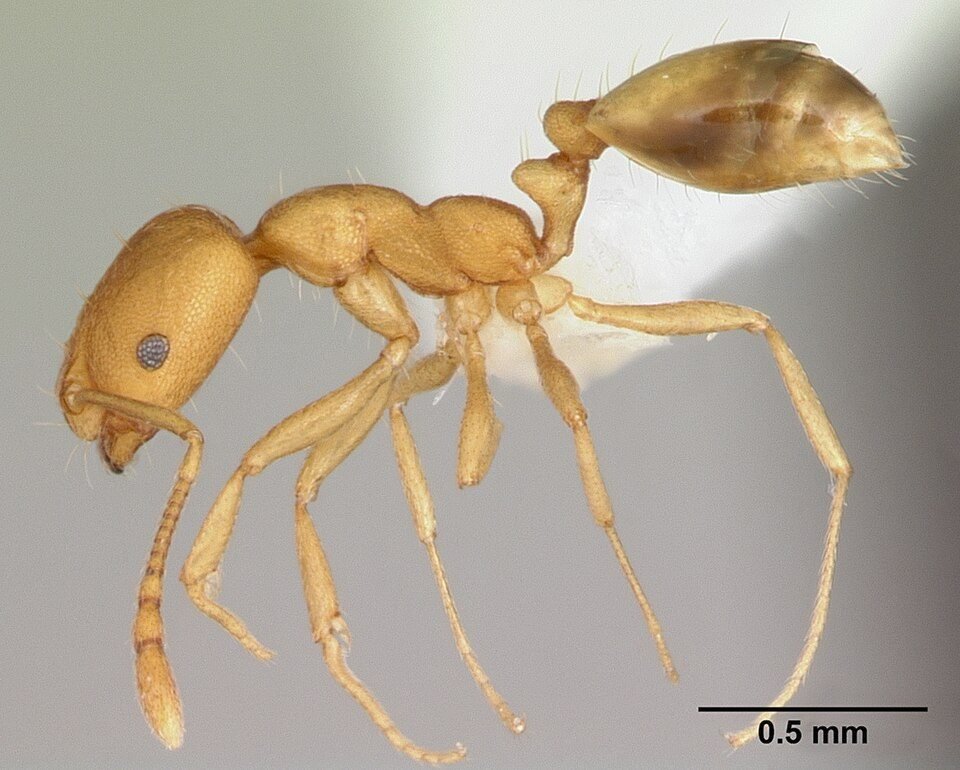
| Pharaoh ant | About 1/16 inch, yellow to orange, two nodes | Wall or cabinet voids and behind baseboards or insulation, in warm moist spots | Fats, proteins and sweets |
| Thief ant | About 1/32 inch, yellow to light brown, two nodes | Soil or under rocks outdoors, behind wallboards or baseboards indoors | Greasy and fatty foods, sometimes sweets |
Health Canada lists carpenter, little black, odorous house, thief, pharaoh and pavement ants among the species found in Canadian homes. It notes that piles of sawdust may mean carpenter ants, which can cause structural damage as they hollow out wood for their nests. Carpenter ants do not eat wood the way termites do. A nest inside a wall or a wooden structure is one a spray on the surface will not reach.
Fix the outdoor reasons ants keep coming
The University of California IPM program recommends keeping plants, grass and mulch at least a foot away from the foundation, fixing leaky faucets and sprinkler heads that attract thirsty ants, and trimming branches so they do not touch the house. Ants also tend aphids, scales and mealybugs for their honeydew and protect them from natural enemies, so a plant covered in sticky honeydew next to the house is an invitation. The same guide warns against spraying pyrethroids outdoors on hard surfaces such as driveways and around foundations, because those products pollute waterways.

When a spray still has a place, and when to call a professional
Health Canada says chemical sprays and dusts can be used effectively as barrier and nest treatments, and that applying a chemical directly to the nest may eliminate colonies. The University of California IPM program describes perimeter treatments as a temporary knockdown when used alone. The difference is planning: a licensed professional chooses the product and the placement for the species, and combines treatments so one does not undo the other.
If ants keep returning after several weeks of bait, an inspection to find the nest and the entry points is the next step.
How AstraHive Pest Control gets rid of ants
The goal with ants is the queen, not the workers on your counter. We combine bait that workers carry back to the queen with a weatherproof barrier around the outside of the house, and treat the inside when ants are active there.
How an AstraHive ants treatment works
Inspect and follow the trails
We follow the ant trails to find where they come in and where the nest is likely to be, so the bait and the barrier go in the right places.
Granular bait in the yard
We spread professional granular bait across the front and back yard around the nesting areas and colonies, and along the perimeter of the building. Workers carry it back to the queen, the queen dies and the colony collapses.
Liquid bait in bait stations
We set Scorpio liquid bait in bait stations around the exterior perimeter, near the nest and wherever ants are active. Ants feed and carry it back to the nest, and the stations keep working after we leave.
Weatherproof exterior perimeter spray
We spray a barrier around the foundation, windows, doors and entry points, applied according to the product label. It stays active for about 90 days, so ants coming from outside cross the treated zone before they get in.
Interior treatment if needed
If ants are already active inside, we treat the interior as well as the exterior, never the inside alone: a residual spray along the interior perimeter, baseboards and known travel routes, and gel bait along the trails, out of reach of children and pets.
Document everything
Where we found ants, what we found and every product used goes in the service report, along with what to change around the property, such as moisture and wood-to-soil contact.
Back it with a 90-day warranty
If ants come back within 90 days, we re-treat at no charge.
Our products are Health Canada approved and safe for kids and pets, and we apply every product according to its label. AstraHive is licensed by the Ontario Ministry of the Environment, Conservation and Parks. Ontario requires a ministry-approved certification course before it issues an exterminator licence, and that training is delivered through the University of Guelph, Ridgetown Campus.
Bait and the outer barrier are applied in different places on purpose: the bait stays on the routes ants forage along so workers can carry it home, and the barrier sits at the building's edge. That is also why we ask you not to spray the ants you see or wipe their trails before we arrive: killing the workers stops the bait reaching the queen.
Typical cost: Starting at $350 CAD, with final cost depending on property size and severity of infestation - there is no fixed upper limit. Call 905-925-8427 for an exact free quote.
Why Choose AstraHive
- Licensed & Insured: Certified by the Ontario Ministry of Environment, Conservation and Parks.
- Fast response: Same-day service available, with a callback within 5 minutes.
- 90-Day Warranty: If pests come back within that window, we re-treat at no additional charge.
- Proven track record: 5.0 stars on Google across 200+ reviews.
- Family & pet safe: Health Canada approved products on every job.
Frequently Asked Questions
Does Raid ant killer work?
It kills the ants it reaches, but spraying kills only foraging ants and leaves the colony and queens alive, according to the University of California IPM program. Ants quickly rebuild and return.
Why do I see more ants after spraying?
Barrier sprays can make the situation worse by trapping ants indoors, and the colony keeps sending out new workers. The spray removes the visible ants, not the nest.
Can I use ant spray and ant bait together?
No. Health Canada says not to use chemical sprays to kill ants while using a bait system, or the bait will not work. The University of California IPM program gives the same advice.
How long does ant bait take to work?
It can take 5 to 10 days to see fewer ants, and control may take several weeks. Health Canada suggests keeping baits available for at least two weeks.
Is a perimeter spray around the house better?
A perimeter treatment can reduce ants from outdoor nests coming inside, and Health Canada lists barrier treatments as an option. Used alone it often gives only temporary relief, because ants quickly build back up if the colony is untouched.
Sources
- Health Canada: Ants — Chemicals, sprays and dusts can be used as barrier and nest treatments; a bait system must work slowly enough for the poison to be fed to all members of the nest, which is a highly effective way of getting rid of nests; do not use chemical sprays to kill ants while using a bait system or the bait will not work; keep baits available for at least two weeks and repeat if needed; place bait stations directly in the path of foraging ants but out of reach of children and pets; use plenty of bait stations, and two different baits at the same time give better results; repair and seal cracks in the foundation and exterior walls and caulk along baseboards.
- Ontario.ca: Pesticide licences and permits — Ontario's Ministry of the Environment, Conservation and Parks issues exterminator licences after a ministry-approved certification course, delivered through the University of Guelph, Ridgetown Campus.
- UC IPM: Ants (University of California Statewide IPM Program) — Spraying ants indoors with pesticides will not prevent more ants from entering; spraying around the foundation kills only foraging ants without killing the colony and queens, and ants quickly build back up and invade again; barrier sprays can make the situation worse by trapping ants indoors; baits are taken back to the nest where the entire colony including queens can be killed, and workers pass the material mouth to mouth to other workers, larvae and queens; it can take 5 to 10 days to see fewer ants; do not use insecticide sprays while using baits.
- UC IPM: Ant baits for home and garden (University of California Statewide IPM Program) — The pesticide in a bait must be slow-acting so foraging ants can reach the nest and feed the colony before they die; liquid borate baits go in refillable stations, gels are applied in small cracks and crevices, and granules with cyfluthrin or permethrin are contact insecticides that kill foragers rather than true baits; ant food preferences change through the year and differ by species, so setting out different formulations gives ants a choice; if ants are not taking a bait, reposition the stations or try a different product; it can take 5 to 10 days to see fewer ants and control may take several weeks; baits can dry up or turn rancid and need checking; prepackaged stations are easy to use and safe if kept away from children and pets, and refillable stations suit difficult problems; do not use sprays while baiting.
Areas We Serve
AstraHive Pest Control proudly serves 75+ communities across the following regions:
- Toronto: Toronto, North York, Scarborough, Etobicoke, East York, York, Leslieville, Lakeview
- Durham Region: Oshawa, Whitby, Ajax, Pickering, Clarington, Bowmanville, Courtice, Newcastle, Port Perry, Brooklin, Uxbridge, Scugog, Brock, Seaton
- York Region: Vaughan, Markham, Richmond Hill, Aurora, Newmarket, Thornhill, Woodbridge, Kleinburg, Maple, Stouffville, Unionville, Keswick, Holland Landing, East Gwillimbury, Georgina, King City, King Township, Nobleton, Berczy Village, Cathedraltown, Commerce Valley, Cornell, Wismer, Whitchurch-Stouffville, Sutton, Schomberg
- Peel Region: Mississauga, Brampton, Caledon, Malton, Port Credit, Streetsville, Meadowvale, Cooksville, Bolton, Palgrave
- Extended Service Area: Peterborough, Lindsay, Port Hope, Barrie, Bradford, Innisfil, Collingwood, Wasaga Beach, Orillia, Burlington, Oakville, Milton, Hamilton, Grimsby, St. Catharines, Welland, Niagara Falls
Don't see your city listed? Call us — we likely cover it.
Got a pest problem right now?
Call AstraHive for a free consultation. Licensed & insured, serving the GTA, Durham, York, Peel and Simcoe County.
Call 905-925-84275.0 Stars — 200+ Google Reviews | Licensed & Insured | Health Canada Approved