Mice hide from you by instinct, so the six signs below, droppings, gnaw marks, grease trails, nesting material, scratching sounds, and an ammonia-like odour, are usually how homeowners actually discover an infestation. If you're noticing more than one of these at once, you're no longer dealing with a single mouse.


Why You Almost Never See the Mouse Itself
Mice are prey animals and nocturnal by default. Seeing one mid-day, out in the open, generally means the population indoors is already large enough that subordinate mice are getting pushed out of the nest to forage during unsafe hours.
That's why every AstraHive technician is trained to read the environment first and the mouse itself second. By the time a homeowner spots one on a countertop, the physical evidence has usually been building for weeks.
The 6 Signs We Check On Every Mouse Inspection
1. Droppings
Small, dark, rice-shaped pellets are the single most reliable indicator. We look along baseboards, behind the fridge and stove, inside cabinets, and under the sink first, since these are travel corridors, not random deposit spots.
- Fresh droppings are dark, soft and slightly moist to the touch
- Older droppings dry out, harden and turn grey or brittle over days to weeks
- A mix of fresh and old droppings in the same spot tells me the location is in active, ongoing use, not a one-time visit
2. Gnaw Marks
A mouse's incisors never stop growing, so it has to gnaw constantly to file them down. We look for chewed corners on cardboard or plastic food packaging, gnawed wire insulation near appliances and behind panels, and chewed foam or fibreglass insulation around pipe penetrations. Gnawed wiring is the one we take most seriously, since it's a fire risk, not just a nuisance.
3. Grease Trails (Rub Marks)
Mice reuse the exact same route along a wall every single trip, because they navigate largely by touch, keeping their bodies close to vertical surfaces. Over weeks, the oil and dirt in their fur builds into a visible dark smear on baseboards, wall corners, and pipe runs. A grease trail with sharp, dark definition means the route is still in heavy current use.
4. Nesting Material
Shredded paper, insulation, cotton batting, or fabric balled up in a hidden void is a nest, and a nest means breeding, not just transient activity. We find these most often inside drawers that are rarely opened, behind large appliances, inside dropped ceilings, and inside wall voids accessed through utility penetrations.
5. Scratching Sounds
Because mice are nocturnal, scratching, scurrying or light thumping inside walls, above ceilings, or behind appliances tends to show up after dark when the house goes quiet. Homeowners often describe it as sounding like it's "inside the wall" rather than in the room, which is accurate, that's exactly where the activity is.
6. A Concentrated Musky, Ammonia-Like Smell
Mouse urine has a distinct musky, ammonia-forward odour. In an enclosed space like a closet, cabinet, or crawlspace, a concentrated version of that smell almost always points to active nesting nearby rather than a mouse that simply passed through once.
Quick gut check: One sign in one spot could be an isolated visitor. Two or more of these signs, or the same sign in multiple rooms, means the colony has already established feeding and nesting routes through your home.
The Health Risk Behind These Signs
These aren't just cosmetic annoyances. Mouse droppings, urine, saliva and nesting material can carry pathogens including Salmonella, Leptospira, LCMV, and hantavirus. Hantaviruses are found around the world and are spread by rodents, such as mice and rats, most often through their droppings, urine and saliva. When fresh urine, droppings, or nesting materials of an infected rodent are stirred up, the virus can get into the air, which is exactly what happens when someone dry-sweeps or vacuums droppings instead of wetting them down first with disinfectant.
The risk is low but not zero, and it's entirely avoidable with correct cleanup: wet the area with disinfectant, let it sit, then wipe, never sweep or vacuum dry droppings.
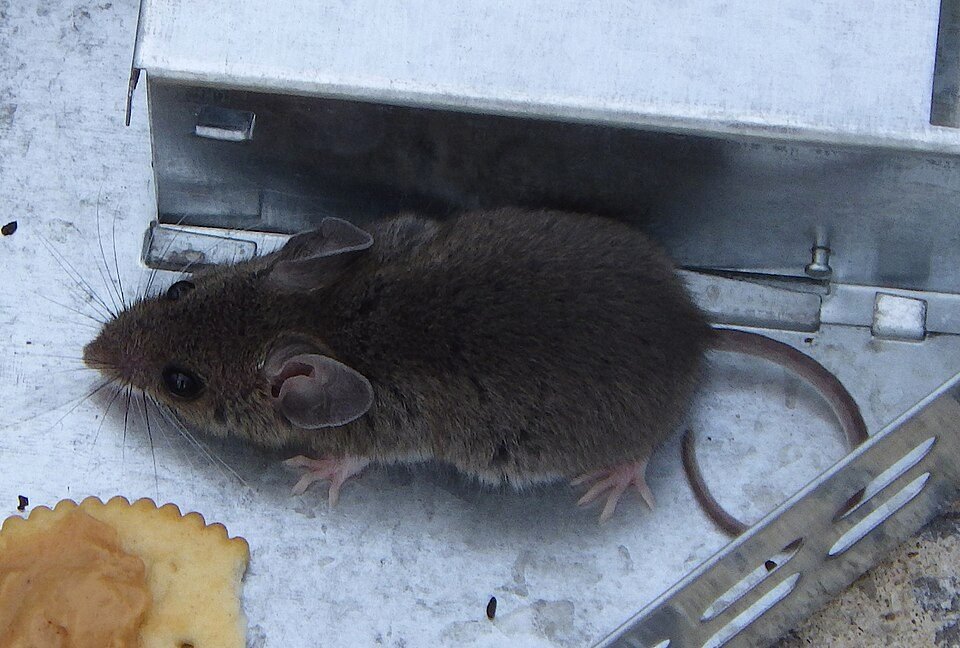

How AstraHive Pest Control gets rid of mice
Mice get in through small gaps, so the lasting fix is at the outer shell of the building. We find the entry points, close them from the outside and deal with the mice already inside.
How an AstraHive mice treatment works
Inspect and find the entry points
We inspect the outside and inside of the building for droppings, gnaw marks, runways and every gap. A single property usually has several entry points, not just the one you noticed.
Seal the exterior entry points
We seal the exterior only: foundation cracks, utility and pipe penetrations, vents, weep holes, rooflines and garage door corners. Gaps are packed with steel wool or copper mesh locked in with sealant or foam, and larger openings get hardware cloth. Foam or caulk alone is not a rodent barrier.
Trap and bait where needed
Mice already inside are removed with traps and with tamper-resistant bait stations, inside and outside where needed, using Health Canada approved products applied according to the product label.
Flag structural damage and report
If we find structural damage that needs repair beyond what we can seal, we flag it in the service report, along with every observation, every entry point found and every product used.
Follow up and back it with a 90-day warranty
We come back to re-inspect, refill the bait stations and make sure everything is holding. If mice return within 90 days, we re-treat at no charge.
Our products are Health Canada approved and safe for kids and pets, and we apply every product according to its label. AstraHive is licensed by the Ontario Ministry of the Environment, Conservation and Parks. Ontario requires a ministry-approved certification course before it issues an exterminator licence, and that training is delivered through the University of Guelph, Ridgetown Campus.
Sealing is what ends repeat visits. Traps and bait only remove the mice that are already inside, and new mice keep coming for as long as an exterior entry point stays open.
Sealing lowers the risk a great deal, but it cannot make a house completely mouse-proof. Mice can chew new ways in through the softer parts of a building, such as the rubber seal on a garage door, weatherstripping, siding, wood trim and the plastic coating on wires, and a house keeps shifting and ageing, so gaps that did not exist on the day of the work can open later. Chewing can also damage the structure itself, including wiring, insulation and framing, and that wear and tear can continue after every entry point we found has been sealed. We record the damage we find so you can arrange repairs, we check at the follow-up visit that the seals are holding, and anything new that opens up afterward is a new entry point rather than a failure of the old work. If you see fresh gnaw marks or droppings, or hear scratching, call us early.
Typical cost: Starting at $300 CAD, with final cost depending on property size and severity of infestation - there is no fixed upper limit. Call 905-925-8427 for an exact free quote.
Why Choose AstraHive
- Licensed & Insured: Certified by the Ontario Ministry of Environment, Conservation and Parks.
- Fast response: Same-day service available, with a callback within 5 minutes.
- 90-Day Warranty: If pests come back within that window, we re-treat at no additional charge.
- Proven track record: 5.0 stars on Google across 200+ reviews.
- Family & pet safe: Health Canada approved products on every job.
Frequently Asked Questions
What is the very first sign of a mouse infestation?
Droppings are almost always the first sign homeowners notice, small, dark, rice-shaped pellets along baseboards, behind appliances, or under the sink. Fresh droppings are soft and moist looking, while older ones dry out and turn grey, so finding a mix of both means the spot is in regular, ongoing use.
How many mice does it usually take before you notice signs?
By the time droppings, gnaw marks, or grease trails are visible, you're typically dealing with more than one mouse, since mice breed continuously indoors where food, warmth, and nesting material are available. A single mouse passing through once rarely leaves a build-up of trails and droppings in multiple locations.
Is the smell from mice dangerous to breathe in?
It can be. Mouse urine and droppings can carry pathogens including hantavirus and Salmonella, and disturbing dried droppings by sweeping or vacuuming can release contaminated particles into the air. The safer approach is to wet the area thoroughly with disinfectant, let it sit, and then wipe it up while wearing gloves.
Do scratching sounds in the wall always mean mice?
Not always, but nighttime scratching, scurrying, or light thumping inside walls or above ceilings is one of the most common mouse indicators since mice are nocturnal and travel through wall voids and dropped ceilings. If it's paired with droppings, gnaw marks, or a musky odour nearby, mice are the most likely explanation.
Sources
- Health Canada: Rats and mice (Pest control tips) — Mice can squeeze through cracks as small as a dime; metal weather stripping, patching foundation cracks, steel wool around pipes before caulking; snap and electronic traps are very effective when well placed; poisoned baits need tamper-proof stations away from children and pets; wear rubber gloves and a dust mask and dampen droppings with a bleach solution, never vacuum them dry; look for a Pest Control Products number.
- Government of Canada — Hantaviruses are spread by rodents such as mice and rats, most often through their droppings, urine and saliva.
- Public Health Ontario — Ontario has not reported any cases of hantavirus pulmonary syndrome since it became a reportable disease in 2001.
- Canadian Centre for Occupational Health and Safety (CCOHS) — Since 1989 there have been 109 confirmed hantavirus cases and 27 deaths in Canada, according to the Public Health Agency of Canada.
- Ontario.ca: Pesticide licences and permits — Ontario's Ministry of the Environment, Conservation and Parks issues exterminator licences after a ministry-approved certification course, delivered through the University of Guelph, Ridgetown Campus.
- CDC — When fresh rodent urine, droppings, or nesting materials are stirred up, hantavirus can become airborne.
Areas We Serve
AstraHive Pest Control proudly serves 75+ communities across the following regions:
- Toronto: Toronto, North York, Scarborough, Etobicoke, East York, York, Leslieville, Lakeview
- Durham Region: Oshawa, Whitby, Ajax, Pickering, Clarington, Bowmanville, Courtice, Newcastle, Port Perry, Brooklin, Uxbridge, Scugog, Brock, Seaton
- York Region: Vaughan, Markham, Richmond Hill, Aurora, Newmarket, Thornhill, Woodbridge, Kleinburg, Maple, Stouffville, Unionville, Keswick, Holland Landing, East Gwillimbury, Georgina, King City, King Township, Nobleton, Berczy Village, Cathedraltown, Commerce Valley, Cornell, Wismer, Whitchurch-Stouffville, Sutton, Schomberg
- Peel Region: Mississauga, Brampton, Caledon, Malton, Port Credit, Streetsville, Meadowvale, Cooksville, Bolton, Palgrave
- Extended Service Area: Peterborough, Lindsay, Port Hope, Barrie, Bradford, Innisfil, Collingwood, Wasaga Beach, Orillia, Burlington, Oakville, Milton, Hamilton, Grimsby, St. Catharines, Welland, Niagara Falls
Don't see your city listed? Call us — we likely cover it.
Got a pest problem right now?
Call AstraHive for a free consultation. Licensed & insured, serving the GTA, Durham, York, Peel and Simcoe County.
Call 905-925-84275.0 Stars — 200+ Google Reviews | Licensed & Insured | Health Canada Approved