Professionals do several things store-bought pest products cannot: they are trained and licensed in Ontario, they can use pesticide classes that are not sold to the public, they inspect and identify the pest first, they use tools such as steam, dusts and slow-acting baits, and they follow up. Research on foggers and sprays shows why the difference matters.


Training and licensing in Ontario
Ontario says you need an exterminator licence if you perform or offer to perform an extermination, unless exempt. Applicants must complete a ministry-approved course and pass a certification exam within 12 months before applying, and licences are valid for five years. A pest control business is run by an operator, who must be a licensed exterminator, and a technician is someone who has completed pesticide safety training. Ontario has 15 licence categories so that users are trained for the type of structural, land or water extermination they perform.
What a licence requires of the person at your door
Ontario's licensing rules give you things to ask for. Written work orders must record the location of the extermination site, the pest, the pesticide name and registration number, the supervising exterminator's licence number, and a unique identifier for the job. A technician working under supervision must carry or have available the written instructions signed in the last 30 days by a supervising licensed exterminator. Operators must carry insurance, display their licence at each location, mark vehicles that store or transport pesticides, and post warning signs where required. An exterminator licence is valid for five years, and applicants must complete a ministry-approved course and pass a certification exam first.
Products the public cannot buy
Ontario assigns pesticides to classes. Class D pesticides are distributed primarily to the general public for personal use in and around their homes. Class A, B and C pesticides can only be sold by a licensed vendor, and Class B and C pesticides can only be used by certain licensed professionals. A store shelf is limited to the domestic class.
Pesticide classes in one table
| Federal equivalent | Who can buy and use it | |
|---|---|---|
| Class A | Manufacturing | Used only in making a pest control product |
| Class B | Restricted | Licensed vendor only, with additional conditions on display, distribution or use |
| Class C | Commercial | Licensed vendor only; used by trained persons such as licensed exterminators |
| Class D | Domestic | Sold to the public for use in and around the home; products with only allowable-list ingredients, or small ready-to-use containers, are on open shelves |
| Class E | Ontario only | Neonicotinoid-treated seeds |
Source: Ontario's guide to pesticide classes. Classification follows automatically from the federal registration of a product.
Inspection and identification come first
A professional starts by identifying the pest and finding where it lives and how it gets in, because each pest needs a different approach. That matters because the wrong product can make things worse: the University of California IPM program says spraying ants kills only the foragers and can trap ants indoors, and Health Canada says sprays used during a bait program stop the bait working.
Tools that are not in the store aisle
For bed bugs, Health Canada lists the tools professional operators use: liquid and aerosol insecticide sprays, insecticidal dusts, diatomaceous earth, pressurized carbon dioxide snow, and steam and heat treatments. Health Canada also strongly recommends hiring a licensed professional because bedbugs are very hard to get rid of.
What a professional visit includes, step by step
| What happens | |
|---|---|
| Bed bugs | The bed is stripped and taken apart, steam goes over every seam and joint, a HEPA vacuum removes live bugs, a residual spray covers the interior perimeter, dust is injected into cracks and wall voids, mattress encasements are provided, everything is documented, and the technician returns 4 to 6 weeks later |
| Cockroaches | The fridge, stove and dishwasher are pulled out, a residual spray goes along baseboards and under appliances, a flushing agent drives roaches out, dust goes into voids, gel bait is placed, insect monitors are left, and the technician returns 4 to 6 weeks later |
| Ants | Granular bait is spread across the yard, bait stations are set in the activity zones, and an exterior perimeter spray is applied, according to the product label |
| Mice | Inspection, exterior sealing, interior trapping and tamper-resistant bait stations where needed, and a follow-up |
AstraHive backs these treatments with a 90-day warranty.
What the research says about store products
| What the research found | |
|---|---|
| Total-release foggers for bed bugs | Bed bugs showed little if any adverse effect after 2 hours of direct exposure and the insecticide barely penetrated their hiding places. |
| Total-release foggers for cockroaches | Trap counts in fogger-treated homes did not change significantly, while gel baits reduced counts significantly. |
| Sprays on ants | Kill only foraging ants; the colony and queens survive and ants rebuild quickly. |
Sources: Journal of Economic Entomology (2012), BMC Public Health (2019) and the University of California IPM program.
Where a total-release fogger fails
The research on foggers is the clearest example of a store product that costs more than it delivers. In the cockroach study, trap counts did not change significantly after fogger use, while gel baits cut them significantly. Residues on floors and counters were a median of 85 times higher than baseline hours after fogging and were still elevated on about a third of horizontal surface samples a month later. The authors concluded that the high exposure risks combined with ineffectiveness call into question their use in the marketplace, when baits are highly effective. The University of California IPM program and the US EPA reach the same conclusion for bed bugs.
Where doing it yourself is reasonable
Not every pest problem needs a professional. The University of California IPM program describes a do-it-yourself response to ants: remove the food source, clean up the trail, caulk the entry point and put out bait, mainly outdoors. Health Canada recommends snap, electronic and live traps for a small mouse problem, with sealing of gaps and tidy storage. Early, single-room problems with pests that do not breed hidden inside walls respond to this. The signs it is time to call a professional are the ones the same sources give: bed bugs, which Health Canada says are very hard to get rid of, cockroaches in a multi-unit building, a nest inside a wall, or any pest that returns after the sanitation and bait steps.

Follow-up is part of the service
Many pests need more than one visit. Ottawa Public Health notes that bed bug control may involve more than one pest control treatment, and York Region advises contacting a professional if bed bugs persist beyond two weeks. The University of California IPM program recommends continuing to monitor cockroaches after control to make sure re-infestation is not taking place.
How AstraHive Pest Control gets rid of ants
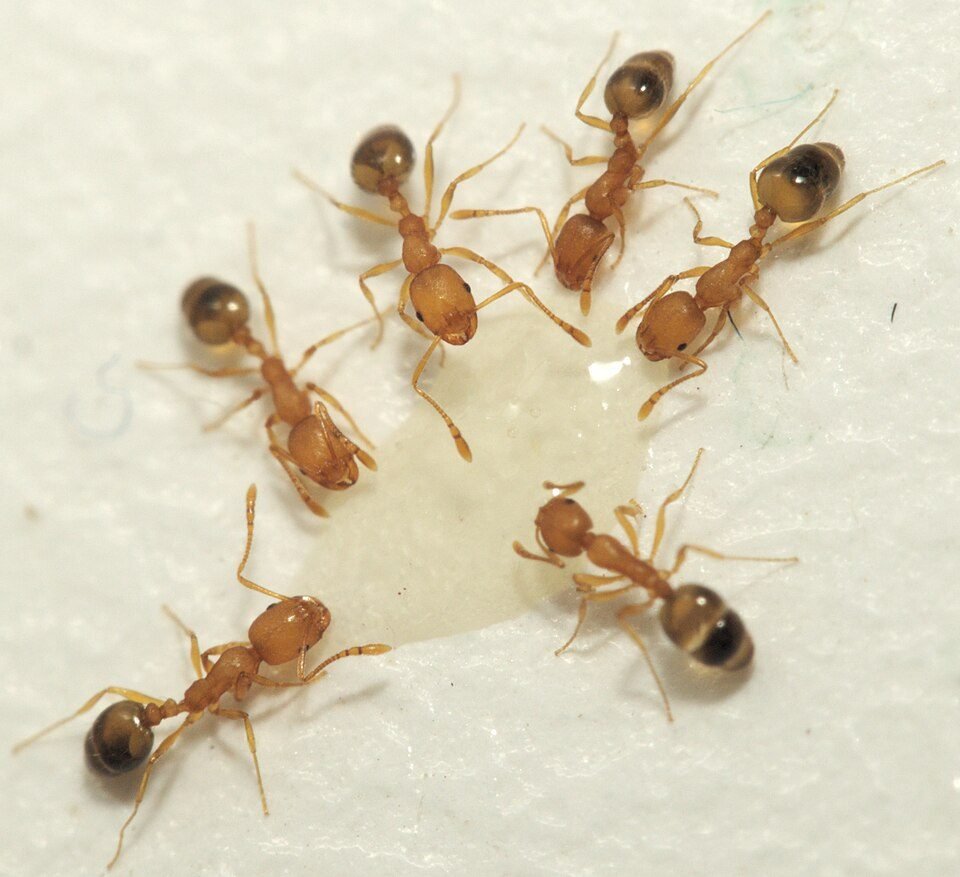
The goal with ants is the queen, not the workers on your counter. We combine bait that workers carry back to the queen with a weatherproof barrier around the outside of the house, and treat the inside when ants are active there.
How an AstraHive ants treatment works
Inspect and follow the trails
We follow the ant trails to find where they come in and where the nest is likely to be, so the bait and the barrier go in the right places.
Granular bait in the yard
We spread professional granular bait across the front and back yard around the nesting areas and colonies, and along the perimeter of the building. Workers carry it back to the queen, the queen dies and the colony collapses.
Liquid bait in bait stations
We set Scorpio liquid bait in bait stations around the exterior perimeter, near the nest and wherever ants are active. Ants feed and carry it back to the nest, and the stations keep working after we leave.
Weatherproof exterior perimeter spray
We spray a barrier around the foundation, windows, doors and entry points, applied according to the product label. It stays active for about 90 days, so ants coming from outside cross the treated zone before they get in.
Interior treatment if needed
If ants are already active inside, we treat the interior as well as the exterior, never the inside alone: a residual spray along the interior perimeter, baseboards and known travel routes, and gel bait along the trails, out of reach of children and pets.
Document everything
Where we found ants, what we found and every product used goes in the service report, along with what to change around the property, such as moisture and wood-to-soil contact.
Back it with a 90-day warranty
If ants come back within 90 days, we re-treat at no charge.
Our products are Health Canada approved and safe for kids and pets, and we apply every product according to its label. AstraHive is licensed by the Ontario Ministry of the Environment, Conservation and Parks. Ontario requires a ministry-approved certification course before it issues an exterminator licence, and that training is delivered through the University of Guelph, Ridgetown Campus.
Bait and the outer barrier are applied in different places on purpose: the bait stays on the routes ants forage along so workers can carry it home, and the barrier sits at the building's edge. That is also why we ask you not to spray the ants you see or wipe their trails before we arrive: killing the workers stops the bait reaching the queen.
Typical cost: Starting at $350 CAD, with final cost depending on property size and severity of infestation - there is no fixed upper limit. Call 905-925-8427 for an exact free quote.
Why Choose AstraHive
- Licensed & Insured: Certified by the Ontario Ministry of Environment, Conservation and Parks.
- Fast response: Same-day service available, with a callback within 5 minutes.
- 90-Day Warranty: If pests come back within that window, we re-treat at no additional charge.
- Proven track record: 5.0 stars on Google across 200+ reviews.
- Family & pet safe: Health Canada approved products on every job.
Frequently Asked Questions
Are professional pesticides stronger than store-bought ones?
Ontario restricts Class B and C pesticides to licensed professionals, so some products are not available to the public. The bigger differences are training, identification of the pest, method and follow-up.
Do I need a licence to do pest control in Ontario?
Unless exempt, you need an exterminator licence if you perform or offer to perform an extermination. Applicants must complete a ministry-approved course and pass a certification exam.
Why do store-bought foggers not work well?
Research found foggers had little effect on bed bugs and did not significantly change cockroach trap counts. The spray does not reach the cracks and crevices where these pests hide.
Can I use store-bought bait?
Yes, and slow-acting bait is the right type of product for ants. Health Canada advises keeping baits out at least two weeks and not using sprays at the same time.
When should I call a professional?
For bed bugs, Health Canada strongly recommends one. For other pests, call one when a problem persists after sensible DIY steps.
Sources
- Ontario: Guide to pesticide licensing — Unless exempt, you need an exterminator licence if you engage in, perform or offer to perform an extermination; there are three types, structural, land and water; applicants must complete a ministry approved course and pass a certification exam within 12 months before applying; an operator runs a pest control business and must be a licensed exterminator, and a technician has completed pesticide safety training; exterminator licences are valid for five years.
- Ontario: Guide to pesticide classes — Federally registered pesticides are assigned one of four classes (Manufacturing, Restricted, Commercial and Domestic), which Ontario calls Class A, B, C and D; Class D pesticides are distributed primarily to the general public for personal use in and around their homes; only a licensed vendor can sell Class A, B or C pesticides, and Class B and C pesticides can only be used by certain licensed professionals; Ontario has 15 licence categories that ensure pesticide users are trained for the type of structural, land or water extermination they perform.
- Health Canada: Bedbugs: how do I get rid of them? — Bedbugs are very hard to get rid of and a licensed professional pest control operator is strongly recommended; operators can use liquid and aerosol insecticide sprays, insecticidal dusts, diatomaceous earth, pressurized carbon dioxide snow, and steam and heat treatments; bedbugs perish at 50 degrees C and steam cleaners emit at least 100 degrees C; freezing needs 4 days of consistent cold at minus 19 degrees C and may not eliminate all bedbugs; a hot dryer needs 30 minutes or more; use only products with a Health Canada PCP registration number, never homemade pesticides, and never apply pesticides to people, pets, bedding, cribs, playpens or toys unless the label allows it; Health Canada warns against ozone generators; treatment is only effective if physical control methods and preventative measures are used together; preparation means emptying storage furniture, bagging belongings, washing all clothes and bedding and moving furniture from walls.
- Health Canada: Ants — Chemicals, sprays and dusts can be used as barrier and nest treatments; a bait system must work slowly enough for the poison to be fed to all members of the nest, which is a highly effective way of getting rid of nests; do not use chemical sprays to kill ants while using a bait system or the bait will not work; keep baits available for at least two weeks and repeat if needed; place bait stations directly in the path of foraging ants but out of reach of children and pets; use plenty of bait stations, and two different baits at the same time give better results; repair and seal cracks in the foundation and exterior walls and caulk along baseboards.
- Ottawa Public Health: Bed Bugs — Licensed operators can identify and control bed bugs and usually give specific instructions to prepare for an inspection or treatment; control may involve more than one pest control treatment; place bedding and pillows in the dryer on a hot setting for at least 30 minutes; place the mattress and box spring in a zippered mattress cover.
- York Region: Bed Bugs — Integrated pest management is a combination of different techniques and products with the least risk to human health and the environment; after treatment you may still see some living bed bugs for up to ten days, which is normal; if bed bugs persist beyond two weeks contact a professional pest control service; use an insecticide specific to bed bugs and the least toxic product available, following all label instructions; consider pillow and mattress bed bug covers; wash sheets in hot water and dry them in a hot dryer for 30 minutes.
- Health Canada: Rats and mice — Mice can squeeze through cracks as small as a dime and rats through a quarter-sized hole; prevention includes metal weather stripping, patching foundation cracks, steel wool around pipes before caulking, fine mesh over vents and tight-fitting garbage lids; use 1 trap per metre along walls or 5 to 10 traps per visible mouse hole; poisoned baits must be used with a tamper-proof bait station in areas accessible to children and pets and anticoagulants are usually highly toxic, so keep them away from children and pets.
- UC IPM: Ants (University of California Statewide IPM Program) — Spraying ants indoors with pesticides will not prevent more ants from entering; spraying around the foundation kills only foraging ants without killing the colony and queens, and ants quickly build back up and invade again; barrier sprays can make the situation worse by trapping ants indoors; baits are taken back to the nest where the entire colony including queens can be killed, and workers pass the material mouth to mouth to other workers, larvae and queens; it can take 5 to 10 days to see fewer ants; do not use insecticide sprays while using baits.
- UC IPM: Cockroaches (University of California Statewide IPM Program) — A German cockroach female carries an egg case for about 30 days and drops it about the time the eggs hatch, each case holds about 30 young and a female may produce a new case every few weeks; one female and her offspring can produce over 30,000 individuals in a year; sprays give a quick temporary knockdown but no long-term control and may repel and disperse cockroaches; baits may take 7 days or longer; when populations are under control keep monitoring with traps to make sure re-infestation is not taking place, and sticky traps are the best way to detect and monitor.
- Ineffectiveness of Over-the-Counter Total-Release Foggers Against the Bed Bug, Journal of Economic Entomology (2012) — Three over-the-counter total-release foggers were tested on field-collected bed bugs; the bugs showed little if any adverse effect after 2 hours of direct exposure; many field-collected bed bugs are resistant to pyrethroids; there was minimal if any insecticide penetration into typical harborage sites and even a susceptible laboratory strain survived under cloth shelter; the authors concluded total-release foggers should not be recommended for bed bug control.
- Exposure risks and ineffectiveness of total release foggers for cockroach control in residential settings, BMC Public Health (2019) — A study in five apartment complexes compared total release foggers with gel baits for cockroach control; trap counts in homes treated with foggers did not change significantly while both gel baits reduced counts significantly.
- Exposure risks and ineffectiveness of total release foggers for cockroach control in residential settings, BMC Public Health (2019) — A study in five apartment complexes compared total release foggers with gel baits for cockroach control; trap counts in homes treated with foggers did not change significantly while both gel baits reduced counts significantly.
- UC IPM: Cockroaches (University of California Statewide IPM Program) — A German cockroach female carries an egg case for about 30 days and drops it about the time the eggs hatch, each case holds about 30 young and a female may produce a new case every few weeks; one female and her offspring can produce over 30,000 individuals in a year; sprays give a quick temporary knockdown but no long-term control and may repel and disperse cockroaches; baits may take 7 days or longer; when populations are under control keep monitoring with traps to make sure re-infestation is not taking place, and sticky traps are the best way to detect and monitor.
- UC IPM: Ant baits for home and garden (University of California Statewide IPM Program) — The pesticide in a bait must be slow-acting so foraging ants can reach the nest and feed the colony before they die; liquid borate baits go in refillable stations, gels are applied in small cracks and crevices, and granules with cyfluthrin or permethrin are contact insecticides that kill foragers rather than true baits; ant food preferences change through the year and differ by species, so setting out different formulations gives ants a choice; if ants are not taking a bait, reposition the stations or try a different product; it can take 5 to 10 days to see fewer ants and control may take several weeks; baits can dry up or turn rancid and need checking; prepackaged stations are easy to use and safe if kept away from children and pets, and refillable stations suit difficult problems; do not use sprays while baiting.
- UC IPM: Bed Bugs (University of California Statewide IPM Program) — Bed bug eggs hatch in about 10 to 15 days at room temperature; bed bugs can go without feeding for 20 to 400 days depending on temperature and humidity, and adults survived more than 400 days without food in the laboratory at low temperatures; some populations have developed resistance to pyrethroid insecticides; over-the-counter total-release foggers are ineffective for bed bug control and potentially harmful to residents; heat treatment needs at least 140 degrees F for two hours or 130 degrees F for three hours (the minimum lethal temperature is 113 degrees F); bugs trapped inside encasements eventually die of starvation; chilling to 32 degrees F or lower for several days also kills bed bugs.
- US EPA: Do-it-yourself Bed Bug Control — Success of do-it-yourself bed bug control depends on how many bed bugs there are, how much clutter provides hiding places, whether neighbours have bed bugs and whether everyone in the building takes part; foggers will not reach the cracks and crevices where bed bugs hide and should not be the only method; treating bed bugs is complex and can take weeks to months depending on the extent of the infestation; protective covers that seal mattresses and box springs trap bed bugs and they die; steam must be at least 130 degrees F; sealed bags of items need three days in a freezer at 0 degrees F.
Areas We Serve
AstraHive Pest Control proudly serves 75+ communities across the following regions:
- Toronto: Toronto, North York, Scarborough, Etobicoke, East York, York, Leslieville, Lakeview
- Durham Region: Oshawa, Whitby, Ajax, Pickering, Clarington, Bowmanville, Courtice, Newcastle, Port Perry, Brooklin, Uxbridge, Scugog, Brock, Seaton
- York Region: Vaughan, Markham, Richmond Hill, Aurora, Newmarket, Thornhill, Woodbridge, Kleinburg, Maple, Stouffville, Unionville, Keswick, Holland Landing, East Gwillimbury, Georgina, King City, King Township, Nobleton, Berczy Village, Cathedraltown, Commerce Valley, Cornell, Wismer, Whitchurch-Stouffville, Sutton, Schomberg
- Peel Region: Mississauga, Brampton, Caledon, Malton, Port Credit, Streetsville, Meadowvale, Cooksville, Bolton, Palgrave
- Extended Service Area: Peterborough, Lindsay, Port Hope, Barrie, Bradford, Innisfil, Collingwood, Wasaga Beach, Orillia, Burlington, Oakville, Milton, Hamilton, Grimsby, St. Catharines, Welland, Niagara Falls
Don't see your city listed? Call us — we likely cover it.
Got a pest problem right now?
Call AstraHive for a free consultation. Licensed & insured, serving the GTA, Durham, York, Peel and Simcoe County.
Call 905-925-84275.0 Stars — 200+ Google Reviews | Licensed & Insured | Health Canada Approved