A cockroach in your home doesn't mean you're dirty. Roaches are hitchhikers that ride in on cardboard boxes, secondhand furniture, delivery packages, and grocery bags, or travel through shared plumbing and walls in multi-unit buildings. Once inside, they contaminate food with bacteria-laden droppings and corrode appliance wiring and circuit boards, causing real property damage.
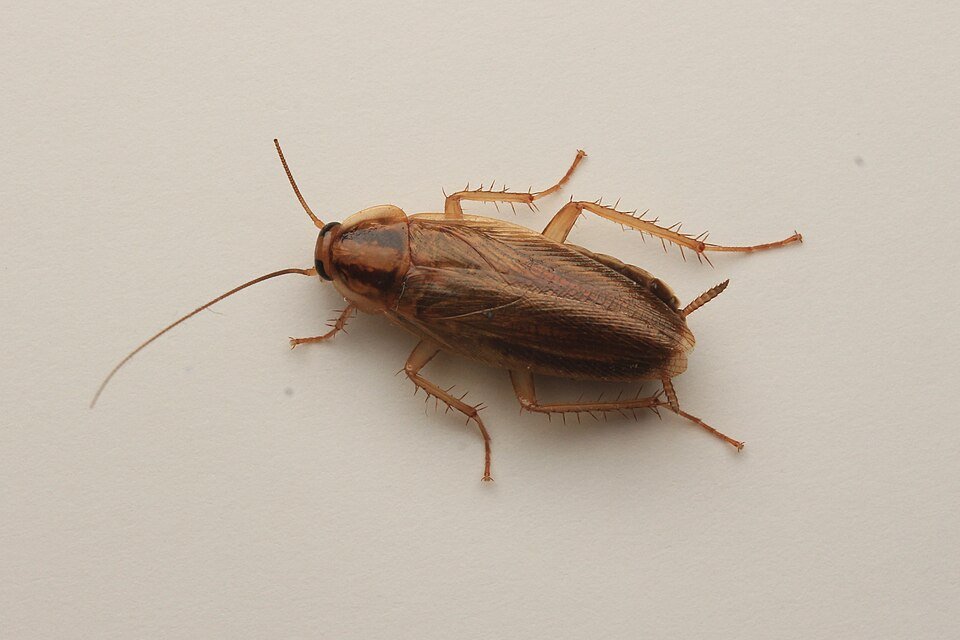

Why Cockroaches Aren't a Hygiene Problem, They're Hitchhikers
I've treated spotless, freshly renovated homes with roach problems just as often as cluttered ones. That's because cockroaches aren't chasing "dirt," they're chasing three things: food residue, moisture, and warmth. A perfectly clean kitchen still has a dishwasher that vents warm moist air, a fridge motor that runs warm 24/7, and trace food film in every cabinet, and that's enough.
The most common entry paths I actually find on service calls are:
- Cardboard boxes and paper packaging from moves, deliveries, or storage units, where egg cases hide in the corrugation
- Secondhand or rental furniture and appliances
- Shared plumbing stacks and wall cavities between units in townhomes, semis, and apartment buildings
- Grocery bags and bulk food packaging brought in from an already-infested store or warehouse
This is also why blaming a tenant or homeowner for "being dirty" is usually wrong. In basement apartments and shared-wall properties specifically, moisture and shared plumbing with the unit upstairs are what let a population re-establish, not how often someone vacuums.
One roach spotted in daylight usually isn't a crisis, it's often just disturbance from cleaning, a renovation, moving an appliance, or even a recent treatment pushing one out of hiding. Multiple roaches scattering when you flip on a light is the real red flag: that pattern points to an established harbourage nearby, not a stray visitor.
How Cockroach Droppings Cause Food Poisoning, Not Just "Gross"
Cockroach feces, saliva, and shed skins aren't a cosmetic problem, they're a food safety and respiratory health issue. Cockroaches are known to spread 33 kinds of bacteria, including E. coli and Salmonella species, along with several parasitic worms and human pathogens. E. coli and Salmonella bacteria carried by roaches can cause food poisoning, with symptoms including belly pain, cramps, diarrhea, nausea, and vomiting.
The mechanism is simple and unpleasant: a roach forages through a drain, garbage, or a dead rodent, then walks across your counter, cutting board, or open cereal box hours later. It doesn't need to bite anyone, contact transfer is enough to contaminate a food surface.
On top of foodborne illness risk, roach material is a documented asthma trigger. Cockroaches contain different proteins that can act as allergens for many people, and children are especially affected. This lines up with what I see in the field: kitchens with an active infestation and no ventilation tend to be where families report worsening allergy or asthma symptoms first.
The Appliance Damage Roaches Cause That You Don't See Coming
Roaches don't just hide near your fridge, microwave, or dishwasher, they nest inside them. The motor compartment, the warm space behind a fridge condenser coil, and the insulation around internal wiring are prime real estate for a colony, and most homeowners never check there until something breaks.
The damage is real, not folklore, but it works differently than most people assume. Stripping wire insulation down to bare copper is a rodent habit, not a roach one, some rodents are instinctively driven to gnaw on things to keep their teeth from overgrowing, and wiring offers just the right amount of resistance. Cockroaches cause damage a different way: their secretions are acidic and corrode metal contacts, circuit boards, and connectors over time, sometimes leading to failures that can't be repaired. Because their droppings, urine, and secretions are also slightly conductive, an accumulation on a circuit board can bridge contacts and short the device out entirely. On top of that, the buildup of shed skins, egg cases, and dead roaches inside equipment restricts airflow and causes overheating. I've pulled roach nests out of dishwasher control panels and behind fridge kick plates on service calls where the client had no idea anything was living in there until a repair tech found droppings during a service visit.
Appliances most at risk in a typical Ontario kitchen:
- Refrigerators (warm motor compartment, condensation line)
- Dishwashers (heat, humidity, food residue on the door seal)
- Microwaves and toasters (crumb trays, warm internal components)
- Coffee makers (standing water reservoirs)
Our 4-Stage Cockroach Treatment Process
Spraying what you can see does almost nothing, because most of the population is hidden in voids, motor housings, and wall cavities. Our process is built to hit the harbourage, not just the roaches out in the open.
- This isn't a quick contact-kill, it stays active on treated surfaces for roughly 3 months, and as roaches travel across it they carry residue back into the harbourage and expose others they contact there, so the kill spreads through the colony instead of just removing the ones you happened to see.
- Selective ULV Actisol fogging: An ultra-low-volume fogging application used to flush roaches out of cracks, voids, and appliance motor compartments where sprays and baits alone can't reach.
- Gel bait placement: An ingestion-based bait placed in cabinet corners, hinge points, and appliance edges, effective for up to about a year, giving continuous control between visits.
- Targeted pesticide dust: Applied into wall voids, under-appliance gaps, and cracks around pipe penetrations, with residual activity lasting roughly 6 months to a year.
We also identify and seal the small gaps roaches actually use to move between rooms and, in shared-wall properties, between units, things like pipe chase gaps under sinks, dishwasher supply line penetrations, and baseboard gaps. Closing these off after treatment is what stops the same crack from being reused for reinfestation.


Related full guides: American Cockroaches in Ontario: Identify and Get Rid of Them
How AstraHive Pest Control gets rid of cockroaches
Cockroaches hide where sprays and traps cannot easily reach, so we open up the places they live and work through eight steps that reach the whole colony.
How an AstraHive cockroaches treatment works
Inspect, pulling out the appliances
We inspect kitchens, bathrooms, appliances, cabinets, wall voids and drains, and look for egg capsules, shed skins and droppings to see how far the problem has spread. We pull out the fridge, stove, dishwasher and the electrical outlet covers, because the colony lives behind the motors and insulation panels, and zones that are not opened up never get treated.
Interior residual spray where they travel
We apply a residual spray, according to the product label, along the interior edges cockroaches travel: baseboards, under sinks and appliances, and along plumbing lines. It stays active for about 90 days, and cockroaches that cross it carry it back to their hiding places and to the cockroaches they touch.
Flush them out
We inject a flushing agent (a ULV treatment where needed) into voids and behind cabinets, applied according to the product label, to force every cockroach hiding there out into the open and through the sprayed areas.
Dust the voids
We inject a pesticide dust into wall voids, electrical outlets, fridge compressor areas and plumbing voids, places the spray and the flushing agent cannot reach.
Gel bait that spreads through the colony
We place a professional gel bait inside cabinet hinges, behind appliances and near moisture and heat sources. Cockroaches eat each other's droppings and dead cockroaches, so the poison in the gel bait passes from one to the next through the whole colony, much like a disease spreading. Where needed we add an insect growth regulator, sometimes as a gel, to stop nymphs maturing into breeding adults.
Document everything
Where we found cockroaches, what we found and every product used goes in the service report, so the next visit shows exactly what changed.
Leave insect monitors
We leave insect monitors in place after treatment so we can track exactly where activity is still showing up.
Follow up in 4 to 6 weeks and back it with a 90-day warranty
We come back 4 to 6 weeks later to check the results, treat again where needed and finish the life cycle. If cockroaches return within 90 days, we re-treat at no charge.
Our products are Health Canada approved and safe for kids and pets, and we apply every product according to its label. AstraHive is licensed by the Ontario Ministry of the Environment, Conservation and Parks. Ontario requires a ministry-approved certification course before it issues an exterminator licence, and that training is delivered through the University of Guelph, Ridgetown Campus.
A real cockroach treatment takes about 1.5 to 3 hours, because the work is behind the appliances and inside the walls. A visit of 20 to 30 minutes cannot reach the colony.
Treatment works best with a change in the home itself: cleaning up food and water sources and storing food in sealed containers. Pest control products alone will not win the fight without those changes.
What This Means for You
If you're seeing roaches, the question isn't "what did I do wrong," it's where the colony is hiding and how it got in. A clean home can still get roaches through a package, a shared wall, or a used appliance, and once they're established, droppings and shed skin become a genuine food-safety and respiratory issue, not just a nuisance.
Typical cost: Starting at $350 CAD, with final cost depending on property size and severity of infestation - there is no fixed upper limit. Call 905-925-8427 for an exact free quote.
Why Choose AstraHive
- Licensed & Insured: Certified by the Ontario Ministry of Environment, Conservation and Parks.
- Fast response: Same-day service available, with a callback within 5 minutes.
- 90-Day Warranty: If pests come back within that window, we re-treat at no additional charge.
- Proven track record: 5.0 stars on Google across 200+ reviews.
- Family & pet safe: Health Canada approved products on every job.
Frequently Asked Questions
Does having cockroaches mean my house is dirty?
No. Cockroaches are hitchhiking pests that arrive through cardboard boxes, secondhand furniture, delivery packages, or shared plumbing and walls in multi-unit buildings. They're drawn to food residue, moisture, and warmth, which exist in even the cleanest kitchens, so a spotless home can still get an infestation.
Can cockroaches actually damage my appliances?
Yes, but not by chewing through wire insulation the way mice or rats do, that's a rodent behavior tied to their continuously growing teeth. Cockroaches damage fridges, dishwashers, and microwaves by nesting in warm motor compartments and leaving behind acidic, mildly conductive droppings and secretions. That waste corrodes circuit boards and metal contacts over time and can bridge electrical connections to cause a short circuit, while accumulated shed skins and egg cases can block vents and cause overheating.
How do cockroach droppings actually cause food poisoning?
Cockroaches carry bacteria like E. coli and Salmonella on their bodies and in their digestive systems after foraging in drains, garbage, or other contaminated areas. When they walk across counters, dishes, or open food packaging afterward, they deposit that bacteria through droppings and body contact, which can cause food poisoning symptoms like cramps, diarrhea, nausea, and vomiting if the contaminated food is eaten.
Why do I only see one cockroach during the day, does that mean it's a small problem?
Not necessarily. A single daytime sighting is often just disturbance from cleaning, moving an appliance, renovation work, or a recent treatment pushing one insect out of hiding. Because cockroaches are nocturnal and forage mostly at night to avoid detection, the visible ones typically represent only a fraction of the population hiding in appliance motors, wall voids, and cabinet cracks.
Sources
- Health Canada: Cockroaches (Pest control tips) — Bait stations kill about 48 to 96 hours after the active ingredient is ingested; aerosols or space sprays can knock insects down and flush them onto treated surfaces; diatomaceous earth is a fine powder made of crushed microscopic marine fossils.
- Health Canada (Pest Management Regulatory Agency) — Health Canada's PMRA reviews and grants registration for pest control products such as cockroach gel baits, assessing risk to humans, including children, before they can be legally sold or used in Canada.
- Ontario.ca: Pesticide licences and permits — Ontario's Ministry of the Environment, Conservation and Parks issues exterminator licences after a ministry-approved certification course, delivered through the University of Guelph, Ridgetown Campus.
- PestWorld (National Pest Management Association) — Cockroaches are known to spread 33 kinds of bacteria including E. coli and Salmonella, which can cause food poisoning symptoms like cramps, diarrhea, nausea, and vomiting.
- Asthma and Allergy Foundation of America (AAFA) — Cockroaches contain proteins that act as allergens and can trigger asthma and allergic reactions in sensitive individuals, especially children.
- Anchor Pest Services — Cockroach secretions are acidic and corrode metal contacts, circuit boards, and connectors over time, and their droppings, urine, and secretions are slightly conductive, so an accumulation on circuit boards can cause a short circuit.
- PestWhisperer — The accumulation of cockroach droppings, shed skins, and egg cases inside electronic equipment restricts airflow and causes overheating.
Areas We Serve
AstraHive Pest Control proudly serves 75+ communities across the following regions:
- Toronto: Toronto, North York, Scarborough, Etobicoke, East York, York, Leslieville, Lakeview
- Durham Region: Oshawa, Whitby, Ajax, Pickering, Clarington, Bowmanville, Courtice, Newcastle, Port Perry, Brooklin, Uxbridge, Scugog, Brock, Seaton
- York Region: Vaughan, Markham, Richmond Hill, Aurora, Newmarket, Thornhill, Woodbridge, Kleinburg, Maple, Stouffville, Unionville, Keswick, Holland Landing, East Gwillimbury, Georgina, King City, King Township, Nobleton, Berczy Village, Cathedraltown, Commerce Valley, Cornell, Wismer, Whitchurch-Stouffville, Sutton, Schomberg
- Peel Region: Mississauga, Brampton, Caledon, Malton, Port Credit, Streetsville, Meadowvale, Cooksville, Bolton, Palgrave
- Extended Service Area: Peterborough, Lindsay, Port Hope, Barrie, Bradford, Innisfil, Collingwood, Wasaga Beach, Orillia, Burlington, Oakville, Milton, Hamilton, Grimsby, St. Catharines, Welland, Niagara Falls
Don't see your city listed? Call us — we likely cover it.
Got a pest problem right now?
Call AstraHive for a free consultation. Licensed & insured, serving the GTA, Durham, York, Peel and Simcoe County.
Call 905-925-84275.0 Stars — 200+ Google Reviews | Licensed & Insured | Health Canada Approved