Ants find your home by sending scout workers out to search for food and water; when a scout discovers a usable resource, it lays down a chemical pheromone trail on its way back to the colony. Other ants detect that trail with their antennae and follow it, which is why one ant quickly turns into a steady line of ants.
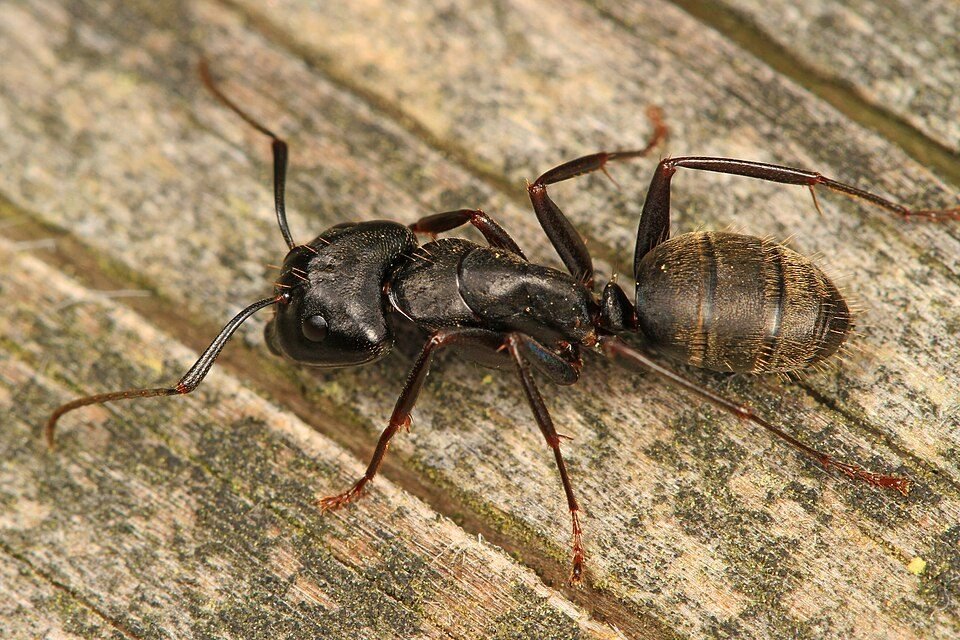

The "One Ant Becomes Many" Mystery, Explained
Here's a scenario we hear on almost every ant call we take: a homeowner spots one ant on the kitchen counter, thinks nothing of it, and by the next afternoon there's an unmistakable line of ants marching along the same six inches of countertop. The question we get every time is some version of "how did they all find the exact same spot?"
The answer isn't luck, and it isn't that the ants are watching each other and copying a path visually. Ants recruit each other to good resources using chemical signals. That recruitment system, built entirely around scent, is what turns a single scout into a full foraging line, and it's the single most important concept for understanding why ants behave the way they do inside a house.
What Is an Ant Pheromone Trail, and How Does It Actually Work?
A pheromone is simply a chemical signal one ant releases that changes the behaviour of another ant that detects it. Ants pick up these chemicals using their antennae, which is why you'll often see an ant waving its antennae low to the ground as it moves. When a different worker sets its antenna down on the trail, it senses the trail, changes its own behavior depending on the specific pheromone, and follows it depending on what kind.
Think of it as an invisible road map painted on your floor or countertop. You can't see it, and we generally can't smell it the way an ant does, but to an ant it's as clear as a painted line on a highway. Ant communication in most species involves pheromones, a method using chemical trails for other ants or insects to find and follow.
How the Trail Develops, Step by Step
- A worker leaves the colony to search for food, water, or other resources.
- It finds something useful, a food spill, a drop of syrup, a pet food bowl, or a damp spot under a sink.
- The worker turns back toward the colony.
- On the return trip, it deposits a pheromone trail along the path it travelled.
- Other workers detect the scent with their antennae as they pass by or leave the nest.
- They follow the chemical signal directly to the food source.
- Each successful ant reinforces the trail on its own trip back, adding more pheromone.
- A visible, organized line of ants develops along the strongest route.
The Positive-Feedback Loop
This is the mechanism worth understanding, because it explains almost everything homeowners notice about ant behaviour:
One ant finds food → a chemical trail is laid → more workers follow it → the food source is confirmed → the trail is reinforced → more workers arrive → a large, visible ant trail appears.
A colony forms a trail when successful foragers deposit pheromone on their return to the nest, with the trail gaining in strength as more and more workers add pheromone to it, providing positive feedback. That's why one small food source, a few crumbs or a sticky spill, can turn into what looks like an ant invasion within a day.
Why Ants Suddenly Appear, Follow the Same Path, and Keep Coming Back
The colony was almost certainly already nearby. What changed wasn't the ants' existence, it was that a worker found something worth exploiting, and the colony recruited more foragers to the discovery. That's why it can feel like ants "appeared overnight" when really you're just seeing the visible result of a resource being found and reinforced.
It's also why ants walk in such a precise line instead of wandering randomly. They aren't following each other visually, they're following a scent trail, and repeated traffic keeps that scent fresh and detectable. This is also why the trail can eventually fade: the trail decays when the food runs out because foragers stop reinforcing it and the existing pheromone evaporates, providing negative feedback.
How long a trail lasts isn't fixed. All pest ants use odor trails for orientation, but these trails differ from one species to another, and where the pheromones originate, their chemical makeup, and how long they last all vary from one ant species to the next. If you remove one food source, don't assume the problem is solved, the colony may simply start foraging somewhere else in the house, which can look like the ants "moved."
Why a Clean House Still Gets Ants
We want to be clear about this because homeowners often feel embarrassed calling us, and there's no reason to. Ants aren't judging cleanliness, they're opportunists. A single drop of syrup, a smear of pet food residue, a sweet drink spill, or a bit of condensation under an appliance can be enough for a foraging scout to consider the trip worthwhile. Clean homes get ants. It happens constantly.
Carpenter Ants: A Quick Note on Indoor Foraging
Carpenter ants use the same pheromone-driven foraging system, but with one added wrinkle worth knowing. Carpenter ants can forage indoors for food even when their main colony is located outside the structure entirely. Seeing carpenter ant activity inside doesn't automatically mean they're nesting in your wood framing, but persistent indoor trails are still worth having inspected, since prolonged activity can point toward a nearby harbourage area that needs to be found.
Trail vs. Nest: What the Line of Ants Actually Tells You
This is a distinction we try to explain on every inspection: a visible trail does not mean the colony is sitting right next to it. The trail is a route, not an address. It might lead outside through a gap under the siding, into a wall void, under a section of flooring, or toward some other structural cavity you can't see into.
That said, the trail is genuinely useful information. Paying attention to where it starts, where it disappears, which direction the ants are travelling, and whether it repeats in the same spot day after day can tell an experienced technician a lot about the foraging route, even if it doesn't reveal the nest location outright.
Common entry points that connect an outdoor colony to an indoor food source include:
- Foundation cracks
- Small gaps around window frames
- Door threshold gaps
- Utility line penetrations (where pipes or cables enter the wall)
- Siding gaps
- Wall voids and other structural openings
- General exterior cracks
The entry point is how the ant physically gets in. The pheromone trail is how every ant after it finds and reuses that exact same route. Ants also tend to travel along walls, baseboards, counter edges, and cabinet lines rather than out in the open, since these edges offer a more protected, efficient path, though it's not a hard rule that ants always hug a wall.
It's also worth knowing that ants in your bathroom and ants in your kitchen aren't necessarily the same foraging line, or even the same colony. Different rooms offer different resources (moisture in a bathroom, food in a kitchen), and a colony can run multiple independent trails to multiple destinations at once.
Why Spraying the Ants You See Doesn't Stop the Colony
This is, practically speaking, the most important takeaway in this entire article. The ants walking across your counter are worker ants, they're the foraging arm of the colony, not the colony itself. Wiping them out with a spray bottle kills what's visible in that moment, but it does nothing to the nest, the queen, or the rest of the workforce that never left the colony.
Spraying the visible trail can also be misleading in another way. You might see fewer ants for a day or two, only to have activity return, or pop up somewhere else entirely, as the colony re-establishes a route around the disturbance. Whether that happens depends heavily on the species, the product used, where it's applied, and where the colony is actually located. We're not going to tell you spraying always backfires, because that's not accurate either, but treating only what you can see is rarely the same thing as addressing the colony.
Cleaning has real value, it removes the food and disrupts some of the chemical residue on the surface, but if the colony is still active and another food or water source is available, ants can lay down a new trail using a different entry point entirely.

Related full guides: Pharaoh Ants in Ontario: Identify and Get Rid of Them
How AstraHive Pest Control gets rid of ants
The goal with ants is the queen, not the workers on your counter. We combine bait that workers carry back to the queen with a weatherproof barrier around the outside of the house, and treat the inside when ants are active there.
How an AstraHive ants treatment works
Inspect and follow the trails
We follow the ant trails to find where they come in and where the nest is likely to be, so the bait and the barrier go in the right places.
Granular bait in the yard
We spread professional granular bait across the front and back yard around the nesting areas and colonies, and along the perimeter of the building. Workers carry it back to the queen, the queen dies and the colony collapses.
Liquid bait in bait stations
We set Scorpio liquid bait in bait stations around the exterior perimeter, near the nest and wherever ants are active. Ants feed and carry it back to the nest, and the stations keep working after we leave.
Weatherproof exterior perimeter spray
We spray a barrier around the foundation, windows, doors and entry points, applied according to the product label. It stays active for about 90 days, so ants coming from outside cross the treated zone before they get in.
Interior treatment if needed
If ants are already active inside, we treat the interior as well as the exterior, never the inside alone: a residual spray along the interior perimeter, baseboards and known travel routes, and gel bait along the trails, out of reach of children and pets.
Document everything
Where we found ants, what we found and every product used goes in the service report, along with what to change around the property, such as moisture and wood-to-soil contact.
Back it with a 90-day warranty
If ants come back within 90 days, we re-treat at no charge.
We also dust into the accessible wall voids and cracks where ants travel and nest, with a professional dust that keeps working in places a spray cannot reach. That, together with the bait and the outside barrier, is how we keep ants from coming back, rather than trying to seal every gap, because ants find another way in.
Our products are Health Canada approved and safe for kids and pets, and we apply every product according to its label. AstraHive is licensed by the Ontario Ministry of the Environment, Conservation and Parks. Ontario requires a ministry-approved certification course before it issues an exterminator licence, and that training is delivered through the University of Guelph, Ridgetown Campus.
Bait and the outer barrier are applied in different places on purpose: the bait stays on the routes ants forage along so workers can carry it home, and the barrier sits at the building's edge. That is also why we ask you not to spray the ants you see or wipe their trails before we arrive: killing the workers stops the bait reaching the queen.
Typical cost: Starting at $350 CAD, with final cost depending on property size and severity of infestation - there is no fixed upper limit. Call 905-925-8427 for an exact free quote.
Why Choose AstraHive
- Licensed & Insured: Certified by the Ontario Ministry of Environment, Conservation and Parks.
- Fast response: Same-day service available, with a callback within 5 minutes.
- 90-Day Warranty: If pests come back within that window, we re-treat at no additional charge.
- Proven track record: 5.0 stars on Google across 200+ reviews.
- Family & pet safe: Health Canada approved products on every job.
Frequently Asked Questions
Why do ants suddenly appear in my kitchen overnight?
It usually isn't sudden at all, a colony that was already nearby found a usable food or water source, and a scout ant laid down a pheromone trail leading back to it. Other workers detected that scent trail and followed it, and the visible line you're seeing is the reinforced result of that recruitment, not a new colony arriving overnight.
Can I see or smell an ant's pheromone trail myself?
No, humans generally can't see or smell ant pheromone trails the way ants detect them through their antennae. The only evidence you'll notice is the behavioural result, a visible line of ants consistently following the same path along a counter, wall, or floor.
Does spraying the ants I see get rid of the colony?
Spraying visible ants kills the worker ants that happen to be out foraging at that moment, but it doesn't reach the nest, the queen, or the rest of the colony. Activity often returns within days because the resource that attracted the ants, and the colony behind it, is usually still there.
If I clean the counter thoroughly, will the ants stop coming back?
Cleaning removes the food source and disrupts some of the chemical residue on the surface, which can genuinely reduce activity along that specific route. But if the colony is still active nearby and another food or moisture source is available, ants can establish a new trail through a different entry point.
How much does professional ant treatment cost with AstraHive?
Every ant treatment includes a 90-day warranty covering free re-treatment if activity returns within that window.
Sources
- Health Canada: Ants (Pest control tips) — Bait systems must work slowly enough for the whole nest to be fed; place bait stations in the path of foraging ants and keep baits available at least two weeks; do not spray while baiting; scouts find food and ants favour sugary and greasy foods; look for a Pest Control Products number.
- Health Canada - Pesticide Compliance and Enforcement — All pesticide products registered for use in Canada must carry a Pest Control Product (PCP) registration number on the label.
- Ontario.ca: Pesticide licences and permits — Ontario's Ministry of the Environment, Conservation and Parks issues exterminator licences after a ministry-approved certification course, delivered through the University of Guelph, Ridgetown Campus.
- Wikipedia - Ant communication — Ants detect pheromone trails with their antennae, and following a food trail causes a worker to reinforce it further, recruiting more workers.
- ScienceDirect - Communication in ants (Current Biology) — Ant pheromone trails strengthen through positive feedback as more foragers use them, and decay through negative feedback once a food source is exhausted.
- University of Florida IFAS - School IPM — The chemical composition and persistence of ant trail pheromones vary significantly from one ant species to another.
Areas We Serve
AstraHive Pest Control proudly serves 75+ communities across the following regions:
- Toronto: Toronto, North York, Scarborough, Etobicoke, East York, York, Leslieville, Lakeview
- Durham Region: Oshawa, Whitby, Ajax, Pickering, Clarington, Bowmanville, Courtice, Newcastle, Port Perry, Brooklin, Uxbridge, Scugog, Brock, Seaton
- York Region: Vaughan, Markham, Richmond Hill, Aurora, Newmarket, Thornhill, Woodbridge, Kleinburg, Maple, Stouffville, Unionville, Keswick, Holland Landing, East Gwillimbury, Georgina, King City, King Township, Nobleton, Berczy Village, Cathedraltown, Commerce Valley, Cornell, Wismer, Whitchurch-Stouffville, Sutton, Schomberg
- Peel Region: Mississauga, Brampton, Caledon, Malton, Port Credit, Streetsville, Meadowvale, Cooksville, Bolton, Palgrave
- Extended Service Area: Peterborough, Lindsay, Port Hope, Barrie, Bradford, Innisfil, Collingwood, Wasaga Beach, Orillia, Burlington, Oakville, Milton, Hamilton, Grimsby, St. Catharines, Welland, Niagara Falls
Don't see your city listed? Call us — we likely cover it.
Got a pest problem right now?
Call AstraHive for a free consultation. Licensed & insured, serving the GTA, Durham, York, Peel and Simcoe County.
Call 905-925-84275.0 Stars — 200+ Google Reviews | Licensed & Insured | Health Canada Approved