Pharaoh ants are tiny yellow to red ants, only 1.5 to 2 mm long, that live inside heated buildings, nesting in wall voids and behind baseboards. They are the most difficult household ants to control, and spraying makes them worse. To get rid of pharaoh ants, use slow-acting baits on their trails and do not use sprays.

What do pharaoh ants look like?
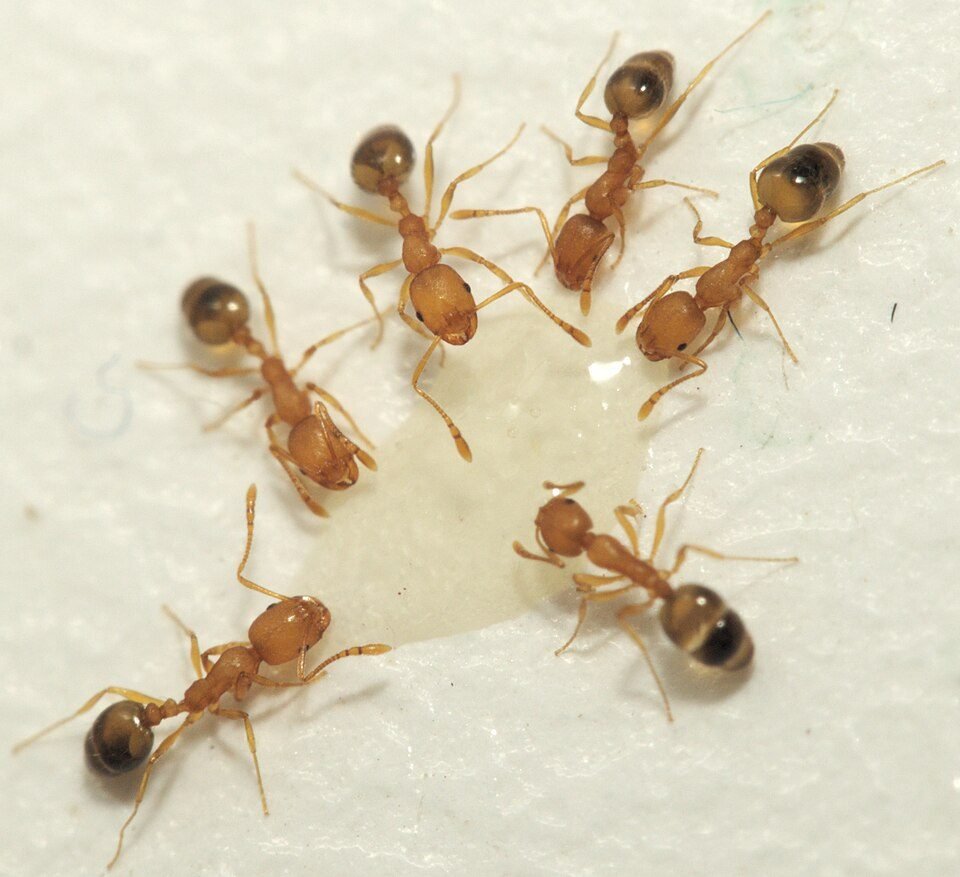
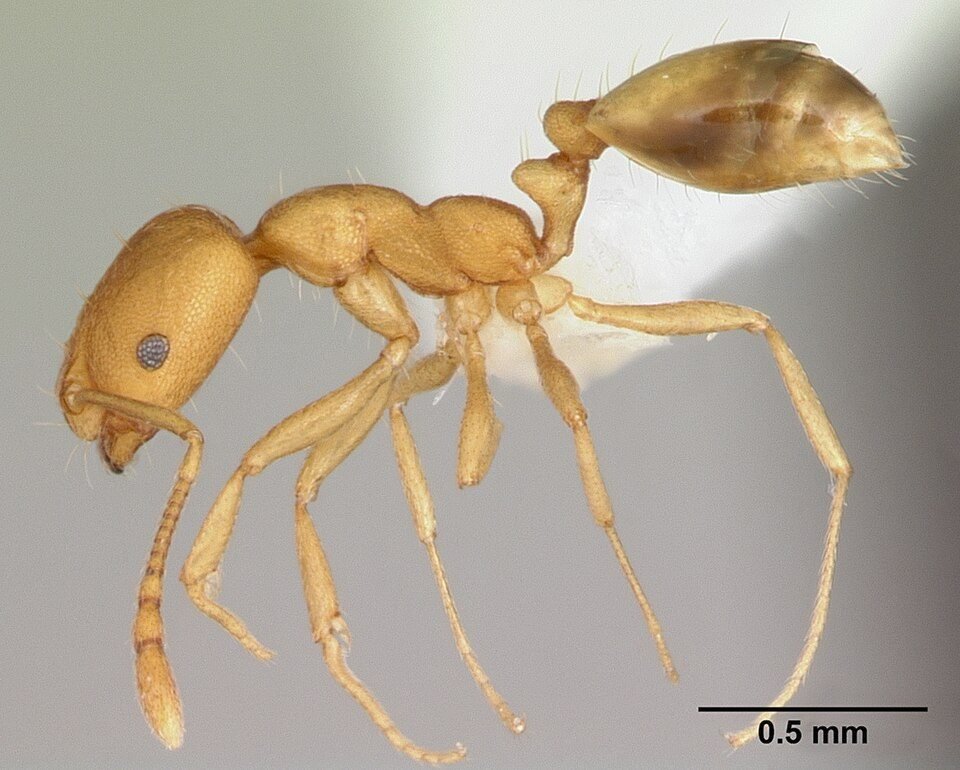
Pharaoh ants (Monomorium pharaonis) are one of the smallest ants found in homes. Workers are all the same size, about 1.5 to 2 mm long, and their colour ranges from yellowish or light brown to red, with the abdomen often darker, almost blackish. The antennae have 12 segments and end in a club of three segments, and the eyes are small. The workers have a stinger, but they rarely use it, and they do not bite. Because they are so small they fit into places that other insects cannot reach, and that is a large part of why they are so hard to control.

Pharaoh ant vs odorous house ant and other small ants
Most small ants in Canadian homes are not pharaoh ants, and the difference decides the treatment. Health Canada lists the pharaoh ant among the five ants known to invade Canadian homes, alongside carpenter ants, little black ants, odorous house ants and thief ants. The pharaoh ant is the one that nests indoors and buds when sprayed.
| Feature | Pharaoh ant | Odorous house ant | |
|---|---|---|---|
| Size | Very small, about 1.5 to 2 mm | Small, about 2.5 mm | |
| Colour | Yellowish to light brown or red, with the abdomen often darker | Brown to black | |
| Where the nest is | Indoors, hidden in warm, humid spaces such as wall voids, behind baseboards and under floors | Outdoors, in mounds of soil; workers travel far and come in for food | |
| Swarms? | No. New colonies form by budding | Winged ants leave to start new colonies | |
| How you notice it | Steady trails to sweets, fats and pet food in kitchens, bathrooms and bedrooms, all year | Trails indoors in warm weather, following a scent trail from outdoor nests | |
| Best control | Slow baits on the trails; never sprays | Baits on the trails, plus outdoor treatment |
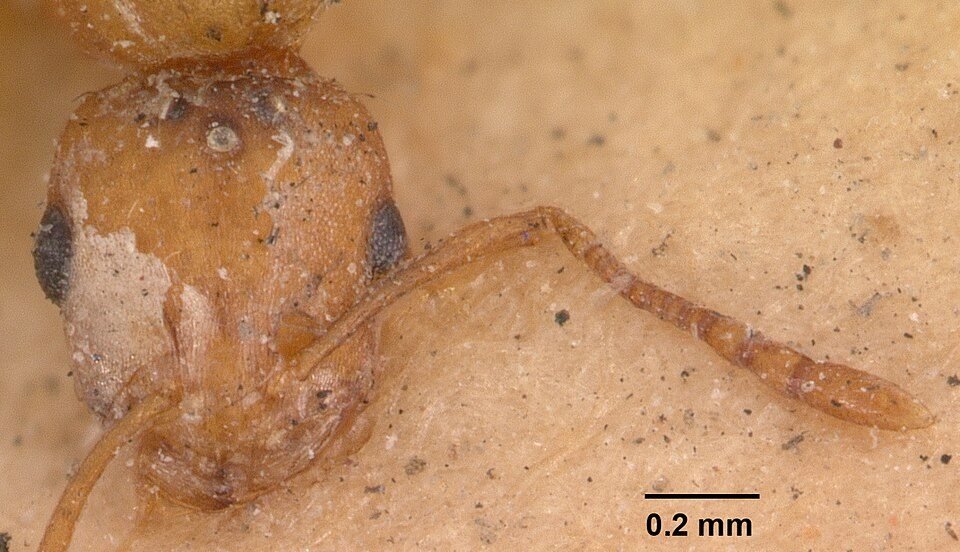
Thief ants are also small and pale and are easy to confuse with pharaoh ants. The give-away is under magnification: a thief ant has only 10 antennal segments and a two-segment club, while a pharaoh ant has 12 segments and a three-segment club. Pharaoh ants also have no spines on the thorax, which separates them from fire ants.
Pharaoh ant biology and how a colony spreads
Pharaoh ants are a tropical species, probably native to Africa, that has been carried around the world by trade. In cold climates like ours they cannot nest outdoors, and they survive only in heated buildings. That is why their colonies are so persistent: a building gives them steady warmth, water and food all year.
How a pharaoh ant colony grows and spreads
A hidden, warm nest
The colony nests in inaccessible places near food and water, such as wall voids, behind baseboards, under floors, in furniture and even between layers of linen or clothing. It wants warmth, roughly 27 to 30 C, and high humidity.
Many queens, fast growth
A large colony can have several hundred egg-laying queens. A queen can lay 400 or more eggs, and a worker develops from egg to adult in about 38 days.
Trails to food
A worker that finds food lays a chemical trail back to the nest. Pharaoh ants often travel through walls and between floors along wiring and hot water pipes.
Budding, not swarming
There is no mating swarm. When a colony is too big or is disturbed, a group of workers carries brood to a new site, often with one or more queens, and starts a new colony. Sprays and repellents can trigger this.

Pharaoh ants in Ontario: where and when
Pharaoh ants are a less common find than odorous house ants, but they are recorded here. The Global Biodiversity Information Facility (GBIF) holds 48 Ontario records of the species, including specimens in the University of Guelph Insect Collection. Unlike outdoor ants, which are seen mostly in warm months, these records are spread through every month of the year, from March to December and into January and February. That fits a species that lives in heated buildings. They are sightings, not a survey, so they are a pointer, but they agree with the general rule: if you have tiny ants in the kitchen in January, think of pharaoh ants.
Why pharaoh ants get in: pharaoh ants in the house
This species has been carried around the world by trade, and in a building it spreads from one unit to the next. Once inside, it stays because the building offers everything it needs. They like water, so leaking taps and damp areas draw them, and they love pet food, sweets, fats and greasy foods. A messy home with more places to hide helps them, and so does food left out. They are a particular problem in apartment buildings, where the colonies run through shared walls.
Signs of a pharaoh ant infestation
- Steady trails of tiny yellowish ants to sweets, fats, pet food or a dripping tap, in any month.
- Ants that keep coming back after you spray, sometimes in new places.
- Ants travelling along pipes, wiring, baseboards and the edges of floors.
- Ants in unusual places such as between bed linen, in a pile of clothes, in an electrical outlet, in appliances or among stored paper.
- Food that has to be thrown out because ants have reached it.
- Ants in more than one room, or in neighbouring apartments.
Are pharaoh ants harmful? Do pharaoh ants bite?
Pharaoh ants do not bite. Their danger is what they carry. Because they are so small, they can get into even well-sealed food packaging, and they may contaminate food with germs picked up as they travel through a building. They are a particular risk in hospitals and other places where food is handled, and they have been reported to carry more than a dozen disease-causing organisms, including Salmonella and Staphylococcus. In a home the risk is lower, but it is another reason to throw out any food that ants have reached and to take the infestation seriously.
Do not spray pharaoh ants. A spray kills some workers, but it can make the colony split into several new nests. You can turn one colony into many.
Common myths about pharaoh ants
- "A spray will get rid of them." A spray kills a few ants and can cause the colony to bud into new nests.
- "They are only a problem in dirty homes." They are a problem wherever warm, humid hiding places and food are available, including hospitals and labs.
- "There is one colony, and I can see it." There may be many small colonies close together, each able to keep reproducing.
- "They go away in winter." They live in heated buildings and are active all year.
- "They bite." They do not.
How to get rid of pharaoh ants yourself
- Stop spraying. Sprays and baits do not mix: Health Canada warns that spraying while you are baiting defeats the bait.
- Bait slowly. The poison has to act slowly so that foraging workers can carry it back and feed the entire nest. Set the bait stations right on the ants' trail, and leave them in place for a minimum of two weeks. Boric acid baits are considered low in toxicity to other animals.
- Find the trails first. Watch where ants travel, using a dab of sweet or greasy food, and put the bait where they already walk.
- Clean thoroughly. Combining slow baiting with thorough cleaning works well. Clean floors often and remove places to hide.
- Protect food. Store food in sealed containers, cover pet bowls between meals, and do not leave food out for longer than about two hours.
- Fix water. Repair leaking taps and dry damp areas, since pharaoh ants seek water.
- Use approved products. Any product should show a Pest Control Products number from Health Canada.
Go deeper: Why Ant Colonies Keep Coming Back: The Queen Problem Most Treatments Never Solve · How Ants Find Your Home: Pheromone Trails Explained Simply
How AstraHive Pest Control gets rid of pharaoh ants
Pharaoh ants live inside the building, so the treatment is inside too, but it is bait and not spray. We find the trails and nests, place slow-acting bait where the ants walk, and keep going until the trails stop.
How an AstraHive pharaoh ants treatment works
Inspect and map the trails
We inspect kitchens, bathrooms, wall voids, baseboards, pipes and wiring runs and trace the trails to the nests.
Bait, don't spray
We place non-repellent bait in the ants' path, according to the product label, and avoid sprays that cause the colony to bud. Ants nesting outside also get an exterior perimeter treatment.
Follow up until the trails stop
Baiting works slowly, so we check the bait stations and trails, and we re-treat as needed until the ants are gone.
Back it with a 90-day warranty
If pharaoh ants come back within 90 days, we re-treat at no charge.
Our products are Health Canada approved and safe for kids and pets, and we apply every product according to its label. AstraHive is licensed by the Ontario Ministry of the Environment, Conservation and Parks. Ontario requires a ministry-approved certification course before it issues an exterminator licence, and that training is delivered through the University of Guelph, Ridgetown Campus.
In multi-unit buildings, the ants travel between apartments through shared walls, and treating one unit often just moves them to the next. We advise treating every affected unit together.
Pharaoh ant control in Ontario: when to call an exterminator
Pharaoh ants are one of the pests best left to a professional. Call a licensed pest control company if you see tiny ants in several rooms, if ants keep coming back after you clean and bait, if you have already sprayed and they have spread, if you live in an apartment or condominium, or if you handle food or care for vulnerable people. Alberta Health advises hiring a certified professional when the problem is bad, and notes that it may take several visits over days or weeks.
Typical cost: Starting at $350 CAD, with final cost depending on property size and severity of infestation - there is no fixed upper limit. Call 905-925-8427 for an exact free quote.
Why Choose AstraHive
- Licensed & Insured: Certified by the Ontario Ministry of Environment, Conservation and Parks.
- Fast response: Same-day service available, with a callback within 5 minutes.
- 90-Day Warranty: If pests come back within that window, we re-treat at no additional charge.
- Proven track record: 5.0 stars on Google across 200+ reviews.
- Family & pet safe: Health Canada approved products on every job.
Frequently Asked Questions
How do I get rid of pharaoh ants?
Use slow-acting bait placed directly on their trails and keep it in place for at least two weeks. Do not use sprays, which can make the colony split into new nests. Clean thoroughly, protect food, fix leaks. A serious infestation is best handled by a licensed professional.
What do pharaoh ants look like?
They are tiny, about 1.5 to 2 mm long, yellowish or light brown to red with a darker abdomen, with small eyes and a three-segment antennal club.
Why should I not spray pharaoh ants?
A spray kills some workers but not the colony, and it can cause the colony to bud, forming several new nests. Health Canada also notes that a bait system will not work if sprays are used at the same time.
Do pharaoh ants bite?
No. They have a stinger but rarely use it. Their risk is contaminating food and carrying germs, especially in hospitals and food businesses.
Are pharaoh ants harmful?
They can be. Because they are so small, they get into sealed food and may carry germs picked up as they travel through a building, which makes them a health concern in hospitals and food businesses.
Do I need a pharaoh ant exterminator?
Usually yes. They are very hard to get rid of because there may be many small hidden colonies, and treating one unit in a building can just move them to the next. Call a licensed professional if you see them in several rooms or if sprays have not worked.
Sources
- Health Canada: Ants (Pest control tips) — Species known to invade homes in Canada include the carpenter ant, little black ant, odorous house ant, thief ant and pharaoh ant; a bait system must work slowly enough to feed the whole nest; place bait stations in the path of foraging ants; keep baits available at least two weeks; do not use chemical sprays while using a bait system or it will not work; boric acid baits generally of low toxicity to other animals; look for a Pest Control Products number.
- Government of Alberta: Pharaoh Ants (MyHealth.Alberta.ca) — 1.5 mm, yellow or light brown to red; do not bite; nest near warm, moist areas behind baseboards, in furniture, under floors, between linens; eat syrups, fruits, meats and dead insects; problem in food businesses, hospitals and apartment buildings; can get into sealed food and contaminate it; very hard to get rid of, many small colonies, may bud if disturbed; slow baiting with thorough cleaning; do not use insecticidal spray; hire a professional if the problem is bad; may take several visits.
- CBC News In Depth: Home invasion, Ants — Pharaoh ants are smaller than pavement ants, typically 1.5 mm, yellow to red; multiply quickly and start new colonies, making them difficult to contain; small size lets them into places other insects cannot, a health risk in hospitals.
- City of Winnipeg: Insect Control, Ants — Pharaoh ants very tiny, about one millimetre, yellowish orange, found in dwellings, bakeries and restaurants, nest in piles of clothes, between floorboards and in cracks, several queens; odorous house ants about 2.5 mm, nest outdoors in mounds of dirt, search far for food and enter buildings, leave scent trails.
- Ontario.ca: Pesticide licences and permits — Ontario's Ministry of the Environment, Conservation and Parks issues exterminator licences after a ministry-approved certification course, delivered through the University of Guelph, Ridgetown Campus.
- GBIF.org: Monomorium pharaonis occurrence records, Ontario, Canada — 48 Ontario records of the pharaoh ant, including 3 University of Guelph Insect Collection specimens, recorded in every month of the year. Retrieved September 2026.
- University of Florida IFAS Extension: Pharaoh Ant, Monomorium pharaonis (EENY290) — Probably native to Africa; does not nest outdoors except in southern latitudes and is established in heated buildings in colder climates; workers 1.5 to 2 mm, 12-segment antennae with 3-segment club, yellowish or light brown to red with darker abdomen, stinger rarely used; nests warm (27 to 30 C) and humid in wall voids near food and water; about 38 days egg to worker; no swarms; queens lay 400 or more eggs; budding; several hundred queens in large colonies; serious pest in hospitals, reported to transmit over a dozen pathogens; trails along wiring and hot water pipes; thief ants have 10-segment antennae with 2-segment club; non-repellent baits; repellent baits cause budding; in multifamily buildings treat the entire building; ants nesting outside may be controlled with a perimeter treatment.
Areas We Serve
AstraHive Pest Control proudly serves 75+ communities across the following regions:
- Toronto: Toronto, North York, Scarborough, Etobicoke, East York, York, Leslieville, Lakeview
- Durham Region: Oshawa, Whitby, Ajax, Pickering, Clarington, Bowmanville, Courtice, Newcastle, Port Perry, Brooklin, Uxbridge, Scugog, Brock, Seaton
- York Region: Vaughan, Markham, Richmond Hill, Aurora, Newmarket, Thornhill, Woodbridge, Kleinburg, Maple, Stouffville, Unionville, Keswick, Holland Landing, East Gwillimbury, Georgina, King City, King Township, Nobleton, Berczy Village, Cathedraltown, Commerce Valley, Cornell, Wismer, Whitchurch-Stouffville, Sutton, Schomberg
- Peel Region: Mississauga, Brampton, Caledon, Malton, Port Credit, Streetsville, Meadowvale, Cooksville, Bolton, Palgrave
- Extended Service Area: Peterborough, Lindsay, Port Hope, Barrie, Bradford, Innisfil, Collingwood, Wasaga Beach, Orillia, Burlington, Oakville, Milton, Hamilton, Grimsby, St. Catharines, Welland, Niagara Falls
Don't see your city listed? Call us — we likely cover it.
Got a pest problem right now?
Call AstraHive for a free consultation. Licensed & insured, serving the GTA, Durham, York, Peel and Simcoe County.
Call 905-925-84275.0 Stars — 200+ Google Reviews | Licensed & Insured | Health Canada Approved